A specification level look at what runs underneath retail and wholesale billing, payments, compliance, and customer tracking.
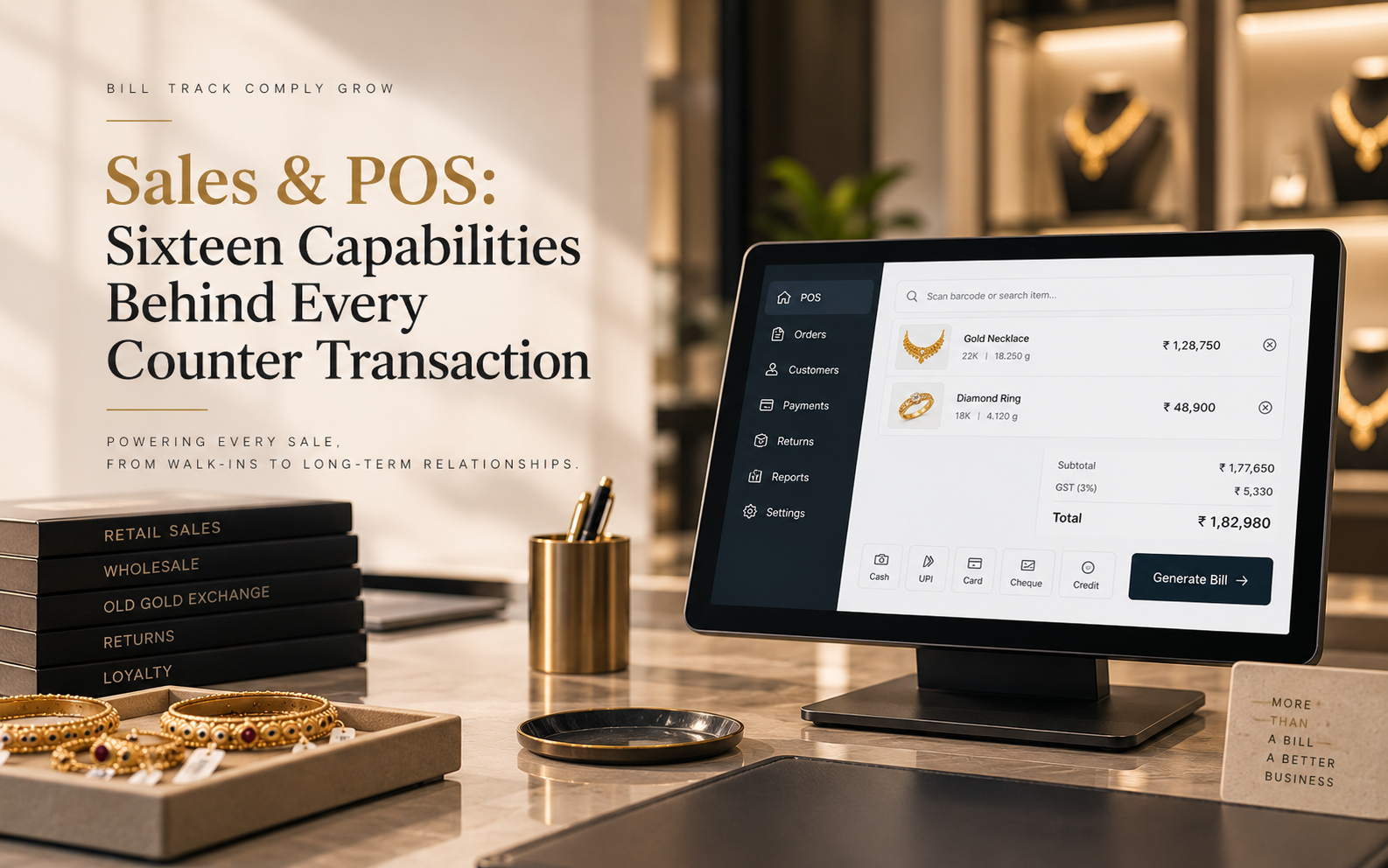
A jewellery counter handles more than one kind of transaction, a walk in retail sale, a wholesale order on commercial terms, a return, an old gold exchange, a payment split across three methods, sometimes all inside the same hour. Sales & POS is the module built to run every one of these without the counter slowing down or a staff member reaching for a workaround. What follows is grouped into four categories, billing flows, counter technology, compliance and documentation, and customer and staff tracking, specified plainly rather than explained at length.
Billing Flows
Goods on approval status connects directly to live stock, covered in our guide to jewellery inventory management.
| Capability | What It Does | Why It Matters |
|---|---|---|
| Retail sales billing | Fast counter billing for walk in jewellery retail. | The most frequent transaction in the business needs to be the fastest, not the most complicated. |
| Wholesale sales billing | Party wise wholesale invoices with commercial terms. | A wholesale order runs on different terms than a retail sale, and the system needs to know the difference automatically. |
| Cash & credit sales | Walk in cash sale and outstanding credit in one flow. | Credit sales should not need a separate process from cash sales just because payment is delayed. |
| Sales return | Clean return documents linked back to the original sale. | A return with no link to its original invoice is a return nobody can fully reconcile later. |
| Order management (advance) | Take advances and convert customer orders into delivery. | An advance payment against a future order needs to be tracked as its own commitment, not folded into general cash. |
| Goods on approval | Track Jangad or approval stock with aging and return matching. | Stock that left the shop on approval is neither sold nor fully in stock, and it needs its own status to avoid double counting. |
| Delivery challan | Dispatch finished goods with proper challan control. | Goods moving without a proper document are goods that are hard to trace if a question comes up later. |
Counter Technology
| Capability | What It Does | Why It Matters |
|---|---|---|
| Barcode POS scanning | Scan tagged pieces and bill without manual weight entry errors. | Manual weight entry at a busy counter is one of the most common sources of billing mistakes. |
| Multi payment POS | Collect across cash, UPI, card, cheque, and credit modes. | A customer paying across two or three methods for one purchase should not need two or three separate transactions. |
| UPI QR generation | Generate a QR at the counter for instant digital collection. | Digital collection needs to happen inside the same billing screen, not a separate app switched to mid sale. |
| Card / EDC integration | Connect card machines into settlement workflows. | A card payment that does not reconcile automatically against the machine settlement becomes a manual matching exercise at day end. |
Compliance and Documentation
Rate settlement here feeds directly into the ledger, see our guide to jewellery accounting software for how that connection works.
| Capability | What It Does | Why It Matters |
|---|---|---|
| e-Invoice (IRN & QR) | Signed IRN and QR generated at the moment of billing. | Compliance generated at billing means nothing needs to be reconstructed later for filing. |
| Old gold exchange | Exchange old metal with purity control in the same bill. | An exchange calculated outside the main invoice is exactly where two numbers stop matching each other. |
| Rate settlement | Settle metal rates with parties without spreadsheet chaos. | Wholesale and bullion rate settlement between parties needs its own clean record, not a side calculation nobody else can check. |
Customer and Staff Tracking
| Capability | What It Does | Why It Matters |
|---|---|---|
| Salesperson tracking | Attribute bills to staff for targets and accountability. | Performance conversations need real numbers behind them, not a rough sense of who sold what. |
| Gift voucher & loyalty | Run schemes that bring customers back to the counter. | A loyalty scheme only works if redemption is actually tracked, not managed on trust at the counter. |
How These Sixteen Work Together, Not in Isolation
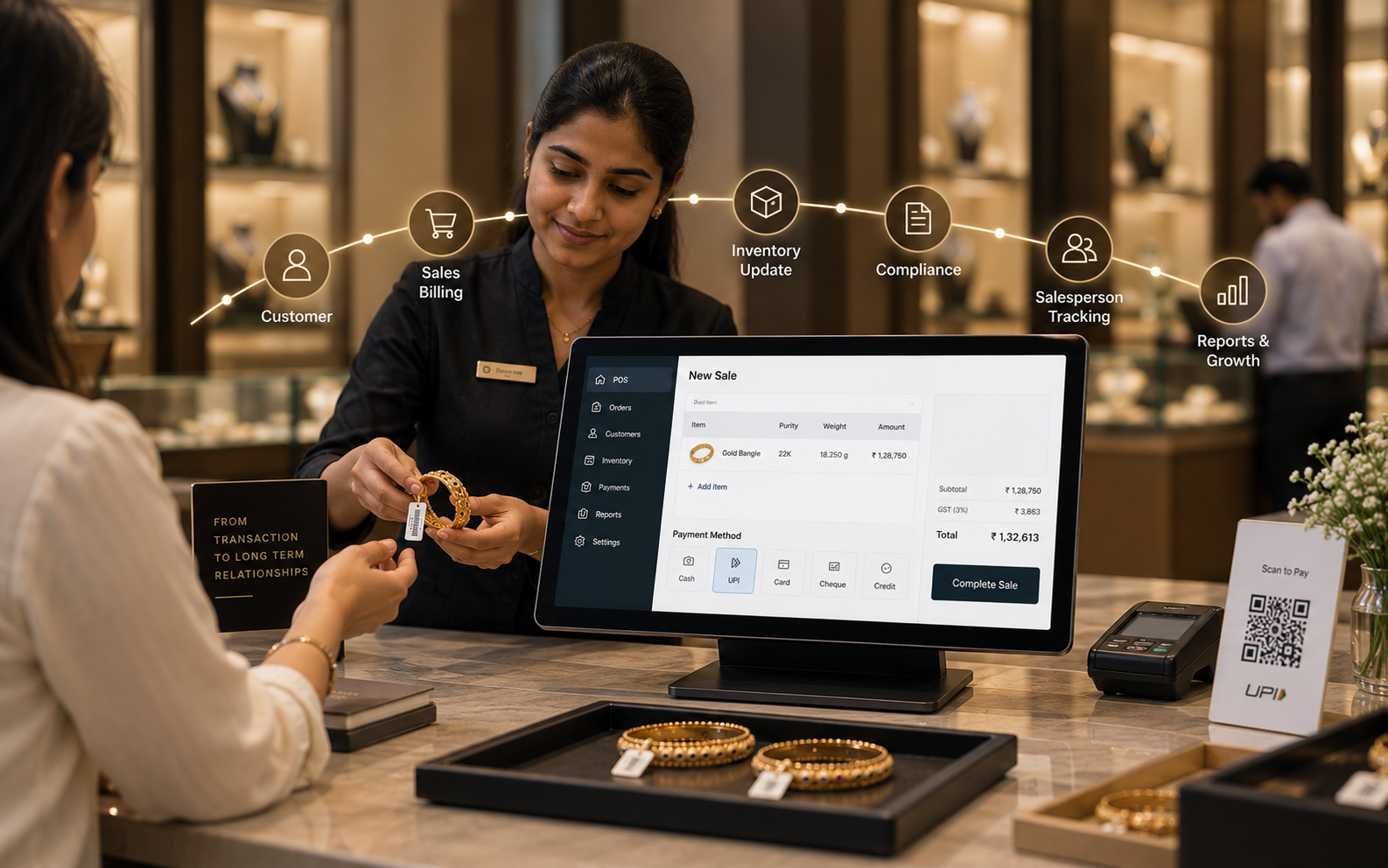
None of this is meant to be evaluated one line at a time. A single wholesale transaction can touch six or seven of these at once. A party wise invoice, split across cash and a card settlement, generating a signed e-invoice, attributed to the salesperson who closed it, with an old piece taken in exchange and revalued against the day's rate, is one continuous transaction, not six separate ones. If any one of those steps happens outside the system, on a separate app, a phone call, or a manual note, the rest of the transaction inherits that gap.
Our guide to jewellery billing software covers the counter side of this in more depth, our guide to jewellery ERP software covers how Sales & POS connects to inventory, manufacturing, and accounting on the same ledger, and our guide to a jewellery management system walks through what a full day built on this connection actually looks like.
Frequently Asked Questions
What is the difference between retail and wholesale billing in the same system?
Retail billing is optimised for speed on a single walk in transaction. Wholesale billing runs on party wise terms, commercial pricing, and often credit arrangements, and needs its own workflow rather than being forced through the retail counter screen.
How does goods on approval avoid double counting stock?
Approval stock gets its own status, out on approval, distinct from both sold and in stock. That status ages until the piece either returns or converts into a sale, so it never quietly counts as available inventory while it is actually sitting with a customer.
Why does old gold exchange need to be part of the same bill rather than a separate step?
Calculating an exchange outside the main invoice creates two numbers that then have to be manually combined, which is exactly where small errors creep in. Our guide to the GST rate on gold jewellery covers how exchange value gets taxed once it is documented correctly inside one invoice.
Does salesperson tracking connect to customer loyalty and gift vouchers?
They are related but distinct. Salesperson tracking attributes a sale to staff for performance and accountability, while loyalty and voucher tracking follows the customer across visits. Our guide to gold scheme management covers the customer side of this in more depth.
Can rate settlement handle bullion or wholesale party accounts separately from retail customers?
Yes, rate settlement is built around party accounts specifically, tracking agreed rates and running balances with wholesale or bullion counterparts distinctly from ordinary retail customer records.
See All Sixteen Running on Your Own Counter
JewelBiz's Sales & POS module runs retail and wholesale billing, every payment mode, old gold exchange, e-invoicing, and staff and loyalty tracking on one connected screen, tied to the same ledger as inventory, manufacturing, and accounting. If you want to see how it handles your own counter's transaction mix, reach out at info@slatebiz.com or call +91 92573 73668, or visit slatebiz.com to book a walkthrough.