
In March, a customer walks into a showroom and enrols in an eleven month gold saving scheme, five thousand rupees a month, a twelfth instalment added free at maturity by the shop. A gold saving plan like this is one of the most common products in Indian jewellery retail, and one of the most quietly mismanaged without proper scheme management software behind it. The difference between a scheme that builds loyalty and one that ends in a dispute usually isn't the scheme itself. It's whether anyone was actually tracking it properly. Here is the same customer's scheme, told two ways.
Version one: running on a register
March, April, and May go fine. The customer pays in cash at the counter, and a staff member notes it in the scheme register, a physical notebook with a page per customer. By June, the shop is mid wedding season, and the entry gets made two days late because the counter was busy. Nobody notices.
In August, the customer misses a payment. There's no automatic reminder, because reminders depend on whoever is managing the register that week remembering to look back through the last two months of entries. The customer isn't chased for six weeks, by which point they've assumed the scheme lapsed and stopped thinking about it entirely.
In November, the customer's daughter gets engaged and the family decides to redeem early instead of waiting for the eleventh month. The staff member on duty has to physically flip back through the register, manually add up nine recorded instalments, apply the shop's early redemption rule from memory, and hope the total matches what the customer remembers paying. It's close, but not exact. The customer accepts it, but leaves slightly less confident in the shop than they arrived.
Nothing here involved dishonesty. It's just what happens when a scheme worth sixty thousand rupees is tracked with the same tools as a shopping list.
Version two: running on scheme management software
The same customer enrols in March, this time onto scheme management software rather than a register. The instalment amount, duration, and maturity bonus are set once, and every payment from that point forward is logged against that specific scheme the moment it's received, whether it comes in cash, card, or UPI.
June's late entry never happens, because the payment gets logged at the counter in the same transaction as the receipt, not written up separately afterward. When August's payment doesn't come in on schedule, the system flags it automatically and a reminder goes out well before six weeks pass, while the customer still remembers why they're paying, a discipline that starts at the same counter covered in our guide to jewellery billing software.
When the family asks to redeem early in November, the system already has the answer. Nine instalments paid, exact dates, exact amounts, the early redemption adjustment applied automatically according to the rule set when the scheme was created. The number is right the first time, and the customer sees it calculated instantly instead of watching a staff member flip through pages.
Same customer, same scheme, same amount of money. The only thing that changed is where the information lived.
What actually separates the two versions
| Moment in the scheme | On a register | On scheme management software |
|---|---|---|
| Recording a payment | Written up later, sometimes days late | Logged at the moment of payment |
| A missed instalment | Noticed only if someone happens to check | Flagged automatically, reminder sent |
| Early redemption | Manually recalculated from the register | Calculated instantly from the rule set at enrolment |
| Maturity bonus | Applied if remembered | Applied automatically every time |
| Multiple active schemes | One page per customer, hard to see at a glance | Every active scheme visible in one dashboard |
Why this matters more than it looks like it should

A gold saving scheme like this customer's isn't the only version showrooms run. Some offer a digital gold scheme instead, where instalments buy a running gold balance rather than locking into a single physical piece at the end. The tracking problem is identical either way, payments, reminders, and redemption all still need to be accurate over months, whether the scheme ends in a specific piece of jewellery or a flexible gold balance, and the gold value behind either version still runs through the same making charges and rate calculations as any other sale.
A single missed reminder or a slightly wrong redemption number feels small in isolation. It rarely is. A gold saving scheme is a multi month promise a customer is trusting a shop to keep accurately. It's usually a customer's introduction to a long term relationship with that showroom, not a one time transaction. Scheme management software isn't really solving a bookkeeping problem, it's protecting the one product in a jewellery business explicitly built around trust extending over time. Our guide to jewellery accounting software covers how scheme payments should flow into the wider ledger once they're collected.
The same logic scales past gold savings schemes into kitty schemes and EMI or instalment finance plans, any product where a customer pays over months and expects the shop to remember the terms as precisely as they do.
What to look for in scheme management software
- Does every payment log against the specific scheme the moment it's received, or get written up separately afterward
- Does a missed instalment trigger an automatic reminder, or rely on someone checking manually
- Is early redemption calculated automatically from the original scheme rules, or recalculated by hand each time
- Does the maturity bonus apply automatically, or depend on someone remembering the scheme's terms
- Can every active scheme across every customer be seen in one place, not one register page at a time
A few questions worth asking before choosing a system
Does it handle more than one type of scheme, gold savings, kitty, and EMI, on the same platform, or does each need a separate workaround? Can a customer's scheme history be pulled up instantly if they call asking about their balance? And if a staff member who normally manages the scheme register is out sick, does the scheme still get tracked correctly that week, or does it depend on one person's memory, the same continuity question covered in our guide to a jewellery management system?
If the honest answer to any of those is a shrug, the register problem hasn't actually gone away, it's just been digitised into a spreadsheet with the same weaknesses.
How JewelBiz Runs Every Scheme on One System
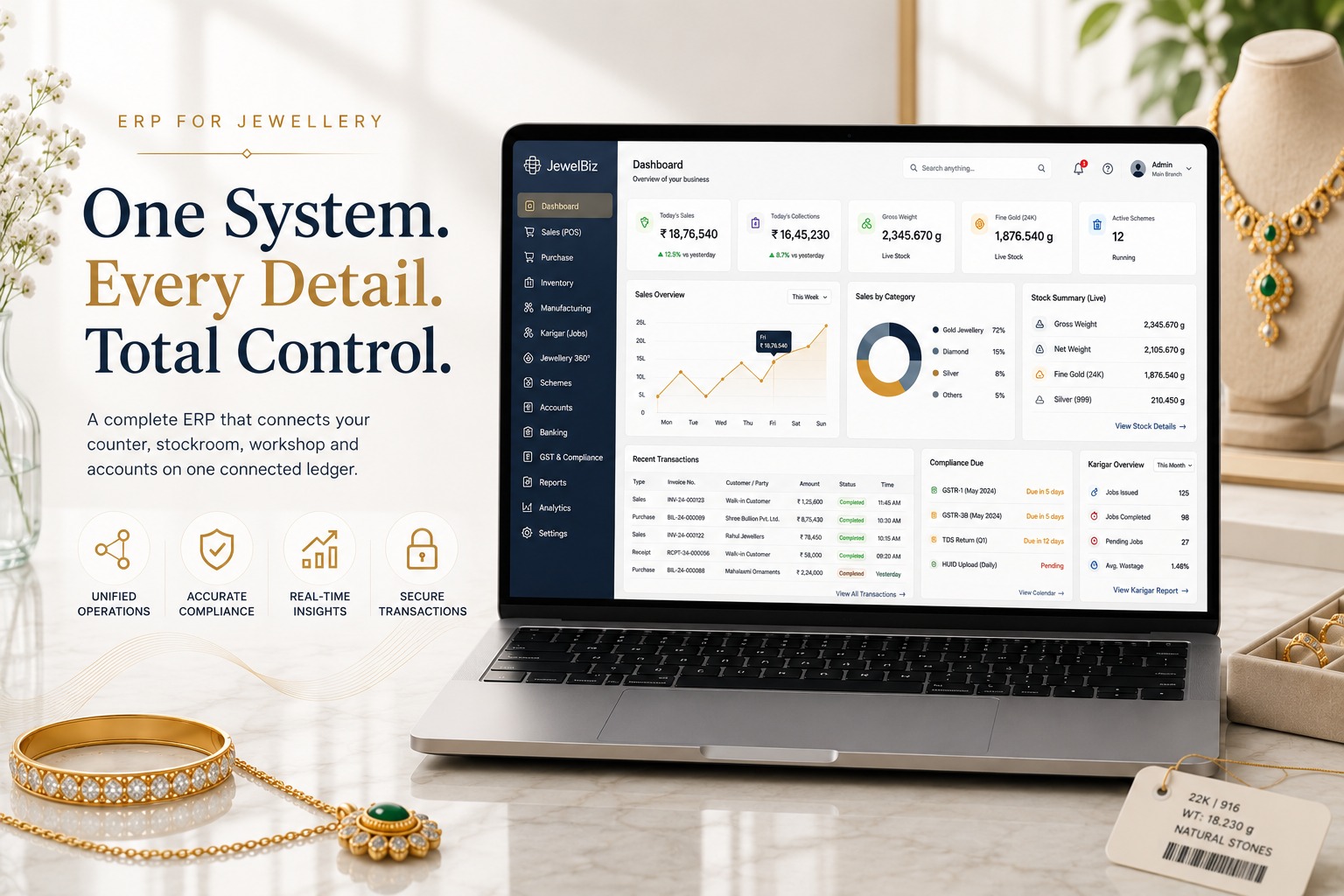
JewelBiz's scheme management covers gold savings schemes, kitty schemes, and EMI or instalment finance plans in one place. Every payment logs the moment it's received, reminders trigger automatically for missed instalments, and early redemption or maturity bonuses calculate from the scheme's original terms rather than getting recalculated by hand. Every active scheme across every customer is visible in one dashboard instead of a stack of register pages, the same connected approach covered in our guide to jewellery erp software. If you want to see how your own scheme customers would look inside it, reach out at info@slatebiz.com or call +91 92573 73668, or visit slatebiz.com to book a walkthrough.