ERP for Jewellery: What a Complete System Actually Needs to Cover
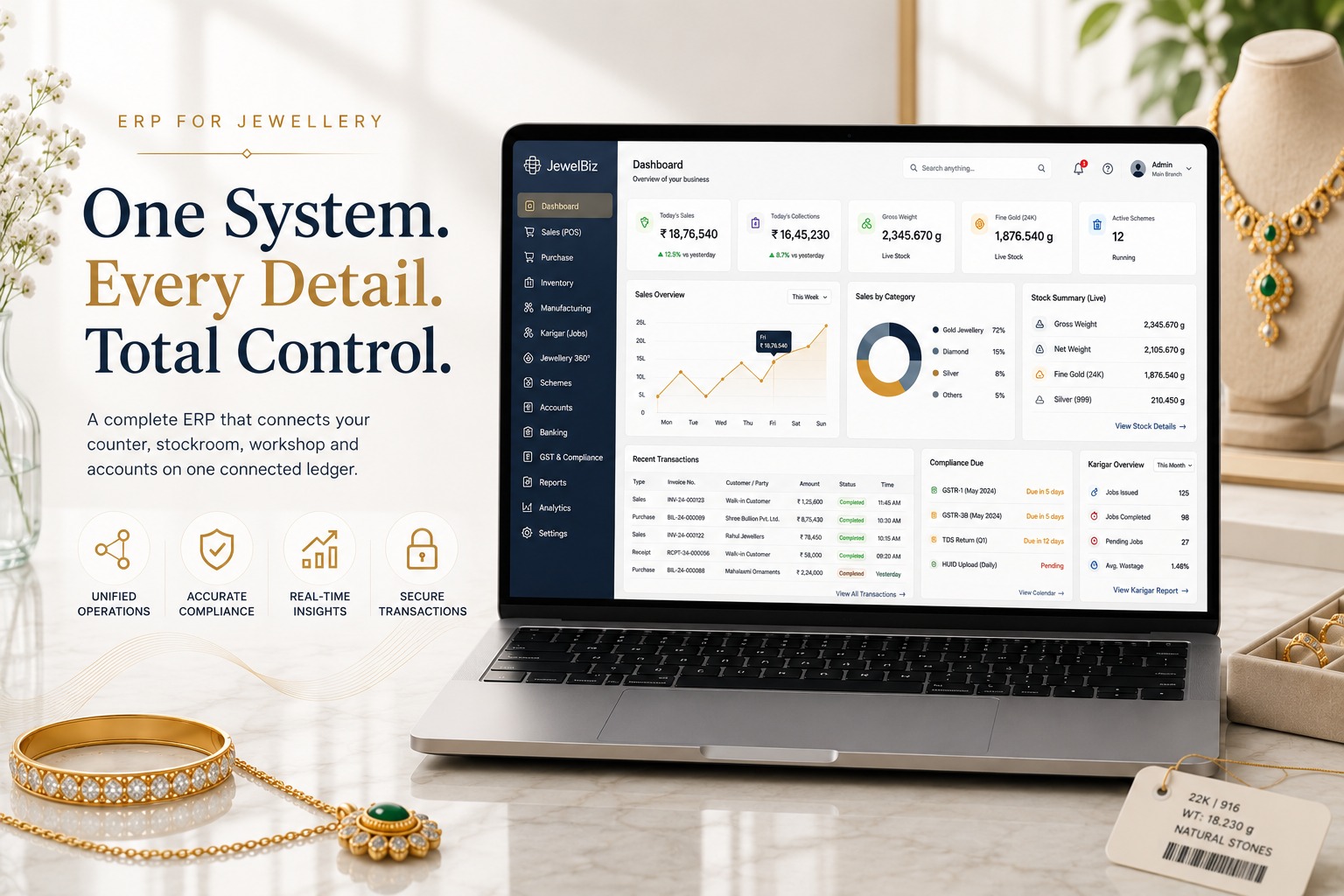
Most jewellers do not go looking for an ERP for jewellery on day one. They go looking for billing software, then inventory software, then something to handle GST, and end up running three or four disconnected tools that never quite agree with each other. An ERP for jewellery exists to close that gap, one system that runs the counter, the stockroom and the karigar workshop on a single ledger, instead of three tools stitched together with spreadsheets.
Why jewellery needs its own ERP, not a general accounting package
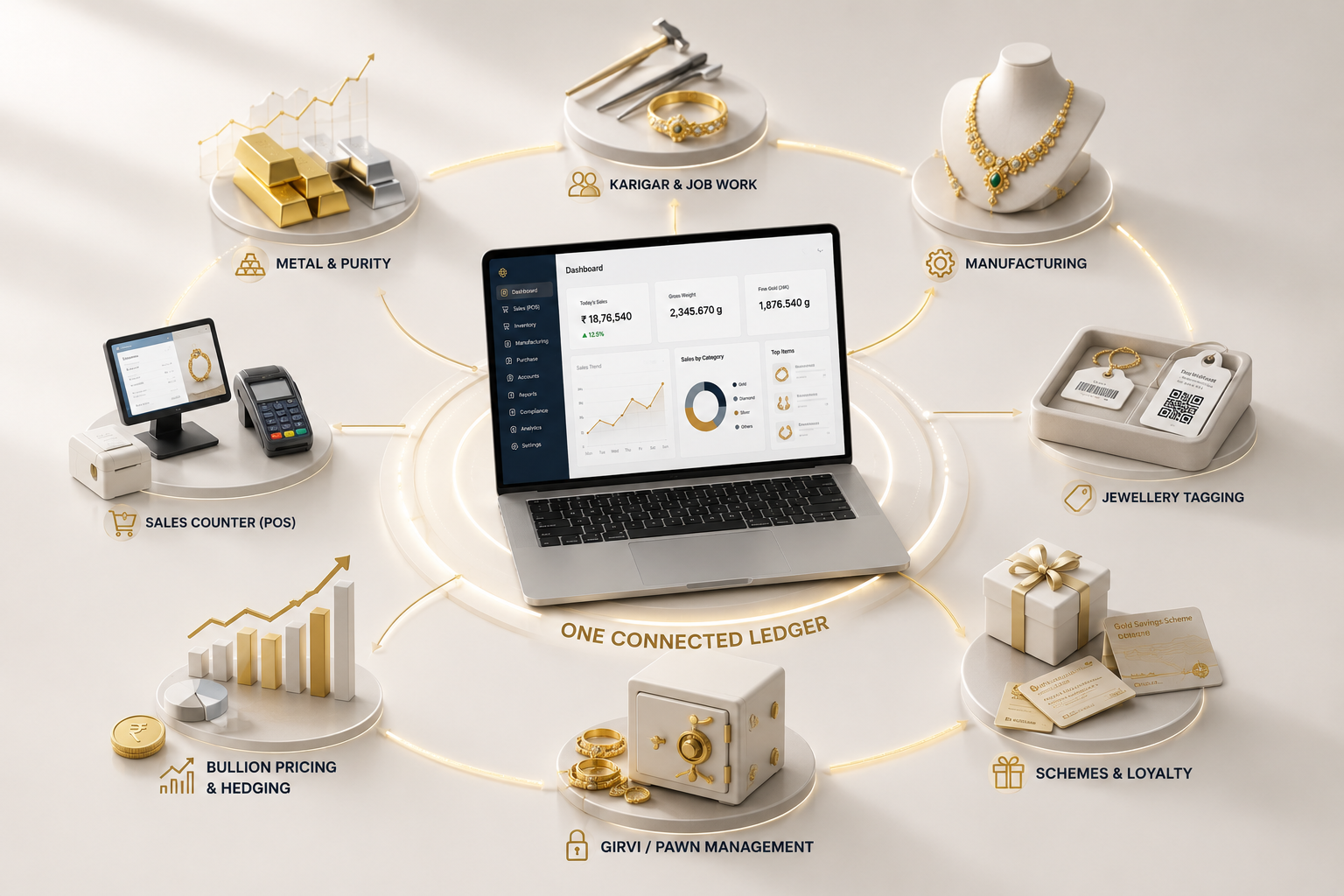
A general accounting package can be configured to sell jewellery. It cannot run a pawn book, a bullion hedge, a savings scheme, a kitty scheme, a Girvi register, job work for a karigar, or jewellery tag tracking, and it was never built to treat fine weight, karigar wastage, or split GST as core concepts. Jewellery businesses run on things no generic retail or accounting system was designed for: metal bought at one purity, converted through manufacturing, and sold at another purity entirely, all while its value shifts with the day's gold or silver rate. An ERP for jewellery has to make all of this sit on one connected ledger, including a dedicated job work ledger for everything that moves through manufacturing, not force it into a system built for a different kind of business.
Where the losses really happen without one
Most jewellery businesses do not lose money to theft. They lose it to positions nobody can actually reconcile at month end.
1. Fine weight nobody can state
Stock sits across multiple purities and counters, and if the fine gold position is an estimate rather than a number, the profit figure sitting on top of it is an estimate too.
2. Karigar balances kept in a notebook
Metal goes out for manufacturing, comes back as a finished piece, and the loss allowed in between is frequently settled from memory rather than tracked against every job.
3. GST split after the fact
Metal, making, stone, commission, discounts on metal, and other expenses all attract different treatment under GST, and reconstructing that breakdown at filing time instead of capturing it at billing is exactly where notices begin.
4. Three different records that never quite match
Most jewellery shops end up keeping the same information in three different places: the billing software, the accounting software, and the owner's own handwritten register. Each one gets updated separately, by different people, at different times. By month end, all three show slightly different numbers, and there is no way to know which one is actually correct.
What a complete ERP for jewellery actually covers
A jewellery ERP is not a billing tool with a few extra fields. It needs to run the full cycle on one connected ledger.
1. Sales, POS and the counter
Barcode scanning, multiple payment modes, old gold exchange valued inside the same bill, and scheme rules that apply automatically at the point of sale.
2. Inventory and stock control
Weight based stock tracked as gross weight, net weight and fine weight, across every purity the business deals in, with a real time register instead of a nightly batch update.
3. Manufacturing and karigar management
Issue and receipt vouchers, work in progress that opens the moment metal goes out, wastage tracked per job, and job costing tied to design.
4. Purchase and vendor management
Registered and unregistered purchase entry, purchase returns, and a vendor ledger that tracks dues and payment terms in one place instead of a separate register.
5. Accounting, banking and compliance
GST calculated correctly on metal, making and stone as distinct components, HSN mapping at the item level, and GSTR-1, GSTR-2B, GSTR-3B and GSTR-9B, TDS reports generated straight from actual billing data.
6. Analytics and dashboards
Sales, inventory and karigar performance visible in one view, ready each morning instead of assembled manually before a meeting.
7. Payment transaction security and PCI PA-DSS compliance
Built in guidelines that keep sensitive card information, credit and debit card data, handled and protected securely at every transaction. This reduces the security risk around payment data and helps the business protect customer payment information as part of the system itself, not as something bolted on separately.
ERP for jewellery versus standalone billing or accounting software
Standalone jewellery billing software and standalone jewellery accounting software both solve one piece of the problem well, but neither closes the loop on its own. Billing software gets the counter right but rarely tracks manufacturing or karigar wastage. Accounting software gets the ledger right but usually cannot calculate making charges automatically at the point of sale. An ERP for jewellery is the layer that makes both of those pieces, plus inventory and manufacturing, sit on one ledger instead of three separate systems that need reconciling every month.
For a deeper dive on the billing side specifically, see our guide to jewellery billing software and for accounting specific features, our jewellery accounting software guide.
What to check before choosing an ERP for jewellery
- Does it run sales, inventory, manufacturing and accounting on one ledger, or are these separate modules that need manual syncing
- Does it track fine weight automatically across purities, or does someone calculate it by hand
- Does it open a work in progress entry the moment metal goes out to a karigar, with wastage tracked per job
- Does it split GST across metal, making and stone at billing, not at filing time
- Does it scale from a single counter to multiple counters and branches without switching platforms later
- Is compliance, TDS, HUID, GST, HSN mapping, GSTR ready reports, and e-invoice, included from the entry level tier, or locked behind a higher plan
What sets JewelBiz apart beyond the core modules
Ten core modules cover what any serious ERP for jewellery needs, now eleven with payment security folded in. What actually separates one system from another is what happens once a business grows past the basics, the specialised tools built for the parts of the trade generic software ignores.
1. Girvi and gold loan pledge tracking
A dedicated pledge register handles Girvi collateral, interest and guarantor details, and redemption, the kind of workflow a general accounting package simply has no concept of.
2. Live MCX rate register
Bullion positions get tracked against a live MCX register with profit and loss settlement built in, instead of a manual spreadsheet tracking exposure separately from the stock ledger.
3. Kitty schemes and EMI installment plans
Customer savings schemes and EMI or installment finance plans run with automated reminders, so scheme management does not depend on a register and a phone call.
4. Digital khata credit ledger
Customer credit balances and due dates sit in a digital khata inside the same system, replacing the informal credit book most showrooms still keep by hand.
5. Scan based stock audits
Physical stock counts run through barcode or RFID scanning and reconcile automatically against the system, with variances flagged rather than discovered weeks later.
6. Melt to new stock conversion tracking
When old pieces are melted down and converted into new stock, weight and purity carry through the conversion as a tracked record, not a manual adjustment entry.
7. Exhibition billing and mobile field staff
Sales from an exhibition or trade show consolidate back into branch sales automatically, and a mobile app lets field staff track jewellery issue and return on customer visits outside the shop.
8. Branch wise profit and loss
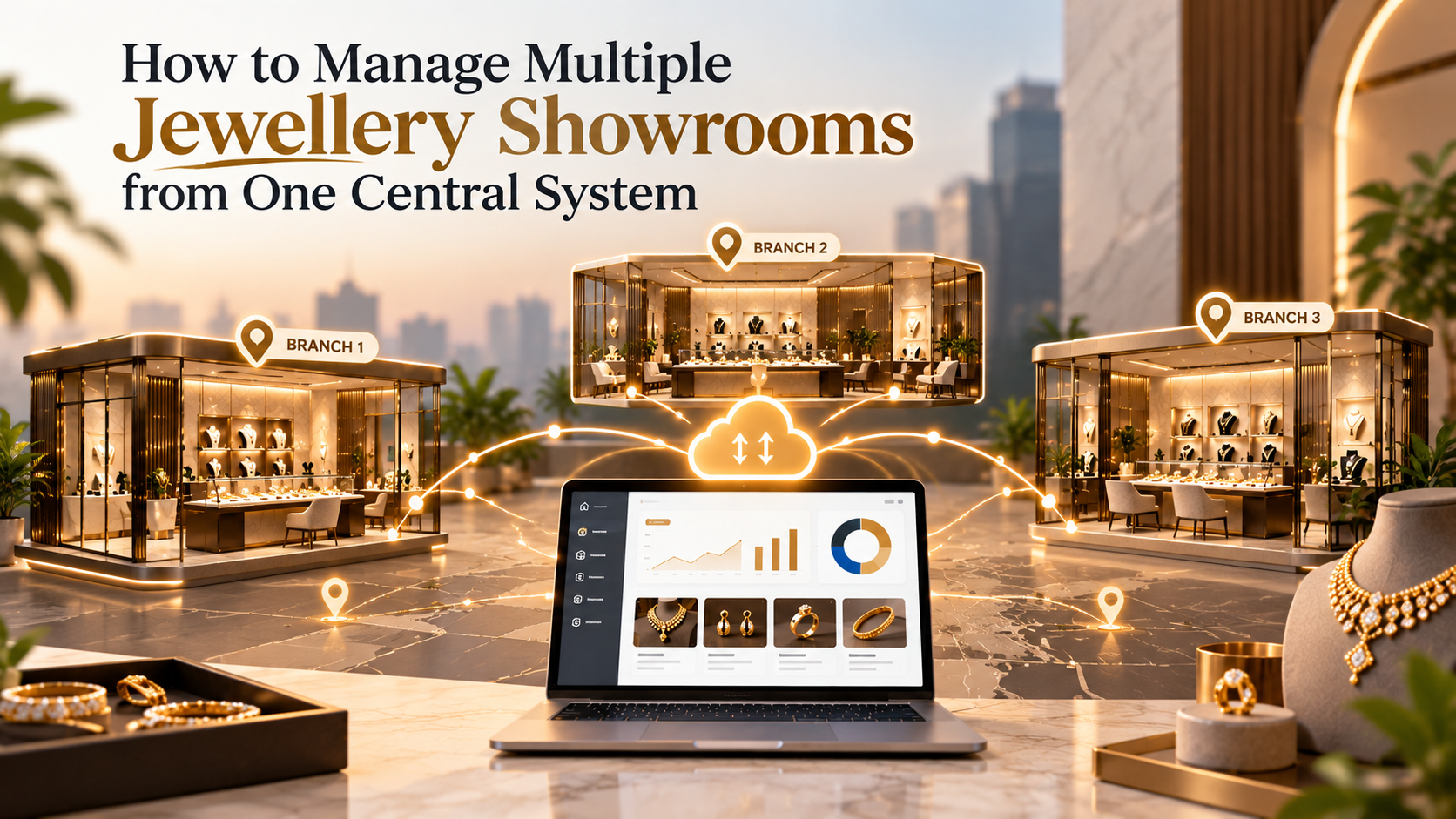
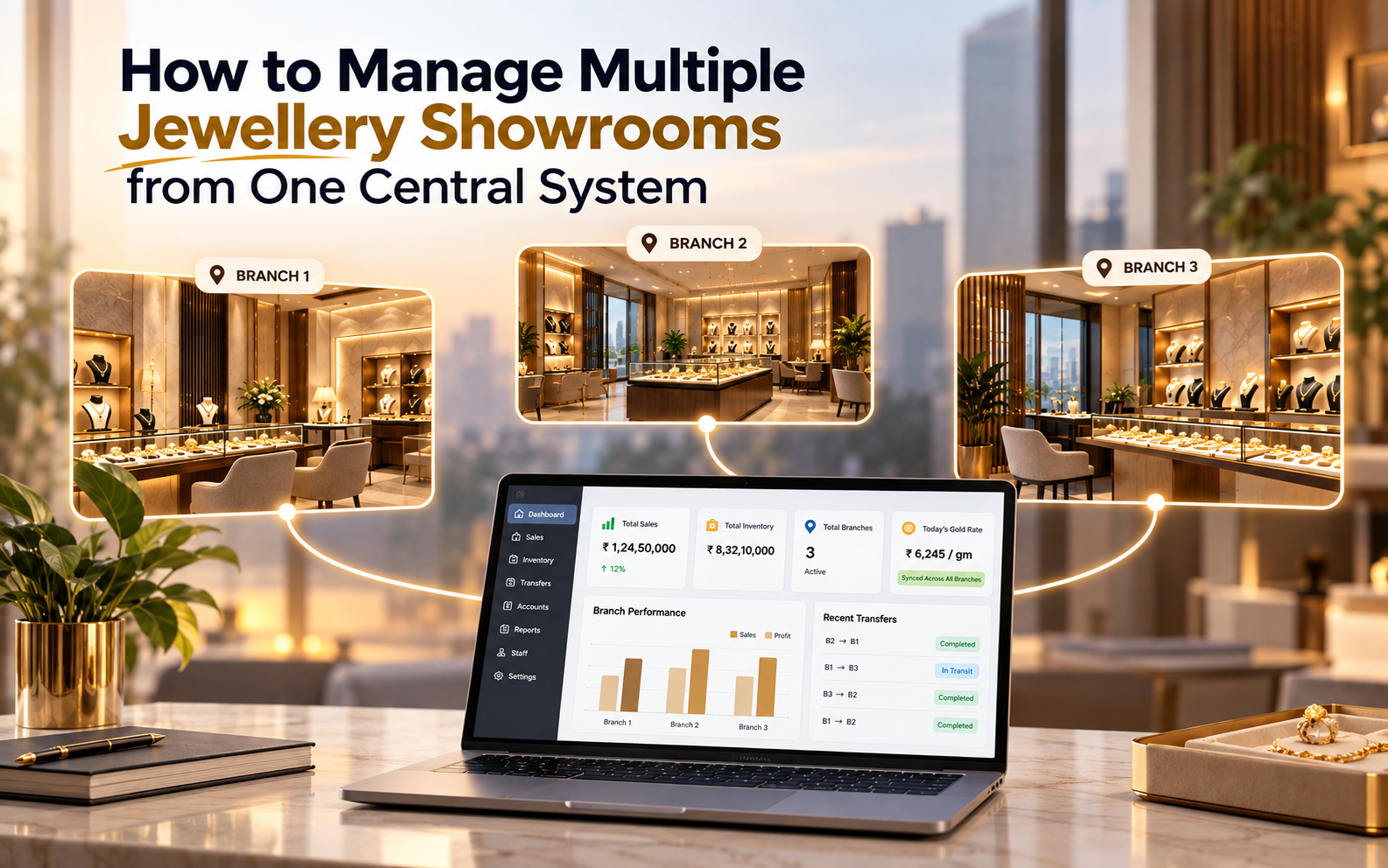
Multi branch operations get profit and loss auto consolidated by branch, so performance across locations is visible without building a manual report every month.
Accounting, banking and GST compliance are complete from the Starter tier. These specialised tools, Girvi, MCX, kitty schemes and HUID hallmark tracking, open up at the Gold and Platinum tiers as a business scales past a single counter. For a closer look at how the stock side of this works day to day, see our guide to jewellery inventory management.
What jewellery businesses see after moving to one system
Jewellers who consolidate onto a single ERP report saving two to three hours a day that used to go into manual reconciliation between billing, stock and accounts. Several showrooms are already running their full operation, billing, inventory, and karigar tracking, on JewelBiz instead of separate disconnected tools.
Frequently asked questions
ERP stands for enterprise resource planning. For jewellery specifically, it means one system that runs sales, inventory, manufacturing, accounting and compliance together on a single ledger, instead of separate tools for billing, stock and accounts that do not talk to each other.
Yes. Billing software focuses on the counter and invoicing. A jewellery ERP includes billing as one module alongside inventory, manufacturing, purchase, accounting and compliance, all connected on the same data. See our guide to jewellery billing software for what the counter specific piece should do on its own.
A jewellery ERP should scale down as well as up. The core modules, billing, inventory and compliance, matter just as much to a single counter shop as to a multi branch chain, the difference is usually which tier of features gets switched on.
A properly built one does. GST should be split automatically between metal value and making charges at the point of billing, with GSTR-1, GSTR-2B, GSTR-3B and GSTR-9B reports generated directly from that data rather than reconstructed later. Our guide to jewellery accounting software covers this in more depth.
See What One Ledger Looks Like for Your Business
JewelBiz runs sales, inventory, manufacturing, purchase, accounting, banking and compliance on one connected ledger, with specialised tools like Girvi tracking, MCX rate registers and HUID hallmark records available as the business grows. If three records that never quite match by month end sounds familiar, it is worth seeing what running the whole business on one ledger actually looks like. Book a demo on your own stock and rate structure and see where the gaps close.