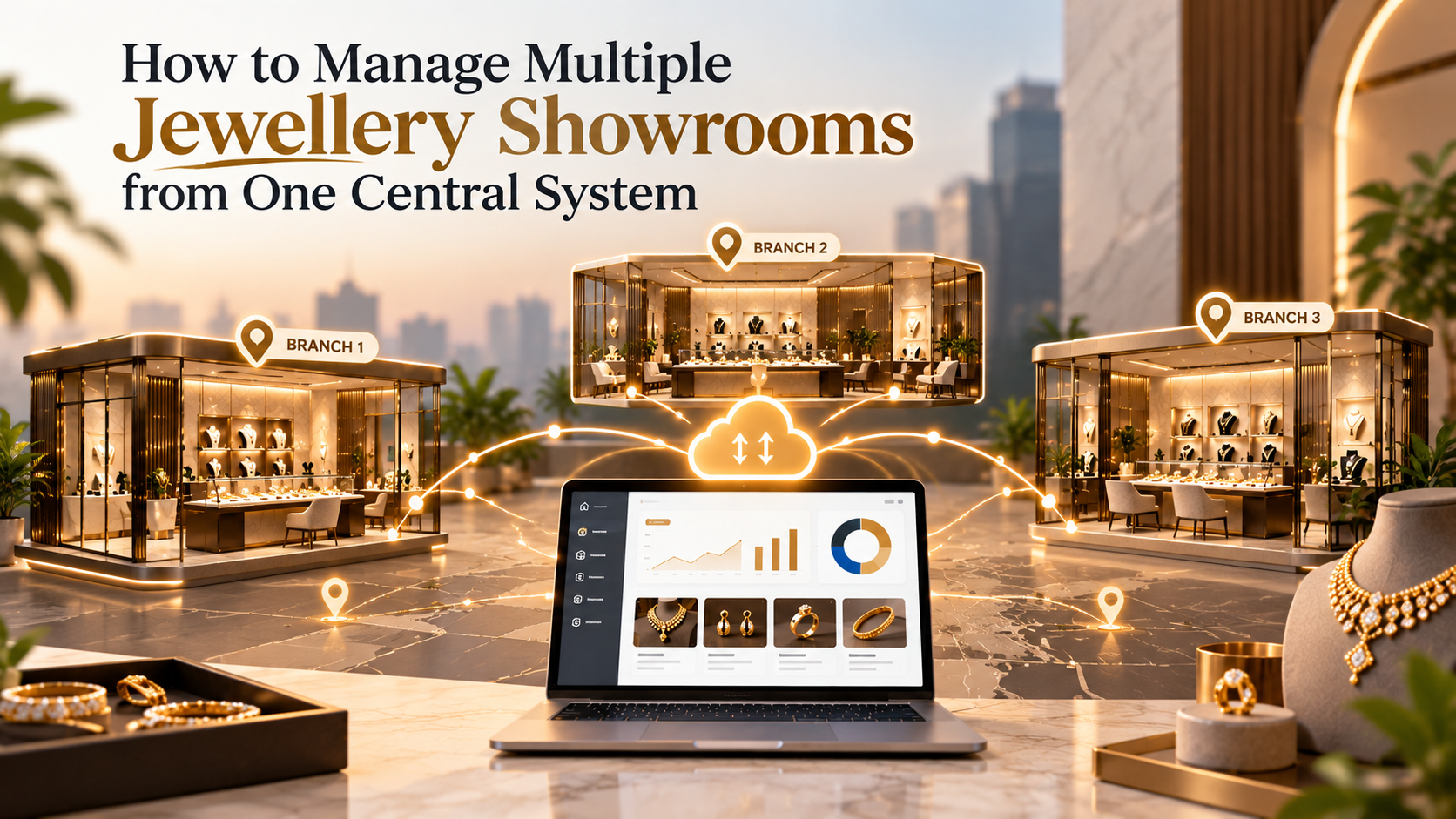
A single showroom owner knows their stock, their staff, and their numbers because they're standing in the middle of all three every day. The second and third branch don't remove that knowledge, they just make it impossible to hold in one head.
Managing multiple jewellery showrooms isn't running the same business three times, it's running one business across three locations that all need to agree with each other, on one jewellery ERP software platform rather than three disconnected setups. Most of the difficulty comes from exactly that gap.
Monday: The Rate Has to Be the Same Everywhere, Instantly
The day's gold rate gets set once, and from that moment every counter across every branch needs to be pricing off the same number. A rate updated at the main branch that takes even twenty minutes to reach a second location is twenty minutes where two showrooms are quoting the same customer two different prices. Customers do compare notes, especially between branches in the same city.
This is the first place a multi branch operation either holds together or doesn't. One rate entry, everywhere, immediately, isn't a convenience feature. It's the baseline requirement before anything else about running multiple branches can work.
Tuesday: A Customer Wants Something Branch Two Doesn't Have
A customer at branch one asks for a design that branch two has in stock. Without shared visibility, that's a phone call, a description over the phone that may or may not match what's actually on the shelf, and a customer who either waits or walks.
With live stock visible across every branch from any counter, that same request becomes a confirmed availability check and a transfer request. It gets handled inside the same conversation instead of a follow up call the next day.
Stock transfers between branches need their own record too, not a mental note that a piece moved. A transfer voucher that updates both branches' stock the moment it's created is what keeps three separate inventories from quietly drifting into three separate, slightly wrong pictures of the same business. Our guide to jewellery inventory management covers what live stock visibility should look like at a single branch before it even gets to a multi branch question.
Wednesday: Head Office Needs to Know Which Branch Is Actually Performing
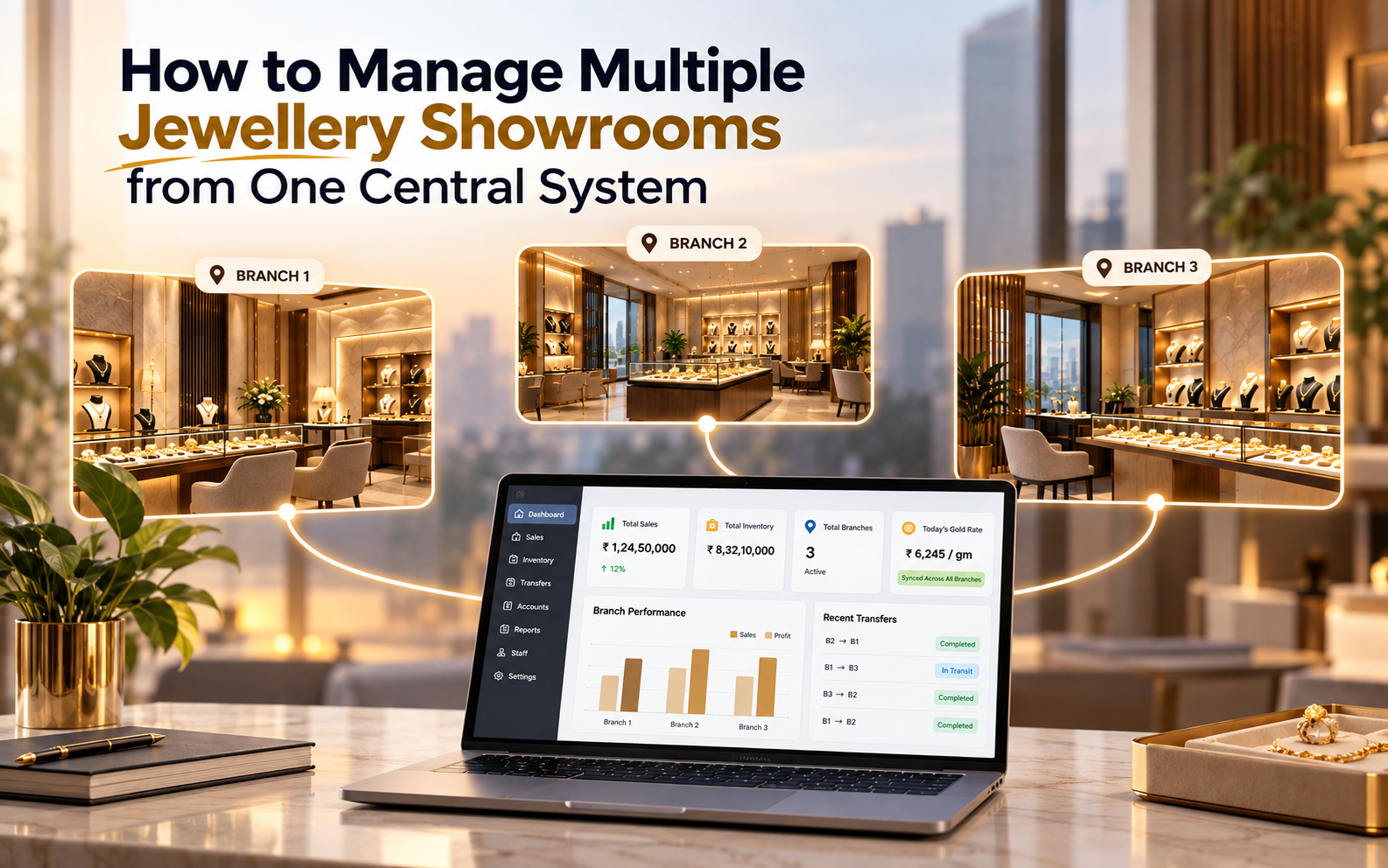
Three branches rarely perform identically, and knowing which one is pulling weight and which one is quietly underperforming matters for everything from staffing decisions to where new stock gets allocated first. That comparison is only useful if it's built from the same data every branch is entering the same way, not three separate registers that get reconciled once a month into a rough estimate.
Branch wise profit and loss depends on the same accounting discipline covered in our guide to jewellery accounting software, applied consistently across every location rather than reconstructed differently at each one.
| Without a central system | With one connected system | What changes |
|---|---|---|
| Each branch tracks stock separately | One stock position across all branches | No duplicate counting, no gaps |
| Rate updated branch by branch | One rate entry reaches every branch instantly | No pricing mismatch between locations |
| Monthly manual consolidation for owner reports | Branch wise P&L available any time | Decisions made on current numbers, not last month's |
| Staff performance tracked per branch in isolation | Salesperson and branch performance visible together | Fair comparison across the whole team, not just one location |
Thursday: A Karigar Issue Reaches Every Branch That's Waiting on It
Manufacturing usually serves more than one branch off a shared workshop, which means job status matters to whichever branch is waiting on that piece, not just the branch that placed the order.
When work in progress is tracked centrally rather than on a workshop specific register, any branch checking on an order gets the same accurate answer. That beats a call to the workshop that may or may not get returned that day.
Friday: Closing the Week Means Closing All Three Branches at Once
End of week reconciliation across three separate systems means three separate closes, then a fourth step combining them into something the owner can actually read. On one connected system, closing pulls from data that's already been entered correctly all week at every counter.
The combined picture is available the moment each branch closes, not days later once someone's had time to consolidate spreadsheets. That daily discipline at a single counter is exactly what our guide to a jewellery management system walks through, multiplied here across every branch running it the same way.
What Actually Breaks First When Branches Aren't Connected
- Rate mismatches between branches on the same day
- Stock that shows as available in one branch's records but has already sold at another
- Owner reports that are always a few weeks behind actual performance
- Karigar job status that depends on someone at the workshop answering the phone
- Staff performance that can't be compared fairly because each branch tracks it differently
What to Check Before Running Multiple Branches on One System

- Does a rate update reach every branch and counter instantly, or does someone update each location separately
- Is stock visible across all branches from any counter, matching the same live visibility standard, or only visible locally
- Do stock transfers between branches update both sides automatically, or rely on manual notes
- Does jewellery billing software at each counter stay fast and independent while still syncing centrally
- Is branch wise profit and loss available on demand, or only after a manual monthly rollup
- Can karigar and manufacturing status be checked from any branch, or only from the workshop
Frequently Asked Questions
What's the biggest risk of running multiple jewellery branches on separate systems?
Rate and stock mismatches between locations. A customer pricing the same item differently at two branches, or being told something is available when it already sold at another branch, damages trust fast and is entirely avoidable with shared, live data.
How many branches justify moving to a connected system instead of separate registers?
Even two branches create the coordination problem, it doesn't wait for a third or fourth location to become worth solving. The gap between one branch's records and another's starts on day one of the second branch, not at some later scale.
Does a connected system slow down billing at individual branches?
It shouldn't. Each branch's counter should operate at full speed independently, live rate and stock data syncing in the background, not requiring a round trip to head office for every transaction.
How does this connect to the rest of a jewellery ERP?
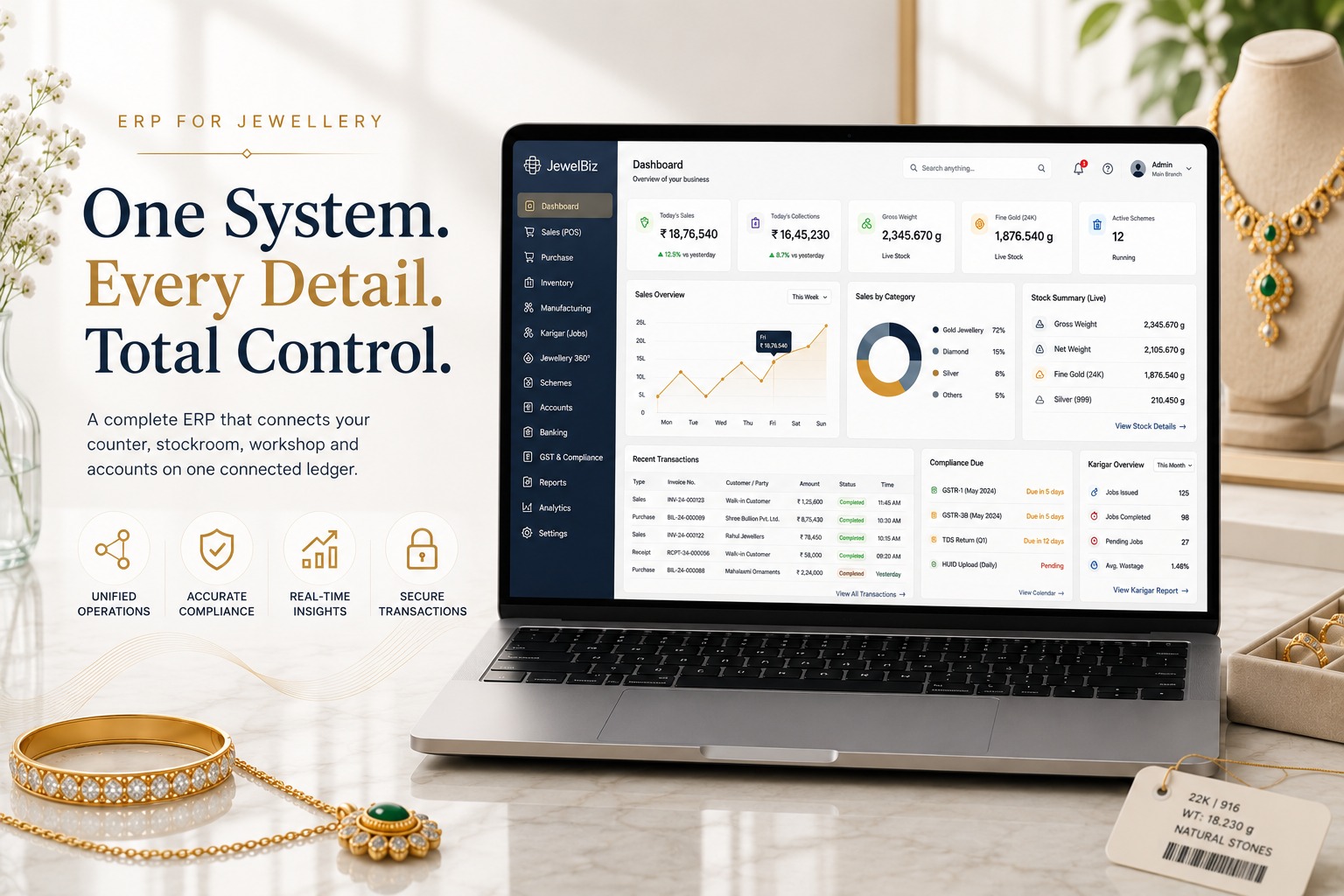
Multi branch visibility is one piece of a complete jewellery ERP software platform, sitting alongside billing, inventory, manufacturing and compliance on the same ledger. Our guides to jewellery billing software and jewellery inventory management cover those connected pieces individually.
See All Your Branches on One Screen
JewelBiz runs every branch on one connected ledger. Live rate updates reach every counter instantly, stock stays visible and transferable across locations, karigar and manufacturing status is available from any branch, and branch wise profit and loss is ready without a manual monthly rollup.
If you want to see how your own branches would look inside one system, reach out at info@slatebiz.com or call +91 92573 73668, or visit slatebiz.com to book a walkthrough.