Most software calling itself a jewellery management system gets judged by its feature list. That is the wrong test. A better one is simple: follow one normal day through the shop and see where the system is actually doing the work of managing the business, and where it quietly leaves that work to a person and a notebook.
Morning: how a jewellery management system starts the day
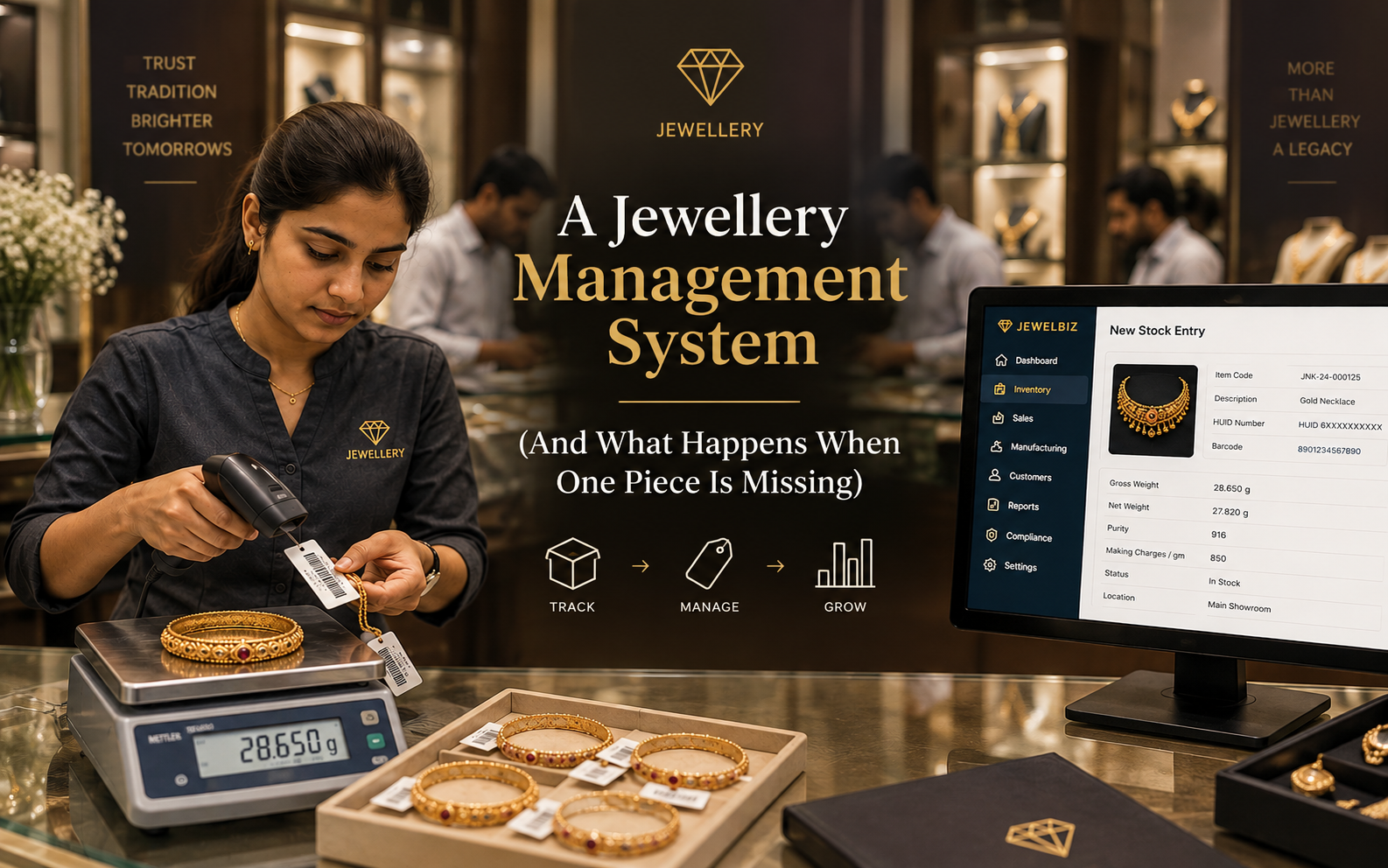
A new lot comes in. Each piece gets a tag, with a barcode and a HUID number, the government hallmark ID every piece of gold jewellery needs. A proper jewellery management system also records the weight and purity right there, whether that is 995, 916, or something custom.
In a good system, this one entry becomes the foundation for everything else that happens to that piece all day. In a basic billing tool, this step usually never touches the software at all. It stays in a paper register, because tagging was never really built into the tool in the first place.
In short: a real jewellery management system starts tracking a piece the moment it enters the shop, not the moment it gets sold.
Mid morning: how a jewellery management system tracks metal sent for job work
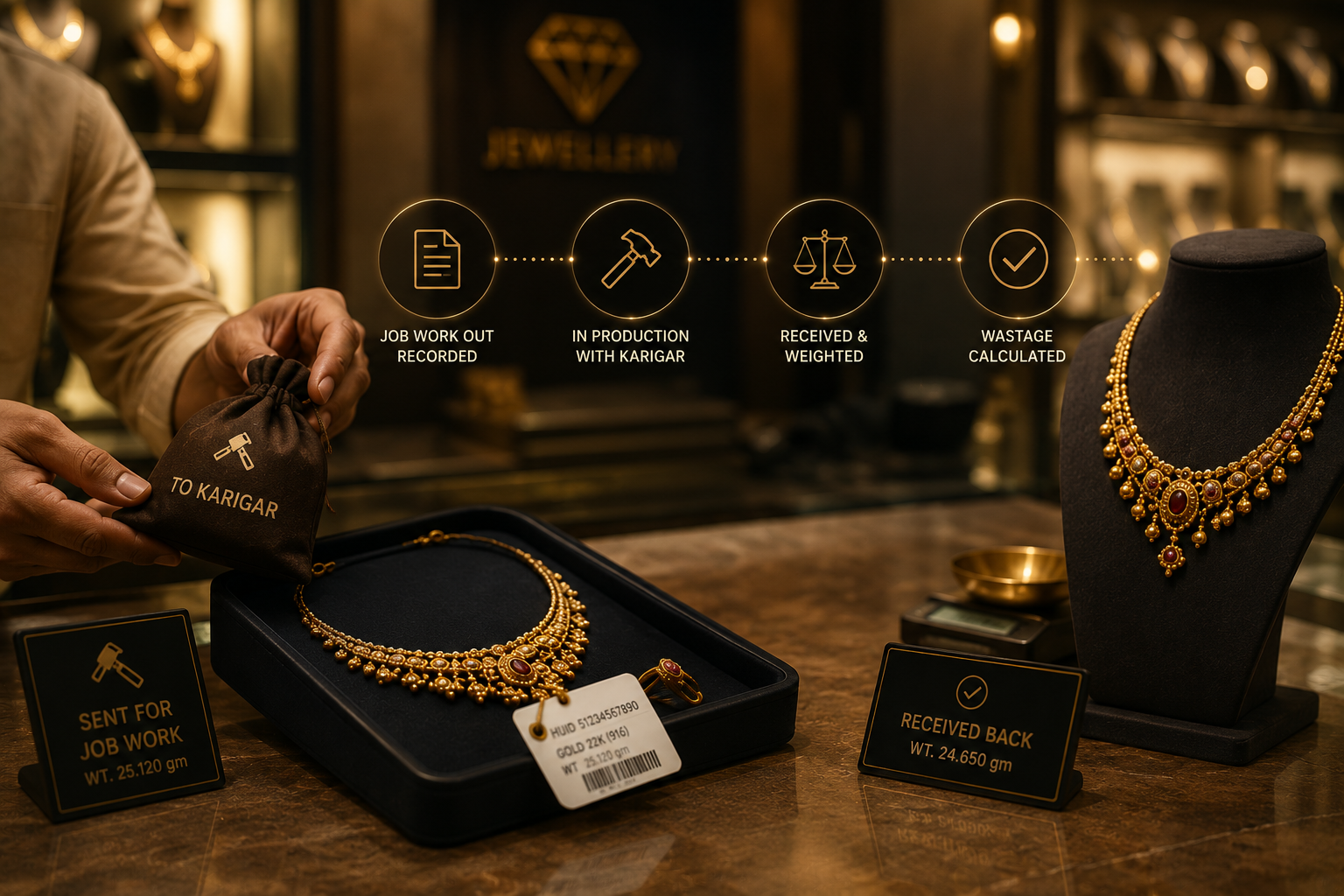
A karigar, the craftsperson who makes and repairs the jewellery, takes raw gold to build a new design. Approval receipts and selection vouchers get created from the same record, so nothing has to be re-entered by hand.
A management system logs this the instant the metal leaves. It expects a certain amount of wastage, the small amount lost during shaping and polishing, and tracks that job until the finished piece comes back. This kind of live visibility is the same principle behind real time stock visibility at the counter, just applied to metal that has left the building.
When the piece returns, the system weighs it and compares that weight to what went out. The loss gets calculated automatically. Without a system managing this, the whole process runs on trust, and the wastage number is really just a guess.
In short: gold sent out for manufacturing should be tracked as carefully as gold sold at the counter.
Midday: how a jewellery management system runs the counter
A customer picks a piece and wants to buy. The system prices it using today's gold rate, already loaded in, nobody types a rate in by hand. Making charges, the labour cost of crafting the piece, get calculated by a set rule instead of a staff member doing the maths at the counter. Two shops rarely land on the same number here, which is exactly why making charges need a consistent rule behind them. If the customer qualifies for a scheme or discount, it applies on its own. Payment can be cash, card, UPI, or a mix of methods, all in the same bill.
In short: a jewellery management system should let the counter move at the speed of the customer, not the speed of manual calculation.
Afternoon: how a jewellery management system handles an old gold exchange
A customer wants to trade in an old piece toward a new one. A good management system values that old piece and subtracts it from the new bill in one single document. A weaker system, usually just billing software wearing a bigger label, treats this as two separate calculations someone has to combine by hand, which is exactly where small mistakes creep in.
In short: one transaction should produce one bill, not two numbers that need reconciling later.
Every bill: how a jewellery management system handles tax automatically
Every sale needs GST calculated correctly. In jewellery, that tax splits differently across the metal value, the making charges, and any stones, all inside one invoice. A real jewellery management system does this the moment the bill is created, along with the compliance paperwork the government requires. Without that, someone has to rebuild all of this manually before the next tax filing, usually in a rush.
In short: tax compliance should happen while the bill is printing, not weeks later under deadline pressure.
Evening: how a jewellery management system closes the day
At close, every purchase, every job sent to a karigar, every sale should already be recorded. Closing the books in a properly built jewellery management system is a formality, not a task. In a basic billing tool, this is actually when the real work starts, someone manually enters the day's manufacturing and stock activity into a separate accounting system, often hours after it happened.
In short: day end should confirm what already happened, not be the first time it gets recorded anywhere.
Next morning: what a jewellery management system has ready before anyone asks
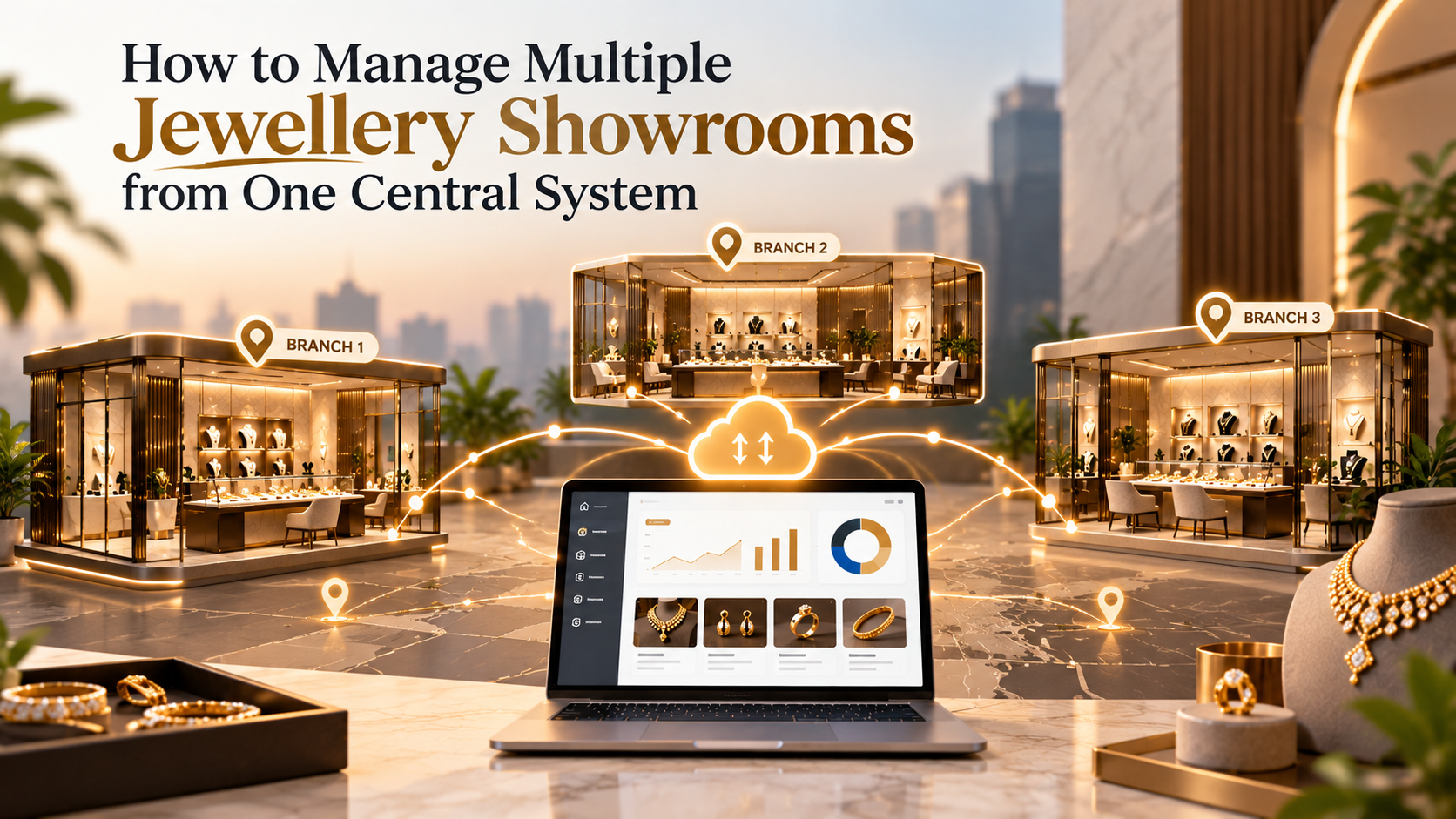
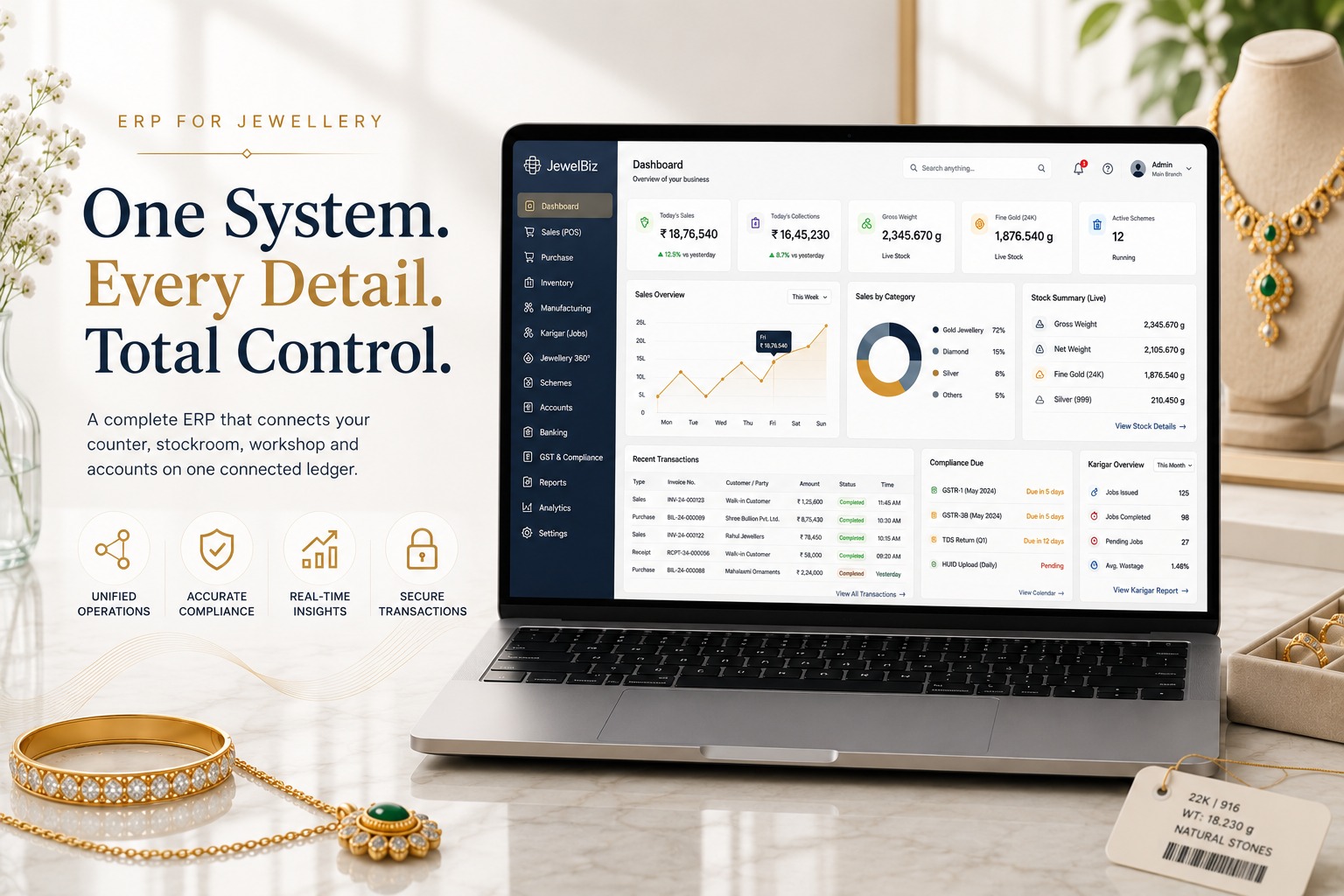
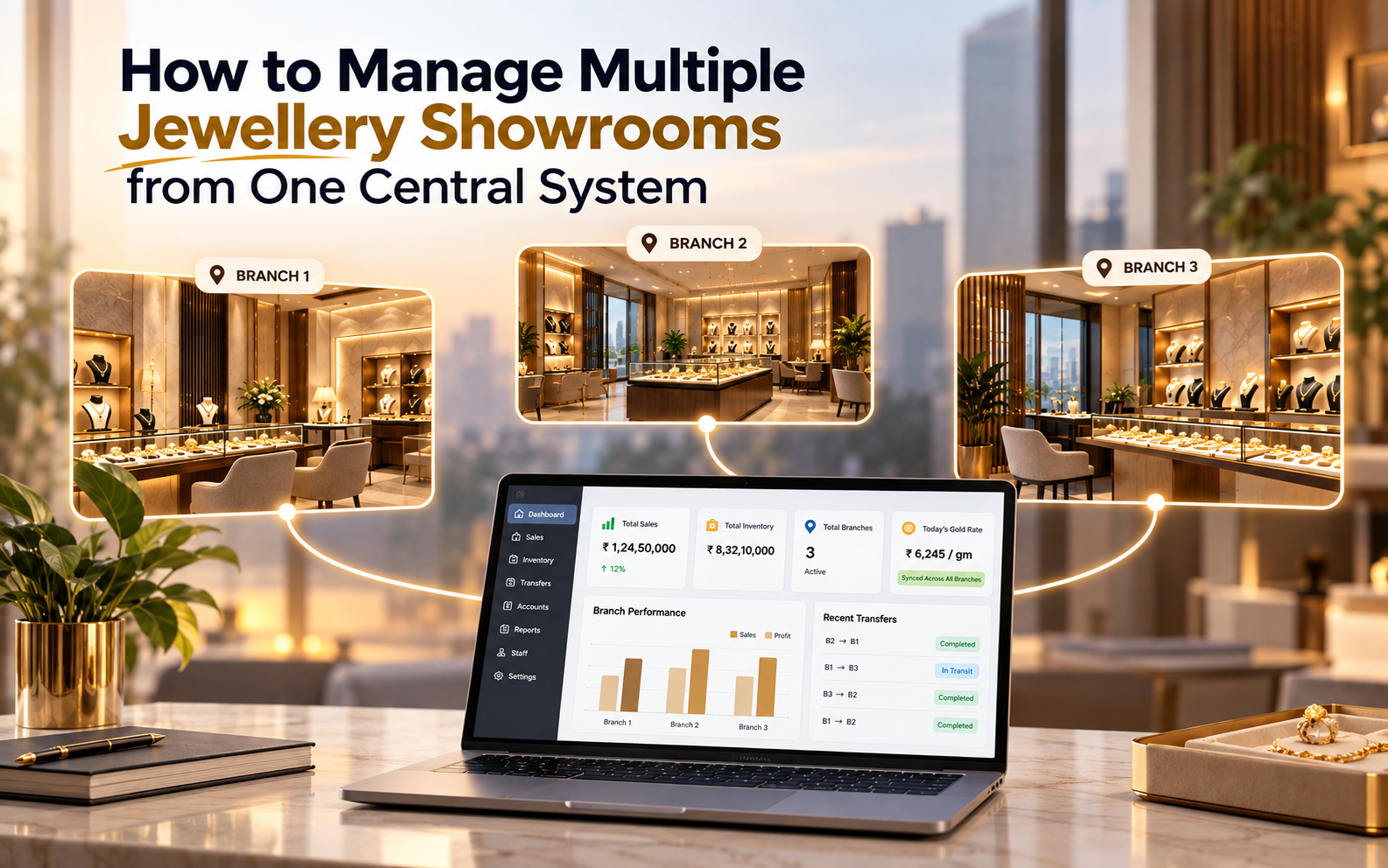
Sales, stock levels, what each karigar produced, how each branch performed, all of it should be ready to view first thing, with nobody building a report from scratch. Seeing all of that in one place matters even more once a business runs more than one showroom, which is where managing multiple branches from one central system starts to pay off. This is really the difference between billing software and an actual jewellery management system. A billing tool can say what sold yesterday. A management system can also say what is still in progress, what is owed, and what changed overnight.
In short: a manager should open a dashboard, not build one.

What a day like this actually shows about a jewellery management system
Every step above is a moment where the business either has accurate, live information, or has a gap that someone fills later using memory, a notebook, or a spreadsheet. A jewellery management system, as opposed to jewellery management software bolted together from separate tools, earns that name by how many of these moments it handles on its own, connected to each other, instead of leaving staff to stitch the day together after it is already over.
Frequently asked questions
What is the difference between a jewellery management system and jewellery billing software?
Billing software handles the sale. A jewellery management system handles the sale plus everything around it: stock, manufacturing, staff performance, and tax compliance, all working together on the same information. See our guide to jewellery billing software for what the counter specific piece should do on its own.
Does a jewellery management system get rid of paper registers completely?
For anything it is built to track, yes. Tagging, weight, karigar work, exchanges, and tax data should all live inside the system instead of in a separate book someone has to check against it later.
Is a jewellery management system only useful for shops that make their own jewellery?
No. Even a shop that only sells, and does not manufacture, benefits from live stock tracking, automatic discounts, and built in tax compliance from a jewellery management system. The manufacturing tracking matters most for shops that produce their own pieces, but the rest matters for every jewellery business.
Is a jewellery management system the same as a jewellery ERP?
Broadly yes, both describe software that runs a jewellery business end to end rather than just one part of it. Our guide to ERP for jewellery covers the same ground from a slightly more technical, module by module angle.
See a full day run on your own stock
JewelBiz is a jewellery management system that handles every step above, tagging, manufacturing, billing, exchanges, tax, closing, and next day reporting, on one connected platform. If a normal day at your shop still means several of these steps happening outside the software, in a register, a spreadsheet, or someone's memory, it is worth seeing what a full day looks like when none of them do. Book a demo on your own stock and rate structure and walk through the day yourself.