Two showrooms, the same design, the same purity, and the final bill still comes out different. That gap is almost never the gold itself, gold trades at the same rate everywhere on a given day. It's gold making charges, the labour cost of turning raw metal into a finished piece. It's the one line on a jewellery bill that genuinely varies shop to shop, design to design, and sometimes customer to customer.
What making charges actually cover
Making charges are the fee a jeweller adds for craftsmanship, design, and the labour of shaping raw gold into a finished piece. They're separate from the gold's own value, which moves with the day's market rate and is identical everywhere. Making charges cover the karigar's skill, the complexity of the design, and in some cases the handling and transport involved in getting a piece from the workshop to the showroom floor.
In many shops today, gold wastage, the small amount of metal lost during shaping and polishing, gets folded directly into the making charge percentage rather than billed as a separate line. Where it's still billed separately, it typically runs 2% to 5% of weight on top of making charges, so it's worth asking directly whether a quoted percentage already includes it.
The two ways making charges get calculated
| Model | How it works | Where it's common |
|---|---|---|
| Percentage of gold value | A fixed percentage, typically 5% to 25%, applied to the gold's market value for that piece | Most common model, easiest for a customer to compare across shops |
| Fixed rate per gram | A flat rupee amount charged per gram of gold used, independent of the day's gold rate | More common on machine made, higher volume pieces |
Neither model is inherently better, but they behave differently as gold prices move. A percentage based charge rises alongside the gold rate, since it's calculated off a bigger number. A fixed per gram rate stays flat regardless of what gold is doing that day. When gold prices are climbing, a fixed rate protects the buyer from paying more in making charges purely because the metal got more expensive. When prices are falling, a percentage model works out cheaper.
Why the percentage varies so much
- Design complexity: a plain machine made chain sits at the low end, roughly 5% to 10%, while a hand finished bridal set or an intricate bangle can run 18% to 25%
- Purity: 22K gold is softer and needs more careful handling than lower purity alloys, which can push labour costs up slightly
- Studded versus plain: setting stones adds labour on top of the base metalwork, so studded pieces carry higher making charges than plain gold of similar weight
- Handmade versus machine made: hand craftsmanship costs more than mass production, consistently across every design category
- Brand and location: a well known brand or an urban showroom with higher operating costs often prices making charges higher for comparable work
A worked example
A ten gram 22K gold chain, gold rate for the day at thirteen thousand five hundred rupees per gram, comes to one lakh thirty five thousand rupees in gold value alone.
- At a 10% making charge (plain, machine made): ₹13,500 added, before GST
- At a 15% making charge (medium design): ₹20,250 added, before GST
- At a 22% making charge (hand finished, bridal): ₹29,700 added, before GST
Same gold, same weight, same day's rate, and the difference between the cheapest and most expensive version of that chain is over sixteen thousand rupees before tax even enters the picture. GST then applies separately, 3% on the gold value and 5% on whichever making charge figure applies, which is exactly why the tax component of a jewellery bill looks different from a single flat rate applied to the total.
Questions worth asking before buying
- Is the quoted percentage inclusive of wastage, or is wastage billed as a separate line?
- Is this a percentage of gold value or a fixed rate per gram, and which one is cheaper given today's gold rate?
- Does the making charge change if the design is customised after the initial quote?
- Is the making charge shown as its own line on the invoice, separate from the gold value, with its own GST?
Note: Making charges and wastage are also not recoverable if the piece is ever resold or exchanged, only the gold content typically gets valued back. That's worth knowing going in, not discovering at resale.
The other side of this: why making charges are hard to bill accurately
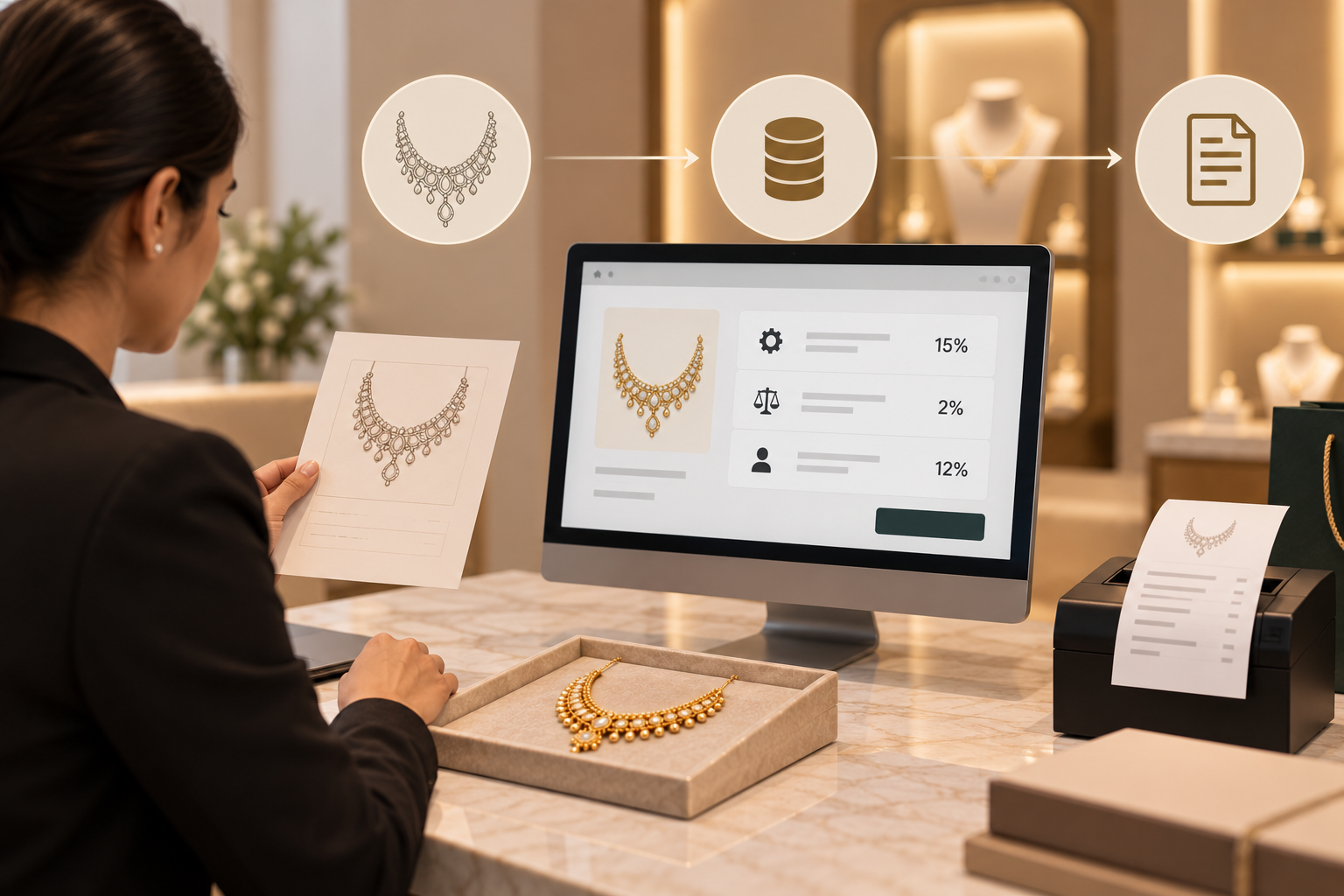
Everything above is straightforward for a buyer to ask about. It's considerably harder for a showroom to bill correctly at scale. A shop carrying hundreds of designs, each with its own making charge percentage, its own wastage treatment, and sometimes a different negotiated rate for a repeat customer, can't run that at the counter from memory without errors creeping in.
A design quoted at 15% making charges in the catalogue and billed at 12% by a staff member in a hurry is a real margin loss that compounds across a season, not a one time mistake. Small counter slips like this are exactly what a connected jewellery management system is built to catch.
This is where a design master, storing the correct making rate against each design rather than recalculating it by hand on every sale, stops being a nice to have. Paired with a rule based billing engine that applies it automatically, it becomes the difference between a catalogue price and what actually lands on the invoice.
Frequently asked questions
What percentage should gold making charges be?
There's no single correct number, it depends on the design. Plain machine made pieces typically run 5% to 10%, medium complexity designs 12% to 15%, and hand finished or bridal pieces 18% to 25%. Comparing the percentage alone across shops only works if the designs being compared are genuinely similar in complexity.
Are making charges the same as GST on gold?
No, they're separate. Making charges are the jeweller's labour fee. GST is a tax applied on top, 3% on the gold value and 5% on the making charges, as two distinct components on the same invoice. Our guide to the GST rate on gold jewellery covers this split in detail.
Can making charges be negotiated?
Often, yes, particularly on higher value pieces or with an existing customer relationship. This is exactly where a showroom needs the making charge to still be tracked accurately even when it's adjusted, rather than becoming an undocumented exception that's hard to reconstruct later.
Do making charges vary between cities?
They can. Urban showrooms with higher operating costs sometimes price making charges slightly higher than smaller town jewellers for comparable craftsmanship, though design complexity remains the bigger factor overall.
How JewelBiz Bills Making Charges Correctly Every Time
JewelBiz stores the correct making rate against each design through a design master, so the rate charged matches the rate quoted without depending on a staff member's memory at the counter. A rule based billing engine applies making charges, wastage, and GST automatically on every invoice, and account specific rates can be set for individual customers where negotiated pricing applies.
This is one piece of the wider connected system covered in our guide to jewellery ERP software, alongside our guides to jewellery billing software and jewellery accounting software for how it connects to the ledger. If you want to see how it handles your own design catalogue and making rates, reach out at info@slatebiz.com or call +91 92573 73668, or visit slatebiz.com to book a walkthrough.