
Jewellery inventory management is not just counting pieces in a tray. In a jewellery showroom, every piece carries four things at once:
- a gold rate that moves every day
- a purity that must match its hallmark
- a weight that decides its price
- a tax treatment that changes line by line on the invoice
Get any one of these wrong and the loss is real and immediate. It usually stays invisible until audit time.
This guide covers the 19 risks that sit inside jewellery stock, billing and books. It groups them into five areas and maps each one to the control that closes it. It also explains why jewellery inventory software built for the trade carries this load better than generic billing or accounting tools.
Why Jewellery Inventory Management Is Different From Regular Retail
Most retailers manage one layer of risk: stock in, stock out, cash reconciled. A jewellery showroom stacks four layers into every single transaction:
- Commodity price risk. The value of the stock changes every time the gold rate moves.
- Inventory risk. Every piece must be physically present and accounted for.
- Purity and weight risk. A half gram error in fine weight is a direct loss, not a rounding difference.
- Financial transaction risk. Each bill involves high value payments, exchanges and tax.
No other retail category asks one system to hold all four at once. This is why spreadsheets and basic billing tools break down as soon as a jewellery business grows past a single counter.
The 19 Risks Inside a Jewellery Business
Commodity and Stock Risks
1. Gold price risk. Rates change daily. Stock sold below replacement cost erodes margin quietly until someone reconciles the books.
2. Inventory loss and miscount. Gold, diamond or finished stock that is lost, damaged or miscounted becomes a loss the moment it happens, not when it is discovered.
3. Theft and pilferage. Value density is extremely high in jewellery. A few missing grams represent a large rupee figure, whether the theft is internal or external.
4. Liquidity risk. Capital locked in slow moving designs creates cash flow pressure and limits how fast the business can respond to demand.
Purity, Weight and Stone Risks
5. Purity and counterfeit risk. Incorrect karat assessment leads to customer disputes and direct loss. Counterfeit or under karat pieces entering stock threaten both the balance sheet and the brand.
6. Weight and wastage risk. Errors in gross weight, net weight, stone weight, making or wastage leak margin on every bill they touch. Across hundreds of bills a month, those leaks compound.
7. Diamond and stone risk. Incorrect grading or valuation either overprices a piece, which damages trust, or underprices it, which damages margin.
Pricing, Credit and Tax Risks
8. Price and margin risk. A wrong selling price, discount, making charge or wastage entered at the counter is a small but real hit to profit.
9. Credit risk. Customers or dealers who fail to pay create bad debts and cash flow gaps.
10. GST risk. Incorrect GST calculation, invoicing or HSN classification leads to penalties, not just paperwork corrections. Metal value, making charges, stone value and karigar job work all need correct treatment on every invoice. Our breakdown of the GST rate on gold jewellery covers each component. The GST portal sets out the current rates and filing rules.
Cash, Fraud and Exchange Risks
11. Cash and payment risk. Shortages, fraudulent payments and reconciliation errors are financial loss by another name.
12. Employee fraud. Unauthorised discounts, stock manipulation, fake returns and billing fraud cause leakage that often stays hidden until a scan based audit surfaces it.
13. Customer fraud. Fake identity, fraudulent payments and manipulated transactions are risks most showrooms underestimate until the first incident.
14. Return, exchange and buyback risk. Incorrect valuation during an old gold exchange or buyback is a quiet but real form of margin loss.
Systems, Compliance and Reputation Risks
15. System and IT risk. Data loss, unauthorised access or software manipulation threaten both daily operations and the financial record.
16. Cybersecurity risk. Ransomware, hacking and data theft cause business interruption on top of data exposure.
17. Operational risk. Billing, inventory and accounting errors feed directly into wrong financial reports.
18. Regulatory risk. This covers non compliance with tax, AML and KYC, and hallmarking rules.
- Six digit HUID hallmarking has been mandatory for gold jewellery sold in notified districts since April 2023.
- Every hallmarked piece carries a unique HUID that regulators and customers can verify.
- A showroom that cannot show clean HUID records against its stock carries regulatory risk, whether or not it has been checked yet.
The BIS hallmarking overview sets out the current requirements.
19. Reputation risk. Complaints about purity, pricing or service erode trust that took years to build.
Risk to Control Map
| Risk area | What it costs | Control that closes it |
|---|---|---|
| Gold price | Margin lost on stock sold below replacement cost | Daily rate entry, rate lock and full rate history |
| Stock loss and theft | Direct rupee loss per missing gram | Item level barcode or RFID with movement history and scan based audits |
| Weight and wastage | Small leaks on every bill | Rule based making and wastage with authorisation limits |
| Purity and stone | Disputes and mispricing | Purity capture per piece, stone certificates stored against each item |
| Discounts and price overrides | Unauthorised margin loss | Approval limits tied to salesperson authority |
| GST | Penalties and rework | Automatic GST split and HSN mapping at item master |
| Exchange and buyback | Overvalued old gold | Controlled valuation inside the same bill |
| Fraud and system access | Hidden leakage | Role based access and audit trail on every transaction |
| Hallmarking | Regulatory penalty | HUID stored and searchable against every item |
Inventory Controls Every Jewellery Showroom Needs
- Fine weight tracking across purity, gross weight, stone weight and net metal weight
- A gold and metal ledger that reconciles physical quantity against book quantity
- Karigar issue and receipt vouchers with loss computed on every job
- Daily cash and bank reconciliation
- Role based access separating salesperson, cashier, manager, accountant and administrator
- Fraud flags on unusual discounts, cancellations, returns, stock adjustments and manual entries
- Backup and disaster recovery, because transaction data carries real financial value
For how live stock data also helps win wholesale orders, read our guide on real time stock visibility for jewellers.
Generic Accounting Software vs Jewellery ERP
A general accounting package can be configured to sell jewellery. It cannot run a pawn book, a bullion hedge or a savings scheme. It was never built to track fine weight, purity and karigar balances in one connected ledger.
The real cost shows up as three separate books that never agree: the billing software, the accounting software, and the owner's own register. None of this is theft. It is simply the absence of a system built for jewellery.
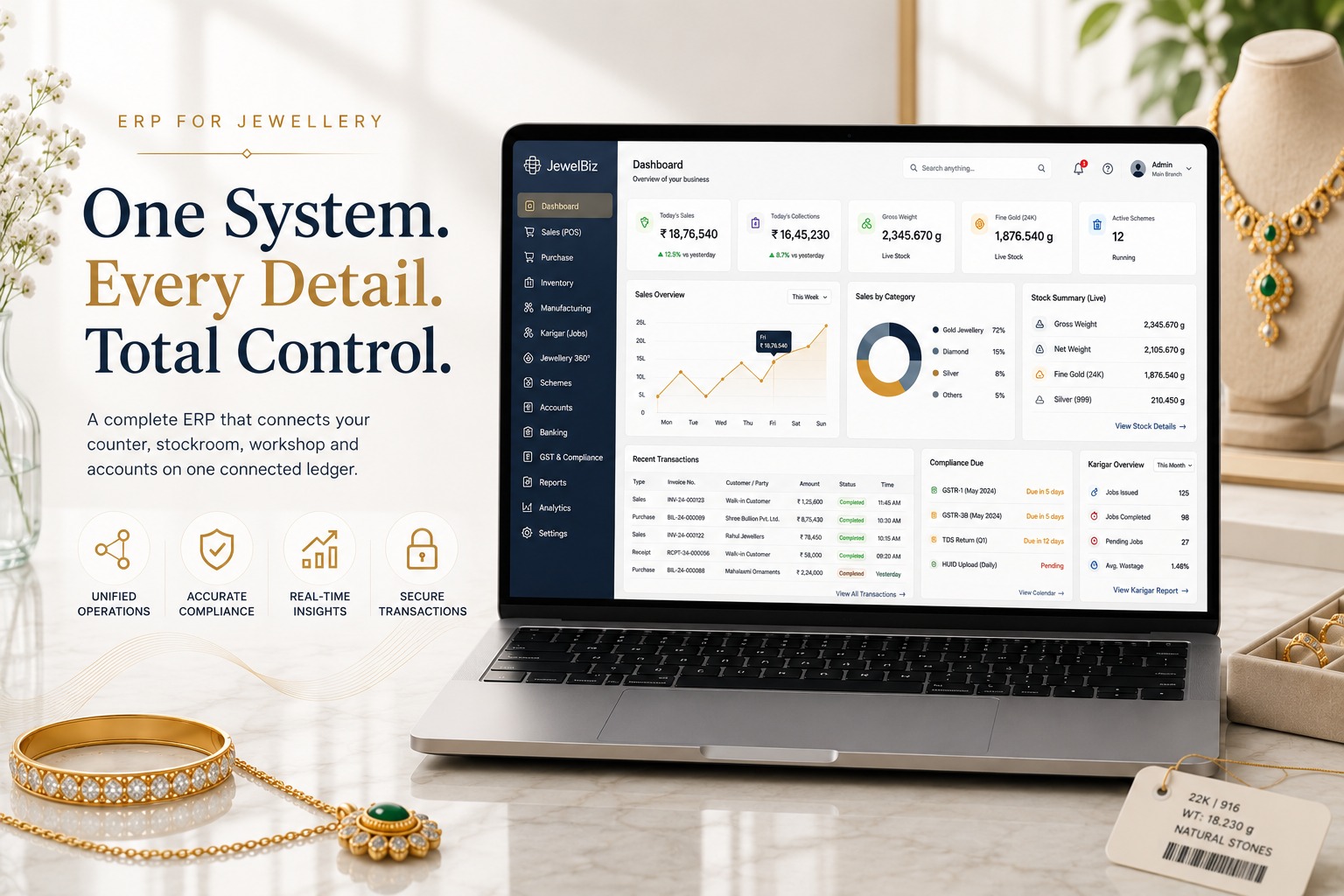
A purpose built jewellery ERP puts sales, inventory, manufacturing, accounting and GST on a single ledger. Every step flows through one system instead of three:
- purchase entry
- tagging with barcode and HUID
- multi purity weight capture
- karigar job work
- counter billing against the day's rate
- old gold exchange inside the same bill
- GST invoicing with signed IRN
| Capability | Generic Accounting Software | Jewellery ERP |
|---|---|---|
| Fine weight and purity tracking | Manual registers | Native, across every purity |
| Karigar ledger and job costing | Not supported | Built in, per karigar and per job |
| Daily gold rate lock and history | Not supported | Rate stamped on every bill |
| Old gold exchange in one bill | Manual workaround | Native billing feature |
| GST split across metal, making, stone | Manual, error prone | Automatic on every invoice |
| Girvi, MCX and pawn book | Not supported | Specialised modules |
| Audit trail on every transaction | Depends on setup | On by default |
If you are comparing options, our guide to jewellery billing software and jewellery accounting software covers what to check before you buy.
Daily Jewellery Inventory Management Checklist

Every showroom should be able to answer these questions on any given day:
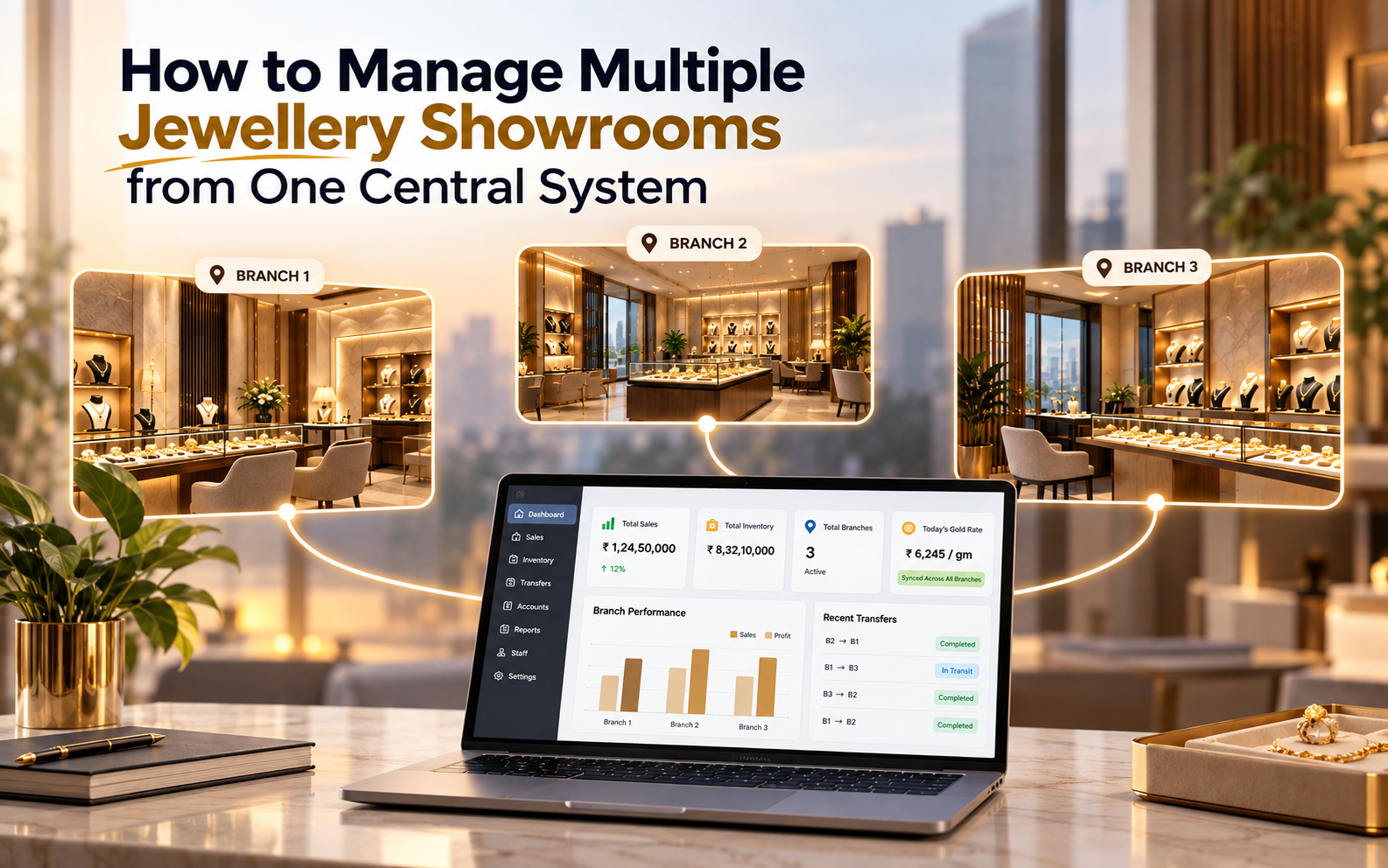
- What is our fine weight position across every branch right now?
- What does every karigar owe us, and what do we owe them?
- Can we pull a full audit trail for any transaction from the last twelve months?
- Is GST split correctly across metal, making and stone on every invoice?
- Does our physical stock match book stock without waiting for a manual audit?
- Are discount and price override limits enforced by the system, or by memory?
If more than one of these is hard to answer quickly, the risk is not theoretical. It is already inside the business.
Frequently Asked Questions
What is jewellery inventory management?
It is the process of tracking every piece of gold, diamond and finished jewellery by weight, purity, stone details and value, from purchase to sale. It also means controlling the price, tax and fraud risks that come with that stock.
How do jewellers track gold stock by weight and purity?
Each piece is tagged with a barcode or RFID that links its gross weight, net weight, purity and stone data. Jewellery inventory software then converts this into fine weight and reconciles it against the metal ledger daily.
What are the biggest risks in a jewellery business?
The highest impact risks are gold price movement, stock loss or theft, weight and wastage errors, GST mistakes, and employee fraud through unauthorised discounts or fake returns.
How often should a jewellery shop audit its stock?
High value counters benefit from daily scan based checks, with a full physical audit at least monthly. Jewellery management software with scan based audits makes frequent counts practical.
Is HUID mandatory for gold jewellery in India?
Yes. Six digit HUID hallmarking has been mandatory for gold jewellery sold in notified districts since April 2023. Each piece carries a unique HUID that can be verified.
Can generic accounting software manage jewellery inventory?
Only partly. It can record sales, but it cannot natively track fine weight, purity, karigar balances, girvi or schemes on one ledger. That is why growing showrooms move to jewellery shop software built for the trade.
Conclusion
Good jewellery inventory management comes down to one principle. A business carrying commodity price risk, purity and weight risk, and financial transaction risk needs one system built for all three, not three tools stitched together after the fact. The 19 risks above are not equally likely, but each one is preventable when controls are in place before the loss, not after.
See how JewelBiz handles your own store's numbers. Write to info@slatebiz.com, call +91 92573 73668, or visit slatebiz.com to book a walkthrough.