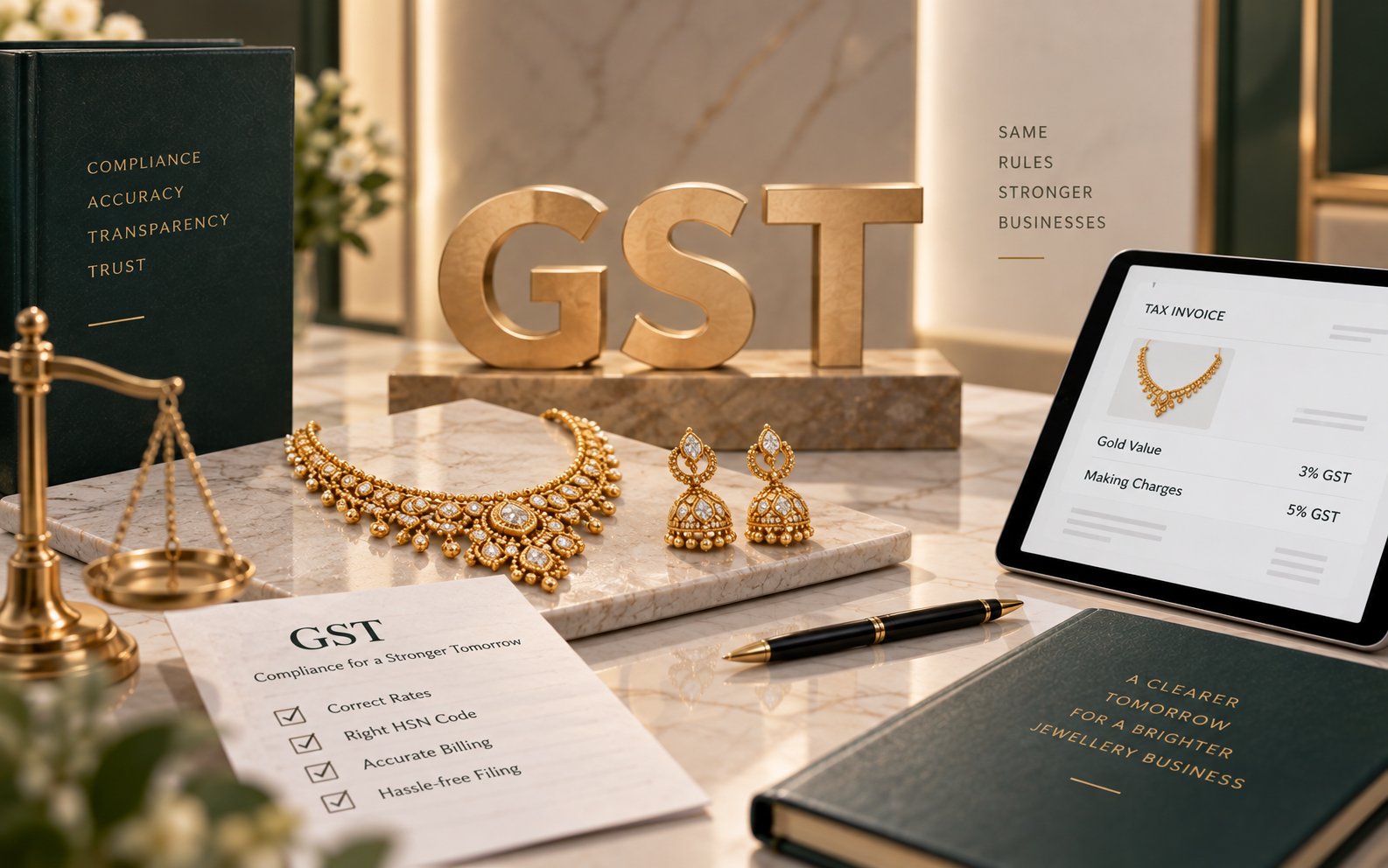
The short answer first, since it's the one most people are actually looking for: the GST rate on gold jewellery is 3 percent on the value of the gold itself, plus a separate 5 percent on making charges. That structure hasn't changed since GST was introduced in 2017, and it stayed exactly the same through the September 2025 GST 2.0 reform that reshaped tax slabs across most other categories.
Gold was deliberately left untouched. Everything below covers what that actually means on an invoice, the HSN code it falls under, and where jewellers most often get the calculation wrong.
The rate, in one table
| Component | GST rate | Split (intra state) |
|---|---|---|
| Gold value (metal) | 3% | 1.5% CGST + 1.5% SGST |
| Making charges | 5% | 2.5% CGST + 2.5% SGST |
| Inter state sale | Same rates | Charged as IGST instead |
| Imitation or artificial jewellery | 18% | Standard slab, not the gold rate |
This applies uniformly across 18K, 22K, and 24K gold, and across jewellery, coins, and bars. Purity doesn't change the rate, it changes the value the rate applies to. There is no compensation cess on gold or gold jewellery.
A worked example
A customer buys a gold necklace. The gold itself is valued at sixty thousand rupees, and the making charges come to six thousand rupees.
- GST on the gold value: 3% of ₹60,000 = ₹1,800
- GST on making charges: 5% of ₹6,000 = ₹300
- Total GST on the invoice: ₹2,100
- Final bill: ₹60,000 + ₹6,000 + ₹2,100 = ₹68,100
The two components are taxed separately and shown as separate lines, not combined into a single blended rate. That distinction matters more than it looks like it should. It's the single most common source of billing disputes, and separately, the single most common thing that goes wrong when GST filings get reconstructed after the fact instead of captured this way at the point of billing. Our guide to jewellery billing software covers what the counter needs to get this split right on every invoice.
Jewellery HSN code: what actually applies
Gold, silver, and diamond jewellery are classified under HSN code 7113. This is the jewellery HSN code that governs GST filing for most showroom products, and getting it right matters directly for GSTR accuracy. Studded pieces, plain gold, and mixed metal items aren't always classified identically within that chapter, so the exact subcode is worth confirming against current CBIC notifications for each specific product line rather than assumed to be uniform across the whole catalogue.
Imitation and artificial jewellery falls outside 7113 entirely and is taxed at the standard 18% slab. That's why a showroom selling both real and imitation pieces needs its billing system to apply the correct rate automatically based on the item, not a single default rate applied to everything. A wrong HSN code on even a small share of invoices compounds across a filing period into a mismatch that's far more tedious to trace back than it would have been to get right at the point of sale.
Old gold exchange: what actually gets taxed

An individual handing over old jewellery to a registered jeweller isn't making a taxable supply, nothing is charged to the customer on that side of the transaction. Where it gets more involved is the exchange itself. When a customer trades old gold toward a new purchase, GST is generally calculated on the value addition, the new gold plus making charges, rather than on the full value of the new piece. That treatment applies provided the exchange is documented that way on the invoice. Get that documentation wrong and the tax authority has grounds to question the whole transaction, not just the exchange portion.
Second hand gold purchased from an unregistered individual has a separate treatment again, GST can be paid only on the margin under the relevant CGST rule, and input tax credit isn't available under that scheme.
Why this specific structure trips up jewellery businesses
Two rates on one invoice, correct HSN classification, a different rule for exchanges, and a third treatment for second hand gold, that's four different tax logics sitting inside what looks to a customer like a single bill. Handled manually, or on billing software that treats GST as one flat percentage, this is exactly where mismatches enter a GSTR filing. None of the individual rules are complicated on their own. The difficulty is applying the right one, automatically, on every single invoice, without anyone having to remember which rule applies to which transaction. That's the gap a connected jewellery management system is built to close.
What this means at GSTR filing time
Every invoice that splits GST correctly between gold value and making charges feeds directly into GSTR-1 and GSTR-3B without needing reconstruction. Every invoice that doesn't, one that recorded a blended rate, or applied the wrong HSN code, or documented an exchange incorrectly, becomes a manual correction someone has to trace back to the original transaction before filing.
Multiply that across a full month of sales during a wedding season rush, and the gap between correct at billing and correct after the fact is the difference between a filing that takes an afternoon and one that takes a week. Our guide to jewellery ERP software covers how compliance connects to the rest of the ledger, not just the billing screen.
- Does every invoice show the gold value GST and making charge GST as two separate line items, or one combined figure?
- Is the jewellery HSN code applied automatically per item, or manually selected each time?
- Are old gold exchanges documented in a way that supports value addition treatment, or recorded as a full price sale?
- Do GSTR-1 and GSTR-3B reports pull directly from billing data, or get rebuilt separately before filing?
Frequently asked questions
Did the GST rate on gold jewellery change in 2025 or 2026?
No. The GST Council's September 2025 reform restructured slabs across most categories but deliberately left gold untouched. The rate remains 3% on gold value and 5% on making charges, exactly as it has been since 2017.
What HSN code applies to gold jewellery?
Gold, silver, and diamond jewellery fall under HSN code 7113. The exact subcode can vary by product type, plain gold, studded pieces, and mixed metal items aren't always classified identically, so it's worth confirming the specific code for each product line rather than assuming one code covers everything.
Is GST charged on the full value of a new piece when old gold is exchanged?
Generally no. When documented correctly, GST applies to the value addition, the new gold and making charges, not the full price of the new piece. Documentation is what makes this defensible, an exchange recorded incorrectly can be treated differently on review.
Can a jeweller claim input tax credit on gold purchases?
Registered jewellers can generally claim ITC on gold and job work charges, but not on gold given away as promotional gifts or sales incentives, and not under the margin scheme used for second hand gold bought from unregistered individuals.
How JewelBiz Applies This Automatically on Every Invoice
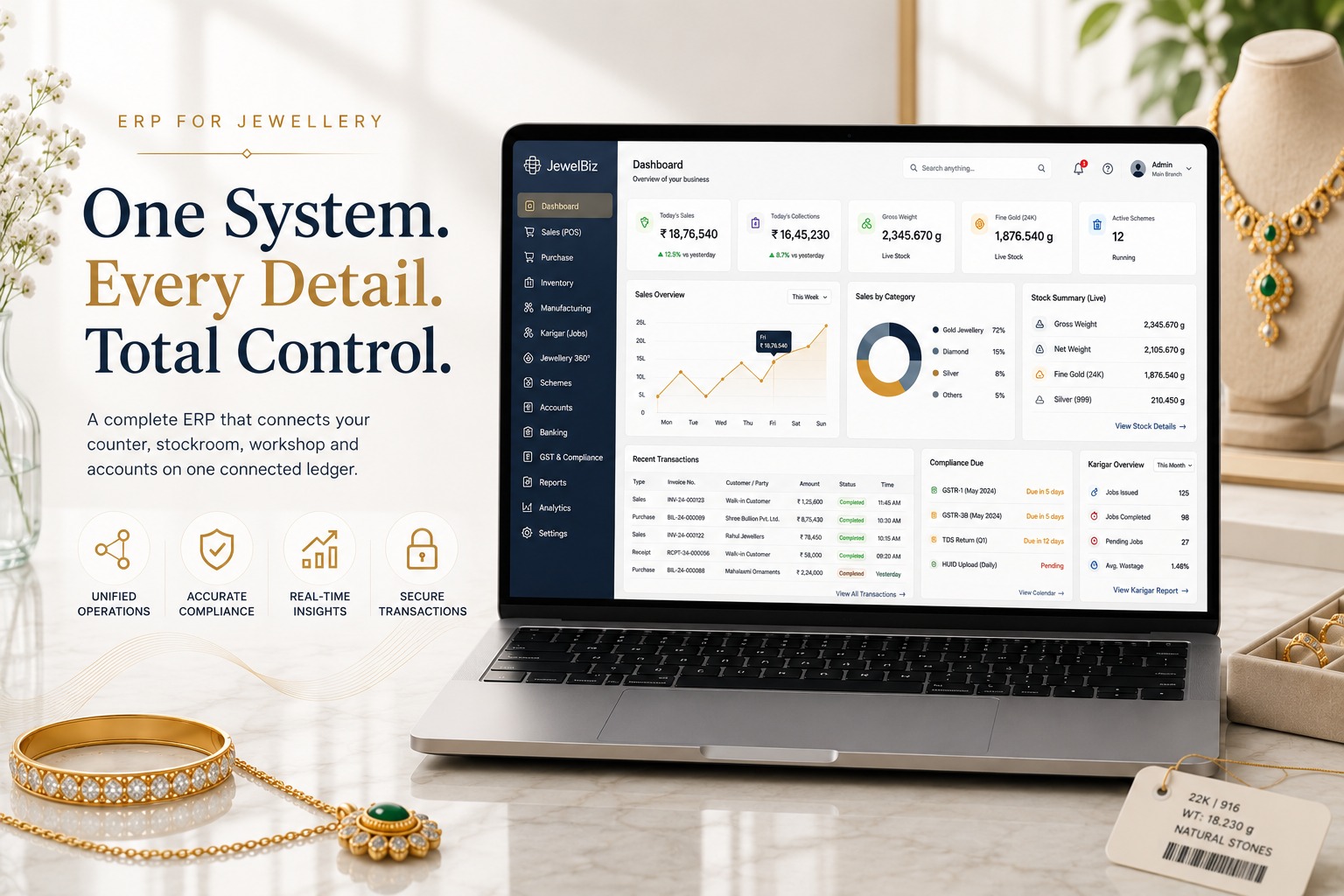
JewelBiz splits GST correctly between gold value and making charges on every bill, applies the right HSN mapping at the item level, and handles old gold exchange documentation as part of the same invoice rather than a separate manual step. GSTR-1 and GSTR-3B reports generate straight from that same billing data, so filing reflects what was actually charged rather than something reconstructed afterward. Our guide to jewellery accounting software covers how this connects to the wider ledger.
If you want to see how it handles GST on your own product mix, reach out at info@slatebiz.com or call +91 92573 73668, or visit slatebiz.com to book a walkthrough.