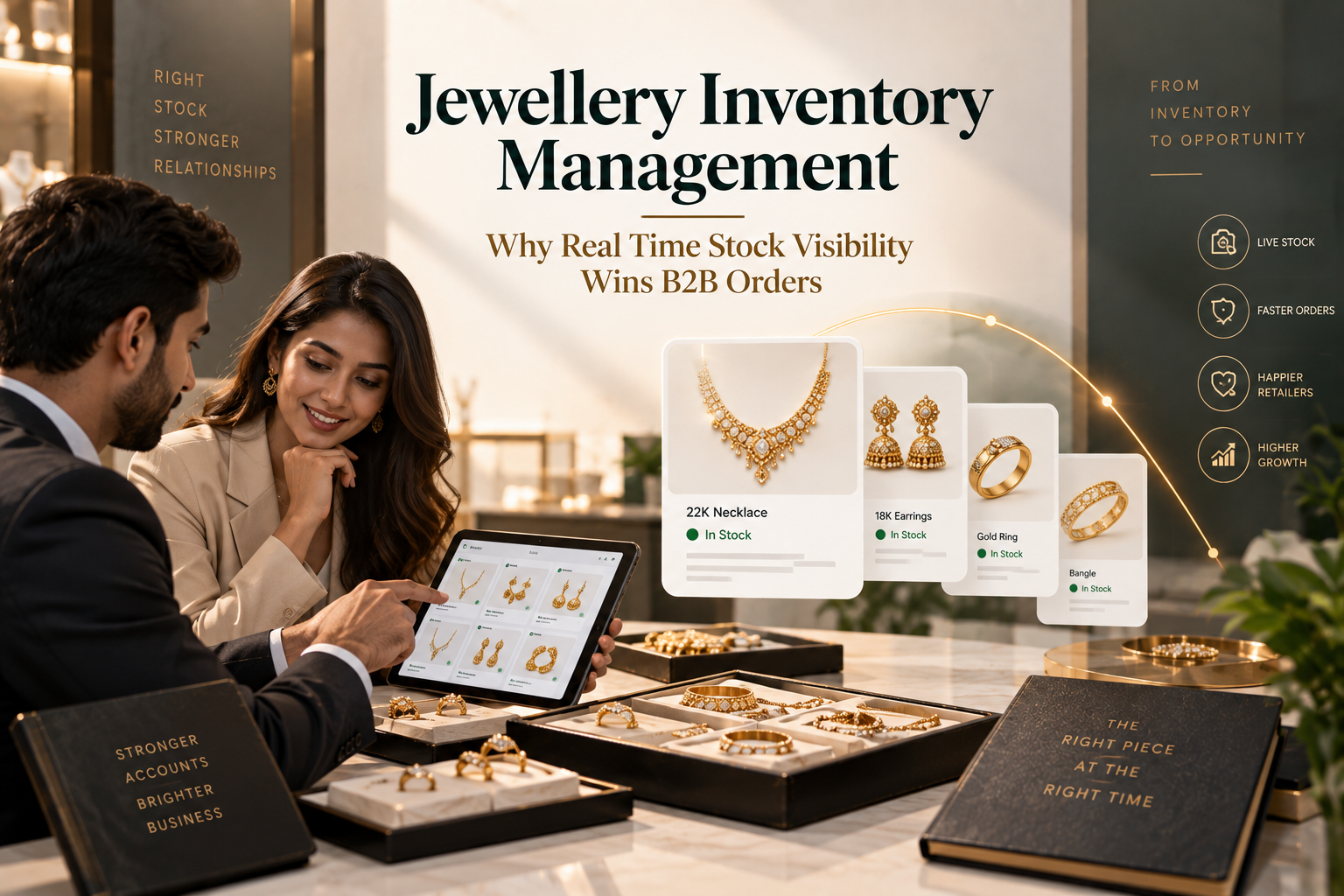
A salesperson walking into a retail showroom with a wholesale order to close is only as good as the stock information in their hand. Jewellery inventory management usually gets framed as a back office problem, counting stock, valuing it, reconciling it at month end. It's just as much a front line sales problem. A salesperson who can't see live stock ends up promising products that aren't available, quoting from a catalogue that's already out of date, or missing the cross sell sitting one shelf over.
Why inventory visibility decides whether a showroom visit converts
Every wholesale sales visit runs on the same question: what can this retailer actually buy today. Without live jewellery inventory management, that question gets answered from memory, a printed catalogue, or a phone call back to the office. Every one of those is slower than the retailer's attention span, and every one of them risks quoting a piece that already sold.
What real time inventory changes about a sales visit
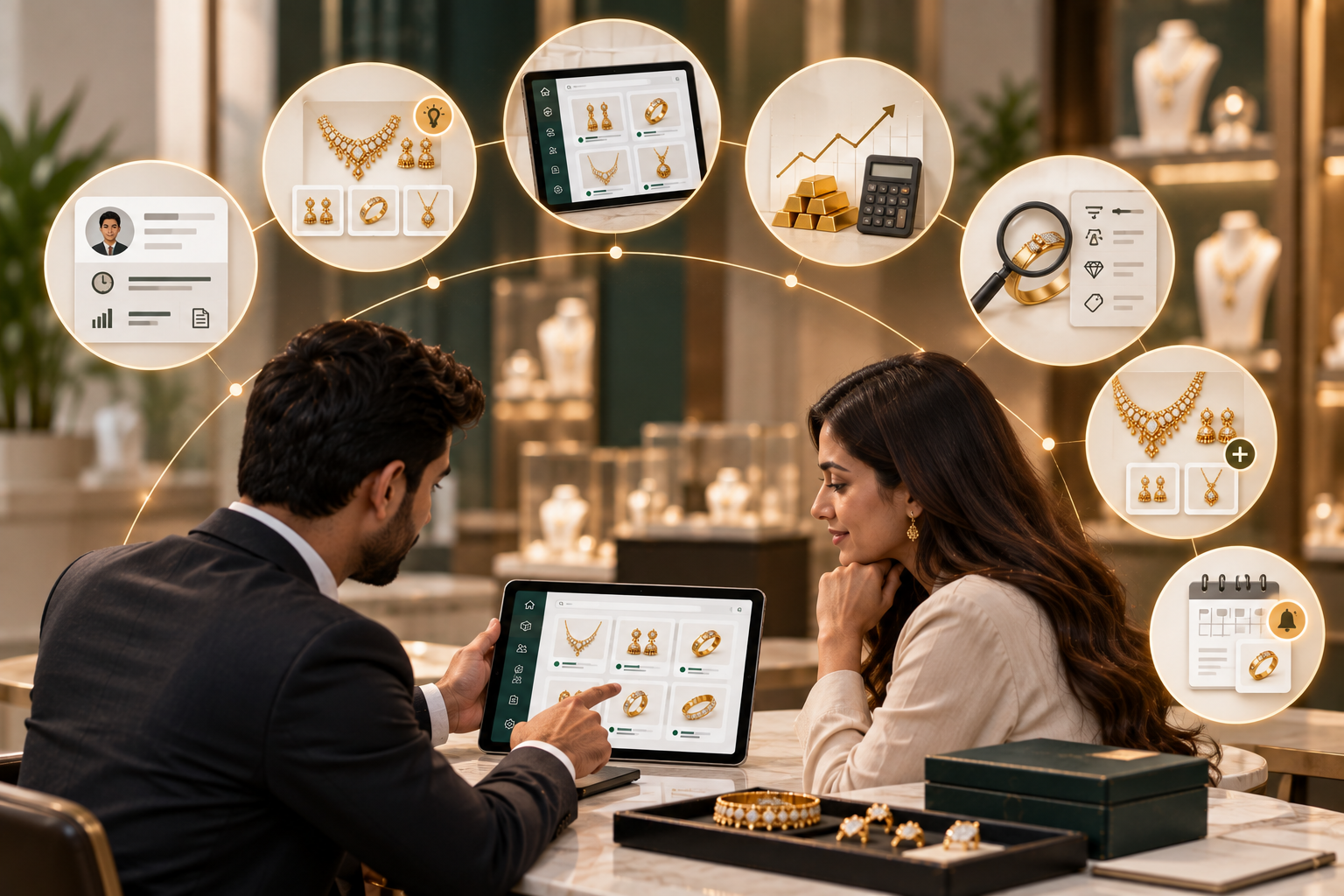
1. A complete profile behind every visit
Before walking in, a salesperson should be able to see a retailer's previous purchases, frequently bought categories, last order date, average order value, pending quotations, and outstanding payments. They should see all of that alongside what's actually available to sell them right now. Inventory data and customer history answering the same question together is what turns "what do you need?" into an actual sales plan.
2. Stock aware product recommendations
Purchase history only becomes useful when it's checked against what's in stock. A retailer who regularly buys 22K chains and rings but hasn't ordered earrings in four months is a clear opportunity. That opportunity only works if the system can also confirm which of the fifteen new earring designs are actually available to show. Jewellery inventory management done well feeds recommendations, it doesn't just record what already happened.
3. A digital catalogue tied to real stock, not a static PDF
A catalogue that shows a product's weight, making charges, stone details, GST and price is useful. One that also shows live stock availability next to each item is the difference between a salesperson creating an order on the spot and a salesperson taking a request back to the office to check.
4. Pricing that reflects current stock and rate, not last week's list
B2B pricing depends on retailer category, quantity, the day's gold or silver rate, making charges, and any customer specific agreement already in place. None of that is stable day to day, and neither is stock. Calculating price against live inventory and live rate at the same time removes the negotiation errors that come from working off a number that was already wrong by the time the conversation started.
5. Answering exactly what's in stock, not roughly
A salesperson should be able to ask something as specific as "show me every 18K ring between three and five grams currently available" and get an immediate answer. That level of granularity is what jewellery inventory management is actually for, and it's what stops a salesperson from promising a retailer something that turned out not to exist.
6. Cross selling that's grounded in what's actually available
A retailer who bought fifty necklaces last month is a natural fit for matching earrings and pendants, but only if those pieces are confirmed in stock before the suggestion gets made. A cross sell recommendation built on inventory that turns out to be empty costs more trust than it's worth.
7. Follow ups that don't depend on memory
A quotation sent today should trigger its own reminder in a few days, tied to the same stock that was quoted. If that stock moves in the meantime, the follow up should know. Chasing a quotation without checking whether the item quoted is still available is how orders fall through after the visit is already over.
What management actually needs to see
The single most useful number for evaluating whether showroom visits are working is sales per visit, not just how many showrooms got visited. A useful jewellery inventory management and sales tracking system should surface a small set of numbers clearly, not bury them in a spreadsheet someone has to build.
| KPI | What it actually shows |
|---|---|
| Showrooms visited | Raw activity |
| Product presentations | Sales effort |
| Quotations generated | Sales opportunity |
| Orders received | Conversion |
| Average order value | Sales quality |
| Repeat orders | Customer retention |
| Sales per visit | Productivity, the number that matters most |
Retailer scoring changes where inventory attention goes
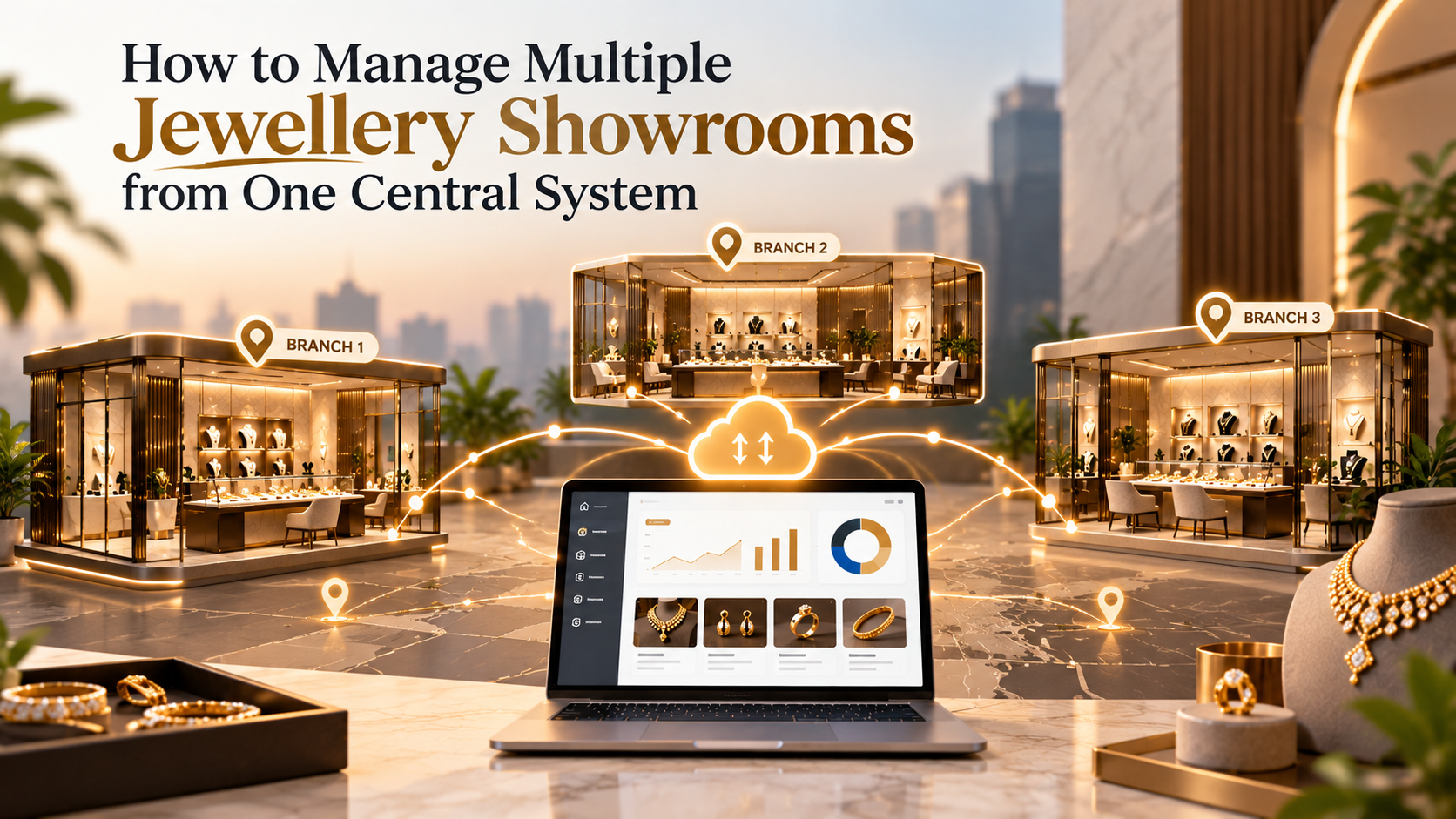
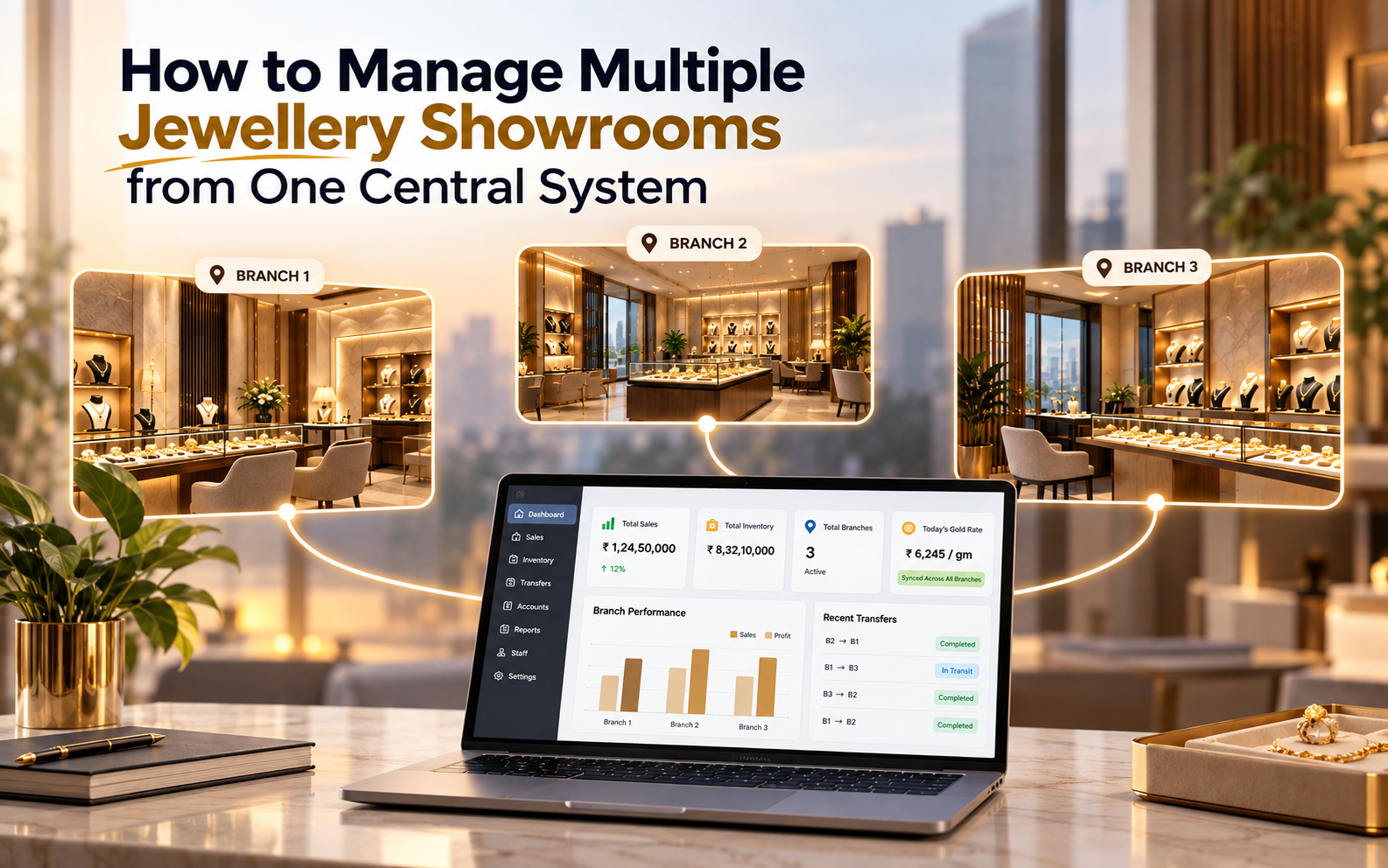
Not every retailer deserves the same stock priority. Accounts can be classified by purchase frequency and value: a high potential retailer buying often and at high value, a growing account with moderate but promising activity, a low activity account, and one that's gone quiet for several months. That classification lets a business decide which relationships get first look at new stock and which get a standard rotation. Jewellery inventory management connected to this kind of scoring means the best new pieces reach the retailers most likely to actually move them, an approach that matters just as much when those retailers are spread across multiple showroom locations.
Jewellery inventory management versus a static catalogue and spreadsheet
A printed catalogue and a stock spreadsheet updated overnight is still how a lot of wholesale selling happens. The gap shows up the moment a retailer asks for something specific, a particular weight range, a purity, an available quantity. The honest answer, too often, is "let me check and call you back." Live jewellery inventory management removes that gap, the answer is available in the same conversation the question got asked in. Our guide to jewellery ERP software covers what a complete connected system looks like beyond just stock.
What to check in a jewellery inventory management system built for sales, not just stock counts
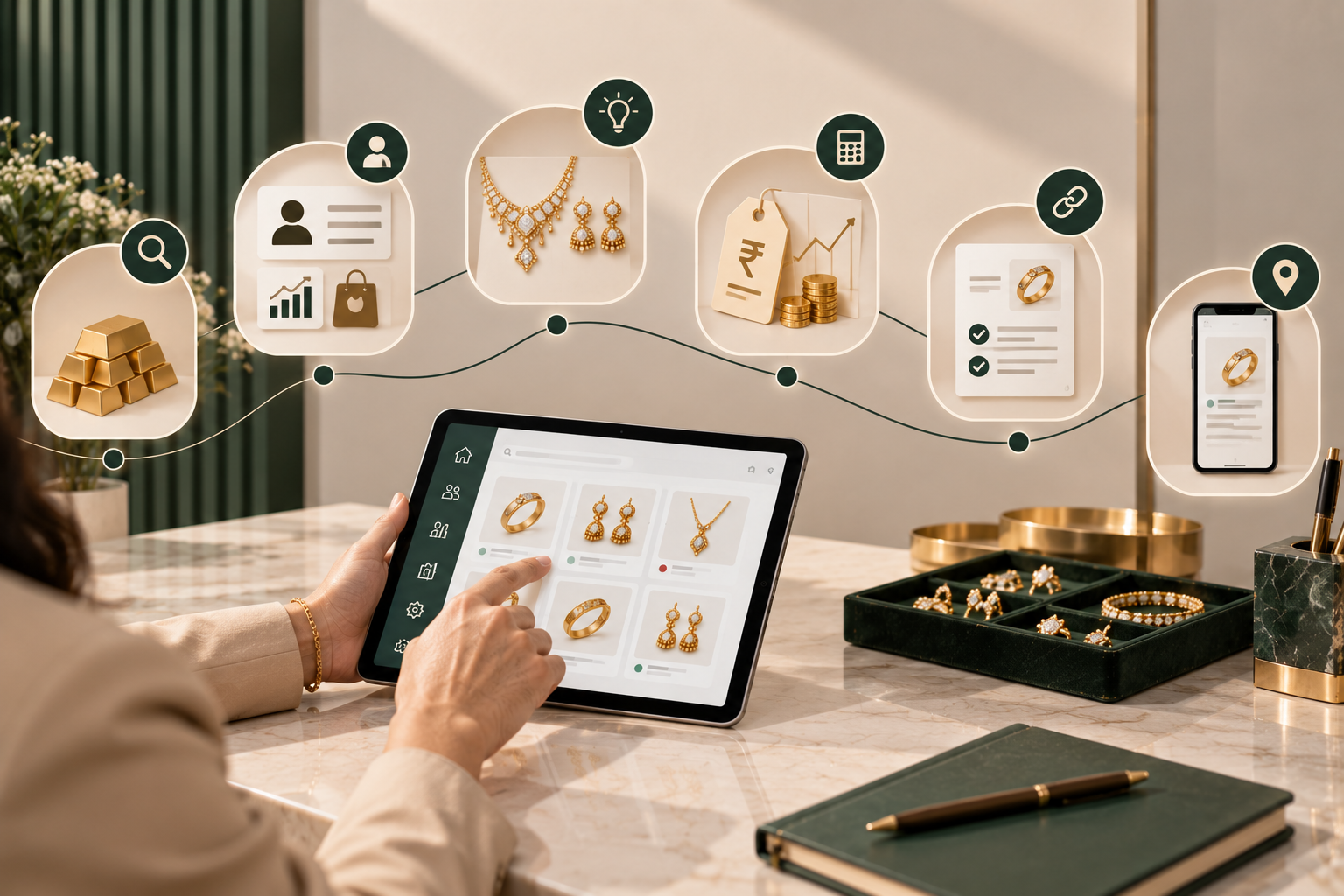
- Does it show live stock availability down to weight, purity and quantity, or a rough category level count
- Does it connect stock data to customer purchase history for recommendations, or keep the two separate
- Can a salesperson search specific criteria on the spot and get an answer immediately
- Does pricing calculate against current stock and rate together, or use a static price list
- Does a quotation stay linked to the specific stock it was quoted against
- Does it work on a mobile device in the field, not just at a desktop back at the office
Frequently asked questions
What is jewellery inventory management?
Jewellery inventory management is the tracking of stock, weight, purity, and availability across a jewellery business in real time. That accuracy matters both for internal stock control and for sales situations like a wholesale showroom visit.
How is this different from general retail inventory management?
Jewellery stock carries weight, purity, and value that changes with the daily gold or silver rate, none of which applies to typical retail SKUs. Jewellery inventory management has to track that detail at the individual item level, not just a quantity count.
Can jewellery inventory management improve B2B wholesale sales specifically?
Yes. A salesperson visiting a retail showroom who can check live stock, quote accurate pricing, and confirm availability on the spot has a real edge. That salesperson converts more of those visits into actual orders than one working from a printed catalogue and a memory of what might still be in stock.
Does jewellery inventory management connect to billing and accounting?
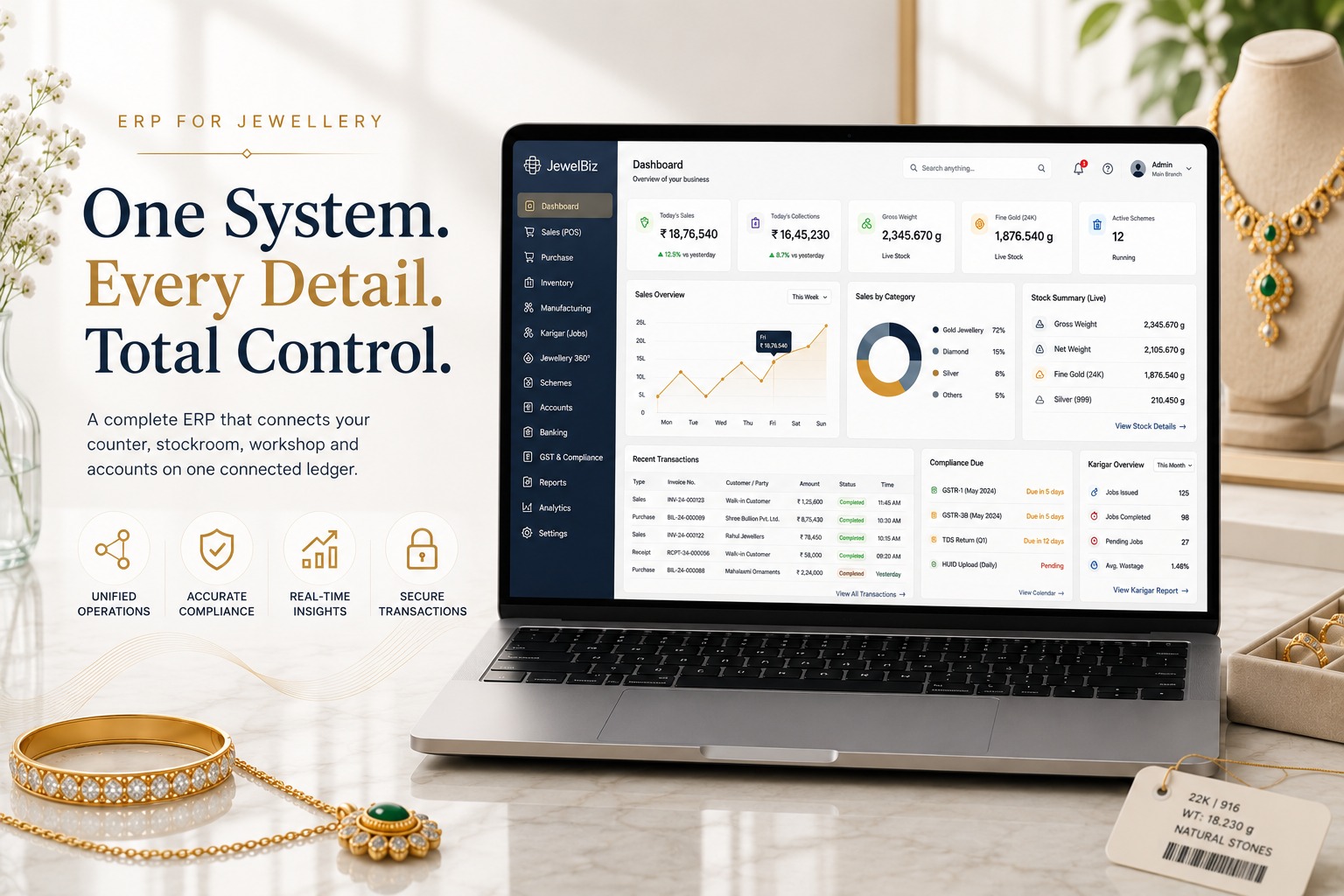
In a complete system, yes. Stock, billing and accounting should sit on the same ledger so a sale updates inventory immediately rather than requiring a separate reconciliation step later. Our guides to jewellery billing software and jewellery accounting software cover those connected pieces in more depth, and our guide to a jewellery management system shows what that connected day looks like from open to close.
See live stock data built into every sales conversation
JewelBiz tracks stock by weight, purity and quantity in real time, connected to the same ledger as billing, accounting and customer history. A salesperson checking availability during a showroom visit is looking at the same data the back office sees. If you want to see how it handles your own stock and customer data, reach out at info@slatebiz.com or call +91 92573 73668, or visit slatebiz.com to book a walkthrough.