
Every piece on a showroom floor was purchased before it was ever sold, and that purchase carries its own compliance weight, GST treatment, and cost detail long before a customer walks in. A jewellery business buys from registered dealers, unregistered local sources, and karigars, sometimes all three in the same week, and each one is taxed and recorded differently. Purchase is the module that keeps all of that straight from the moment metal enters the business.
Purchase Entry: Registered and Unregistered, Captured Accurately
A registered dealer purchase and an unregistered local purchase are not the same transaction under GST, and treating them identically at entry is where filing errors start. Purchase entry captures both correctly from the start, dealer details, invoice reference, and the registration status that determines how the rest of the transaction gets taxed. That same piece eventually moves through the counter covered in our guide to jewellery billing software, so getting the entry right here is what keeps the whole chain accurate later.
Purchase Return: A Debit Note That Keeps the Supplier Ledger Clean
Returning stock to a supplier needs its own document, not a note buried inside the original purchase entry. A proper debit note adjusts the supplier ledger correctly and keeps that account reconciled. A return six months from now does not require reconstructing what actually happened from memory or a phone call to the supplier.
Direct Expenses on Purchase: Freight and Landed Cost
The price on a supplier invoice is rarely the full cost of getting metal into the business. Freight, handling, and related charges all add to what a piece actually cost. Folding those into the landed metal value, rather than treating them as a separate, disconnected expense, is what makes margin calculations later actually accurate.
TDS on Purchases: Withheld Correctly, Without Guesswork
Tax deducted at source applies to certain jewellery purchase transactions. Getting the threshold, the rate, and the deduction timing right matters both for compliance and for the supplier relationship, since an incorrect deduction is something a supplier will notice immediately. TDS on purchases applies withholding automatically where jewellery purchase compliance requires it, rather than depending on someone remembering the current threshold and rate at the moment of entry.
This is a genuinely common point of confusion across Indian business generally, not just jewellery. Exactly which purchases trigger TDS, at what rate, and above what value, changes with notifications and is not always intuitive from the invoice alone. Getting it automated at the point of purchase entry removes that guesswork rather than leaving it to be corrected at return filing.
Reverse Charge Mechanism: Liability That Shifts to the Buyer
Under reverse charge, GST liability shifts from the seller to the buyer for specific transaction types, most commonly certain unregistered purchases. This is one of the more misunderstood areas of GST compliance across most industries. Business owners frequently miss that they, not the supplier, owe the tax on qualifying purchases, and discover the gap only when a mismatch surfaces at filing time.
Reverse charge mechanism handling auto applies RCM liability specifically on unregistered purchases, calculating what the business owes as the buyer at the point of entry rather than requiring a separate manual calculation reconstructed later. Getting this automated removes one of the most common sources of GST notices for growing jewellery businesses that increasingly buy from a mix of registered and unregistered sources.
Piece-wise Purchase Tracking: Intake by the Piece, Not Just the Batch
Bulk weight tells you how much metal came in. It does not tell you which specific piece, at which purity, came from which purchase. Piece-wise purchase tracking follows intake at the individual item level. A specific piece's origin, purity, and cost basis stay traceable all the way through to when it eventually sells, not just as an average buried inside a larger batch figure.
Our guide to jewellery inventory management covers what that same item level tracking looks like once the piece is on the shelf.
Capital Goods Purchase: Kept Separate From Trading Stock
Equipment, fixtures, and other capital purchases follow different accounting and GST treatment than jewellery bought to resell, different depreciation rules, different input tax credit treatment. Recording capital purchases in their own category from the start avoids the mess of separating them out from trading stock later, usually at year end when it is hardest to reconstruct accurately.
Purchase-Sale Linkage: Connecting What Came In to What Went Out
A purchase and the eventual sale of that same metal are two halves of one story, and keeping them connected is what makes real costing possible. Purchase-sale linkage ties the two together. Margin on a specific piece or design can be calculated against what it actually cost, not an estimated or average cost that may not reflect that particular purchase.
Why These Eight Sit Together as One Module
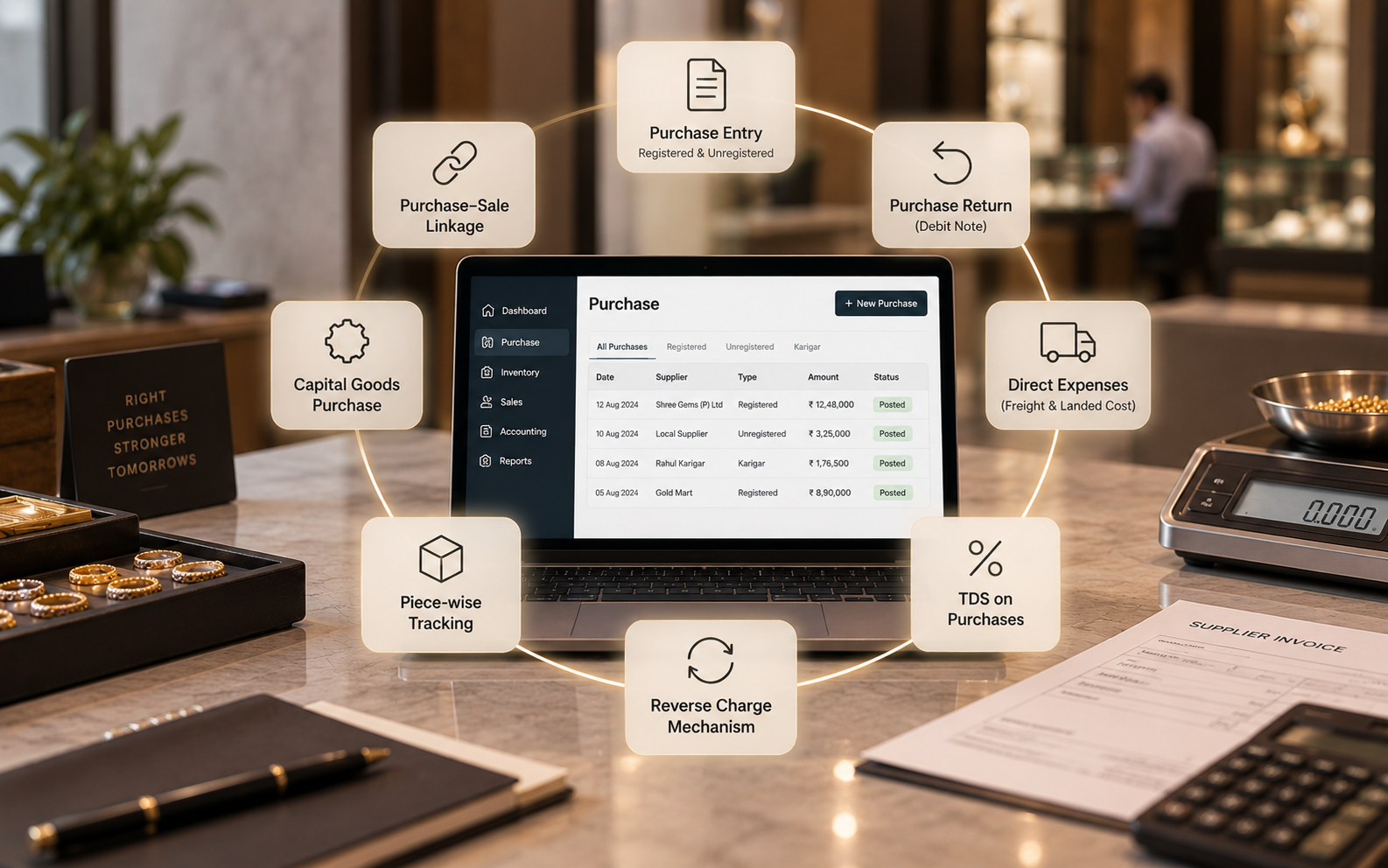
A single incoming shipment can touch five or six of these at once. A mixed registered and unregistered purchase, freight added to the landed cost, TDS withheld on part of it, reverse charge liability on the unregistered portion, and every piece tagged individually the moment it is tracked, all in one delivery. Handled as eight disconnected steps, this is where compliance gaps and costing errors both start.
Our guide to jewellery accounting software covers how purchase data flows into the wider ledger. Our guide to the GST rate on gold jewellery covers the tax side of what happens once that same metal is eventually sold. And our guide to a jewellery management system walks through how a purchase like this fits into one full connected day rather than a series of separate steps.
Frequently Asked Questions
What is the difference between a registered and unregistered purchase for GST purposes?
A registered dealer purchase follows standard input tax credit treatment. An unregistered purchase often triggers reverse charge liability, where the buyer, not the seller, owes the GST on that transaction. The two need to be tracked distinctly from the moment of entry.
Does TDS apply to every jewellery purchase?
No, TDS applies above certain thresholds and to certain transaction types, and the specific rules change with notifications over time. This is exactly why applying it automatically at entry, rather than manually judging it case by case, matters.
How does reverse charge mechanism actually work for an unregistered purchase?
Under RCM, the buyer calculates and pays GST directly on qualifying purchases, rather than the supplier charging it. That liability needs to be captured at the point of purchase, not reconstructed later, since it is the buyer's obligation to report, not something an unregistered supplier's invoice will show.
Why does capital goods purchase need separate treatment from trading stock?
Capital goods follow different depreciation and input tax credit rules than jewellery purchased for resale. Mixing the two at entry means separating them out manually later, typically at year end, which is exactly when it is hardest to do accurately.
What does purchase-sale linkage actually enable?
It connects a specific purchase to the specific sale of that same metal, so margin can be calculated against actual cost rather than an average. Our guide to jewellery ERP software covers how this connects purchase, inventory, and sales on one ledger.
See Purchase Connected to Your Full Ledger
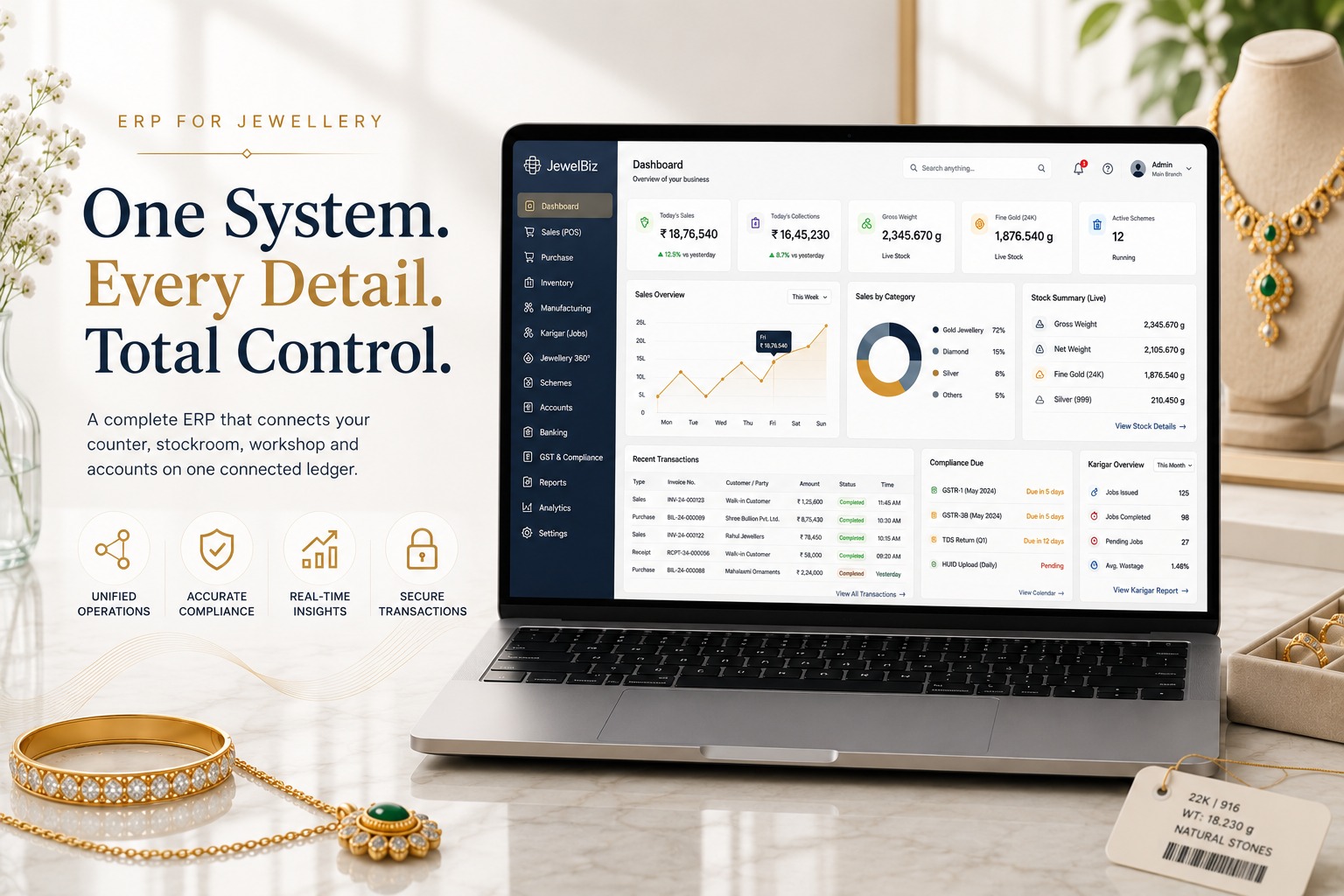
JewelBiz's Purchase module captures registered and unregistered purchases correctly from entry, applies TDS and reverse charge automatically where they apply, and tracks intake piece by piece. Capital goods stay separate from trading stock, and everything connects to the same ledger as sales, inventory, and accounting. If you want to see how it handles your own supplier mix, reach out at info@slatebiz.com or call +91 92573 73668, or visit slatebiz.com to book a walkthrough.