Hospital management software has moved from a nice to have IT project to the single biggest lever for revenue, compliance, and patient experience in Indian healthcare. Most hospitals still run on a patchwork of paper registers, standalone billing tools, and legacy desktop software. Patient records sit in one system, pharmacy stock in another, the accountant has a third, and nobody has a single view of what happened yesterday.
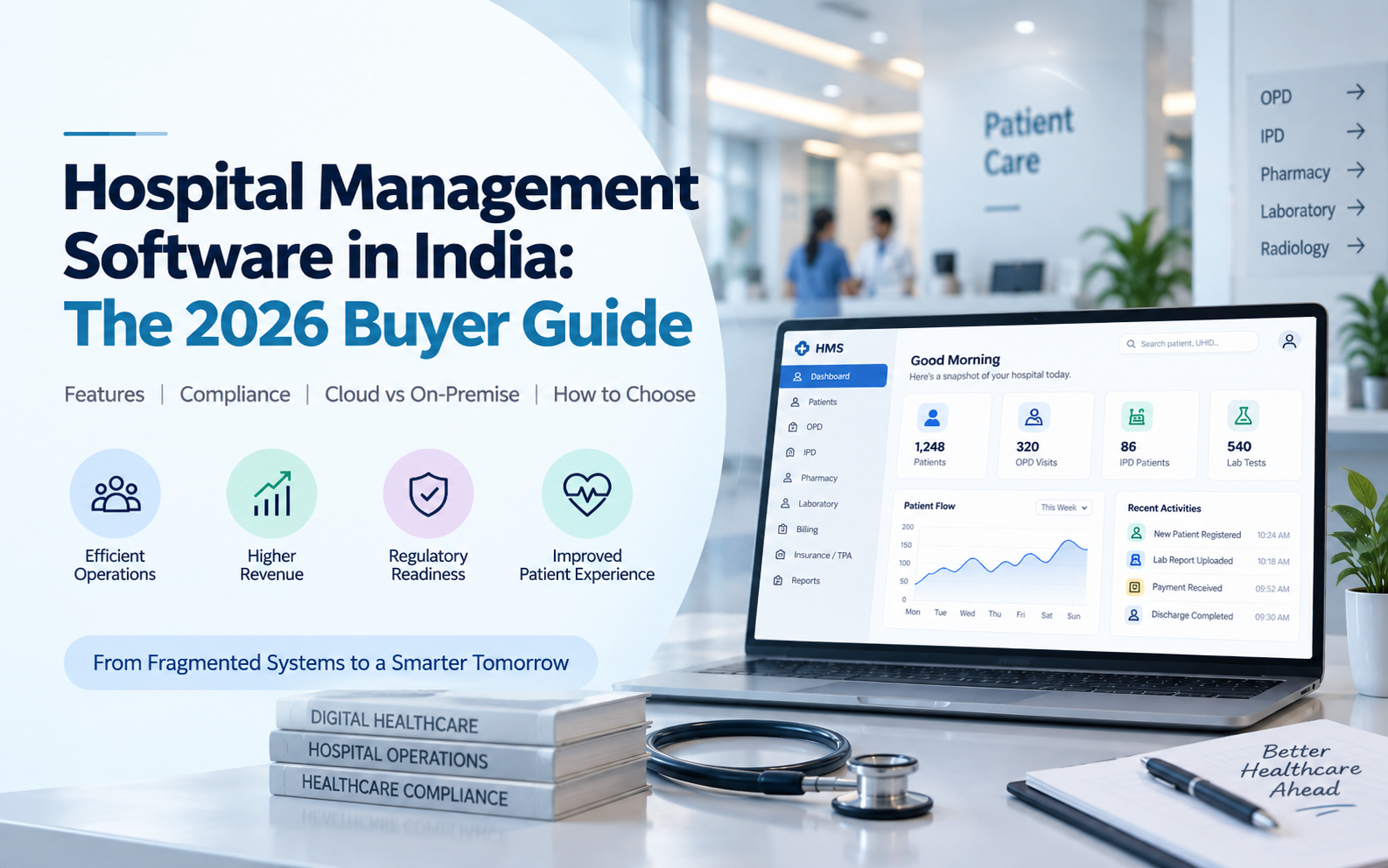
A modern hospital management system, often abbreviated as HMS, replaces that mess. It puts patient registration, OPD, IPD, pharmacy, laboratory, billing, and reporting on one platform so the front desk, the doctor, the pharmacist, and the finance team all work from the same live data.
This guide covers what an HMS actually does, the modules that matter, how cloud deployment compares to on premise, why ABDM and NABH readiness now shape every buying decision, and a checklist to use when you evaluate vendors.
What Is Hospital Management Software
Hospital management software, also called a hospital management system or HMS, is an integrated platform that manages every clinical, operational, and financial workflow inside a healthcare facility. It replaces the fragmented mix of registers, spreadsheets, and disconnected tools that most Indian hospitals rely on today. A well built HMS covers the full patient journey from first appointment to final discharge, and gives management a live dashboard of what is happening across the facility.
The category is sometimes called hospital ERP software because it behaves like an enterprise resource planning system built for healthcare. Unlike a generic ERP, a purpose built HMS understands OPD queues, IPD ward allocation, drug dispensing, insurance TPA workflows, immunisation schedules, and the compliance requirements Indian hospitals face.
Why Indian Hospitals Are Modernising Now
Revenue leakage from manual billing
Mid sized Indian hospitals consistently lose 3 to 8 percent of monthly revenue to unbilled procedures, missed pharmacy charges, and unreconciled insurance claims. A well configured HMS captures every charge automatically as it happens at the ward, the pharmacy, and the lab, then rolls everything into the final bill before discharge.
The ABDM and ABHA mandate
The Ayushman Bharat Digital Mission has moved from optional to expected. Hospitals that want to empanel with public schemes, participate in insurance networks, or simply meet patient expectations need software that supports ABHA, links health records to a national ID, and shares encounter data securely. Legacy desktop tools built in the 2010s cannot do this without expensive rework.
Patient experience is the new differentiator
Patients now compare hospitals the way they compare hotels. Online appointment booking, WhatsApp reminders, digital prescriptions on the phone, and a proper patient portal are no longer luxuries. They are the reason a patient chooses one clinic over another.
Core Modules Every Hospital Management System Should Cover
A serious HMS is built as connected modules that share one database. If any module is bolted on from a third party tool, the integrated view breaks. Insist on the following as standard.

Patient Registration and UHID
Register a new patient in under a minute with demographics, medical history, allergies, and insurance details. Every patient gets a unique hospital ID that persists across visits and departments. Support for pediatric growth charts for children under two and automatic immunisation reminders should come standard, which is why specialised platforms like CuraBiz ship these workflows out of the box.
Electronic Health Records
The EHR module is the digital patient file. It holds diagnosis history, visit history, past treatments, uploaded reports, and vital signs. The real test is speed. Pulling up a returning patient with three years of history should feel instant, not take five to eight minutes as older systems often do. Platforms built on Java and Oracle can handle 70,000 to 80,000 records in seconds, which matters in a busy OPD.
Doctor Consultation and e Prescription
Doctors are the hardest users to win over. A good consultation module gives every doctor a personalised list of favourite drugs and lab tests, a one click way to copy the previous prescription, and a follow up scheduler. The e prescription should generate a clean PDF and be shareable over WhatsApp or SMS in the same click.
OPD, IPD, and Day Care Management
Outpatient and inpatient workflows cover token queues, consultation notes, admission, ward and ICU bed allocation, nursing notes, daily vitals, medication charts, discharge summaries, visitor register, and ambulance dispatch. Day care procedures need their own workflow because they are neither pure OPD nor full IPD.
Pharmacy and Laboratory
The pharmacy module should receive prescriptions directly from the doctor, check stock in real time, dispense against the patient bill, and raise low stock alerts. The lab module should let doctors order tests without paper, upload results back into the patient record, and make previous investigations visible during the next consultation.
Billing, Insurance, and TPA
Billing is where hospitals make or lose money. The system should handle OPD and IPD billing, split payors, process cash, card, UPI, and net banking, manage insurance and TPA settlements, and auto post journal entries. GST slabs should apply automatically with GSTR 1 and GSTR 3B reports ready on demand.
Reporting, Communication, and Security
Live dashboards for revenue, patient visits, doctor performance, disease trends, and ward occupancy should be built in, not sold as an add on. SMS, WhatsApp, and email must be native features. Every user needs a personal login, role based permissions, encrypted data storage, complete audit logs, and automatic daily backups.
Cloud Based HMS vs On Premise vs Hybrid
The old debate is largely settled for new deployments, but the trade offs still matter for larger facilities with strong internal IT teams. The table below summarises how the three models compare on the criteria that decide most buying calls.
| Criterion | Cloud | On Premise | Hybrid |
|---|---|---|---|
| Upfront cost | Low | High | Medium |
| Deployment time | 1 to 4 weeks | 2 to 4 months | 6 to 10 weeks |
| IT staff needed | None | Dedicated team | Small team |
| Updates and patches | Automatic | Manual | Mixed |
| Data control | Vendor hosted | Full local control | Split |
| Best fit | Clinics, polyclinics, small to mid hospitals | Large multi specialty with in house IT | Chains with mixed connectivity |
The most flexible platforms support all three models and run across Windows, Mac, and Linux, so the hospital is not locked into a single hardware vendor. CuraBiz, for example, deploys on cloud, LAN, WAN, or private cloud depending on facility size and internet reliability.
ABDM, ABHA, and NABH Compliance
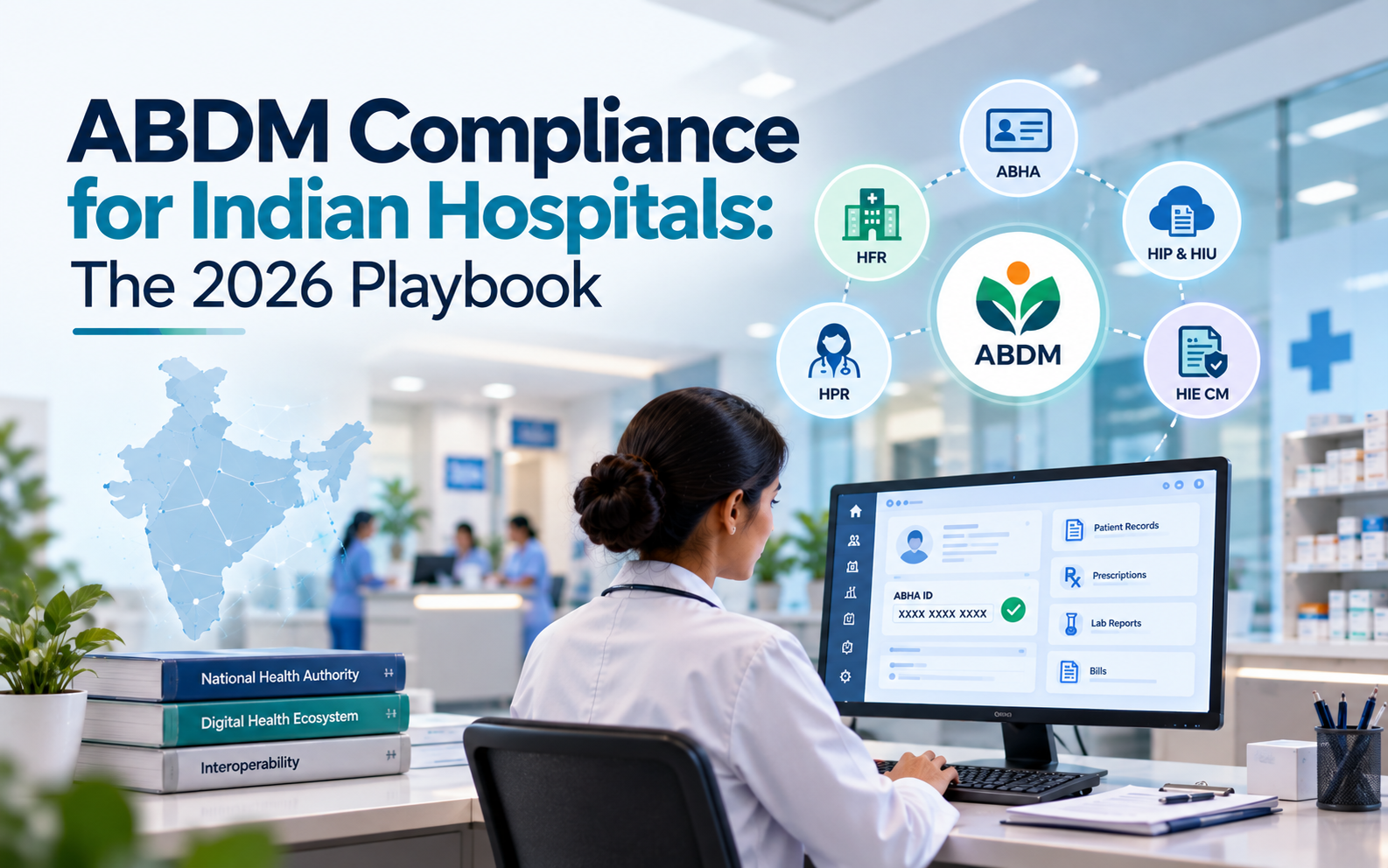
Compliance is where many older systems fall short. Any ABDM compliant HMS must link patient records to ABHA numbers, share encounter data through the national health exchange, and use standardised APIs. During evaluation, ask the vendor to demonstrate a live ABHA lookup and a consent based health record fetch. If they hedge, keep looking.
For hospitals pursuing NABH accreditation, the software must document patient consent, timestamp every clinical action, maintain audit trails, and generate the reports NABH assessors ask for. A well designed NABH ready HMS cuts the accreditation workload from months to weeks.
How to Choose the Right Hospital Management Software
Use this checklist during vendor evaluation. Any vendor who cannot answer these clearly should not make your shortlist.
- Integrated modules on a single database, not a patchwork of connected tools
- Real performance benchmarks with production sized data, not empty demo databases
- ABDM and ABHA readiness with a live demo, not marketing slides
- Cross platform access on Windows, Mac, and Linux
- Role based access control with granular permissions and full audit logs
- GST and financial reporting including GSTR 1, GSTR 3B, P and L, and Balance Sheet
- Pharmacy and lab flows that pass data automatically, without retyping
- WhatsApp, SMS, and email built in as standard features
- Deployment options across cloud, private cloud, LAN, and WAN
- Onboarding support with a dedicated implementation manager
- Continuous updates included in the subscription, not billed as change requests
- Local Indian support with response times specified in the contract
Frequently Asked Questions
What is the cost of hospital management software in India
Cloud based subscriptions for small clinics typically start around 15,000 to 30,000 rupees per year. Mid sized hospitals see annual costs of 1 to 5 lakh rupees. Multi specialty hospitals with 100 plus beds usually invest 8 to 20 lakh rupees in the first year including implementation.
How long does implementation take
A single clinic can go live in one to two weeks. A polyclinic takes three to six weeks. A full hospital with pharmacy, lab, IPD, and insurance integration typically takes eight to twelve weeks including data migration and staff training.
Is cloud based HMS safe for patient data
Yes, when the provider hosts on Indian data centres, uses strong encryption for data in transit and at rest, maintains audit logs, and complies with ABDM data protection standards. In practice, cloud deployments are often safer than an on premise server sitting in an unlocked hospital room.
Is hospital management software mandatory in India
There is no blanket mandate, but effectively yes for any hospital that wants to empanel with government insurance schemes, pursue NABH accreditation, or issue ABHA linked records. The regulatory direction is one way, and hospitals that delay will face rushed migrations later.
Can HMS integrate with medical devices and third party systems
A well built HMS integrates with lab analysers, radiology PACS, patient monitors, payment gateways, insurance TPA portals, and accounting tools through standard APIs. Ask for the integration list during evaluation and confirm any critical integration works in the pilot.
What is the difference between EHR, EMR, and HMS
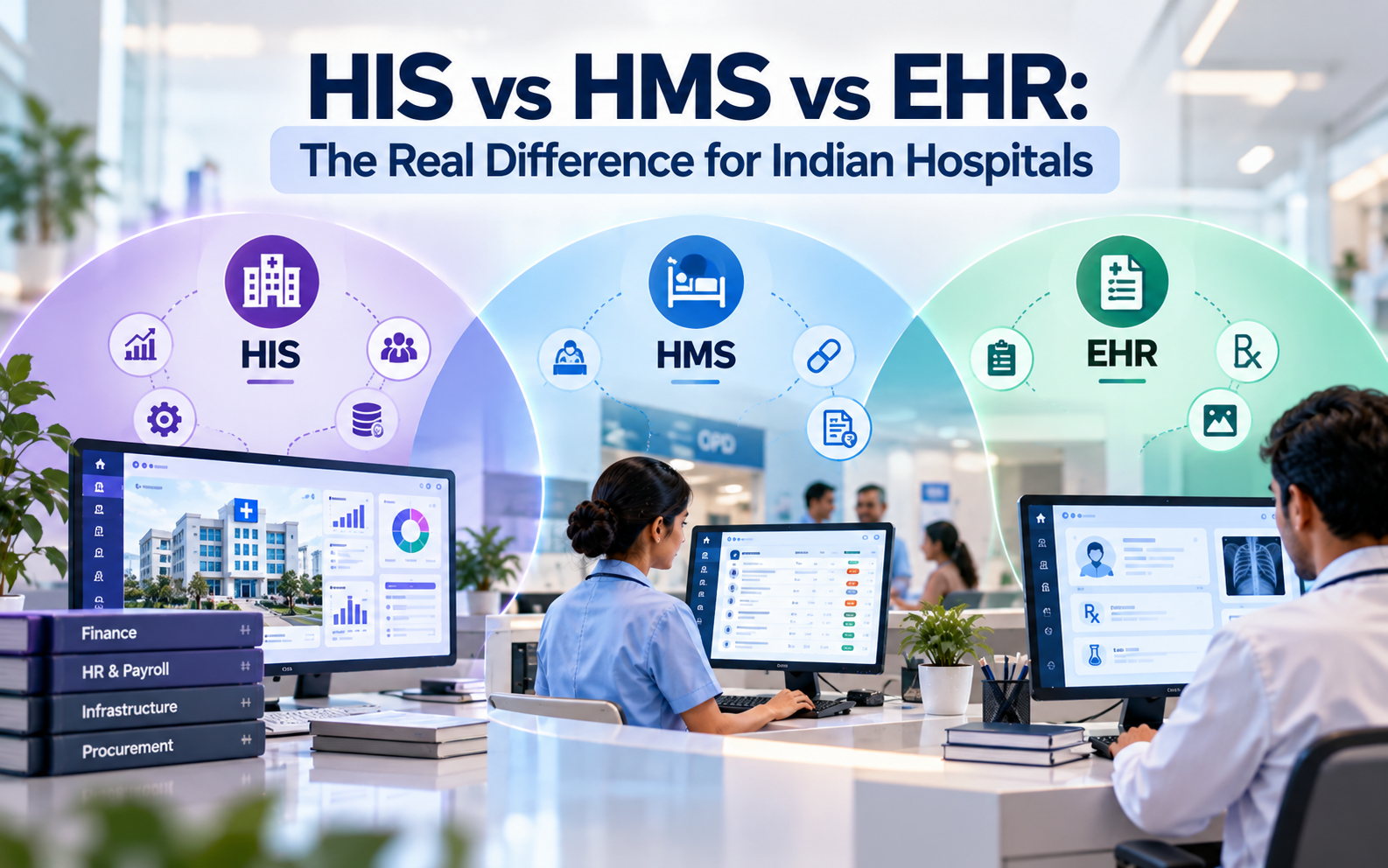
EMR is the electronic version of a single clinic patient chart. EHR is a broader digital record that can be shared across providers. HMS is the full hospital operating system that includes EHR, EMR, billing, pharmacy, lab, and every other workflow. A hospital needs an HMS.
Getting Started
Choosing hospital management software is a five to ten year decision. The platform you pick shapes how your staff works, how patients experience your facility, and how quickly you can respond to regulatory change. The right choice pays for itself in the first year through reduced revenue leakage, faster patient throughput, and lower administrative overhead.
SlateBiz builds CuraBiz, a unified healthcare management platform for Indian hospitals, clinics, polyclinics, and specialty practices. CuraBiz covers every module in this guide on a single database, is built on Java and Oracle for enterprise grade performance, supports ABDM and ABHA workflows, ships with pediatric growth charts and a Panchkarma scheduler for specialty practices, and deploys across cloud, LAN, or WAN.
Reach out at info@slatebiz.com or call +91 92573 73668, or visit slatebiz.com to book a walkthrough.