This is not a pitch deck. It is a category by category breakdown of what it actually costs to run a 50 bed multi specialty hospital in India in 2026, based on operating benchmarks from Tier 1 and Tier 2 city facilities.
If you are a hospital CFO planning the next fiscal, a promoter evaluating a new location, or an administrator justifying a technology budget to the board, this piece gives you the numerical anchors you need.
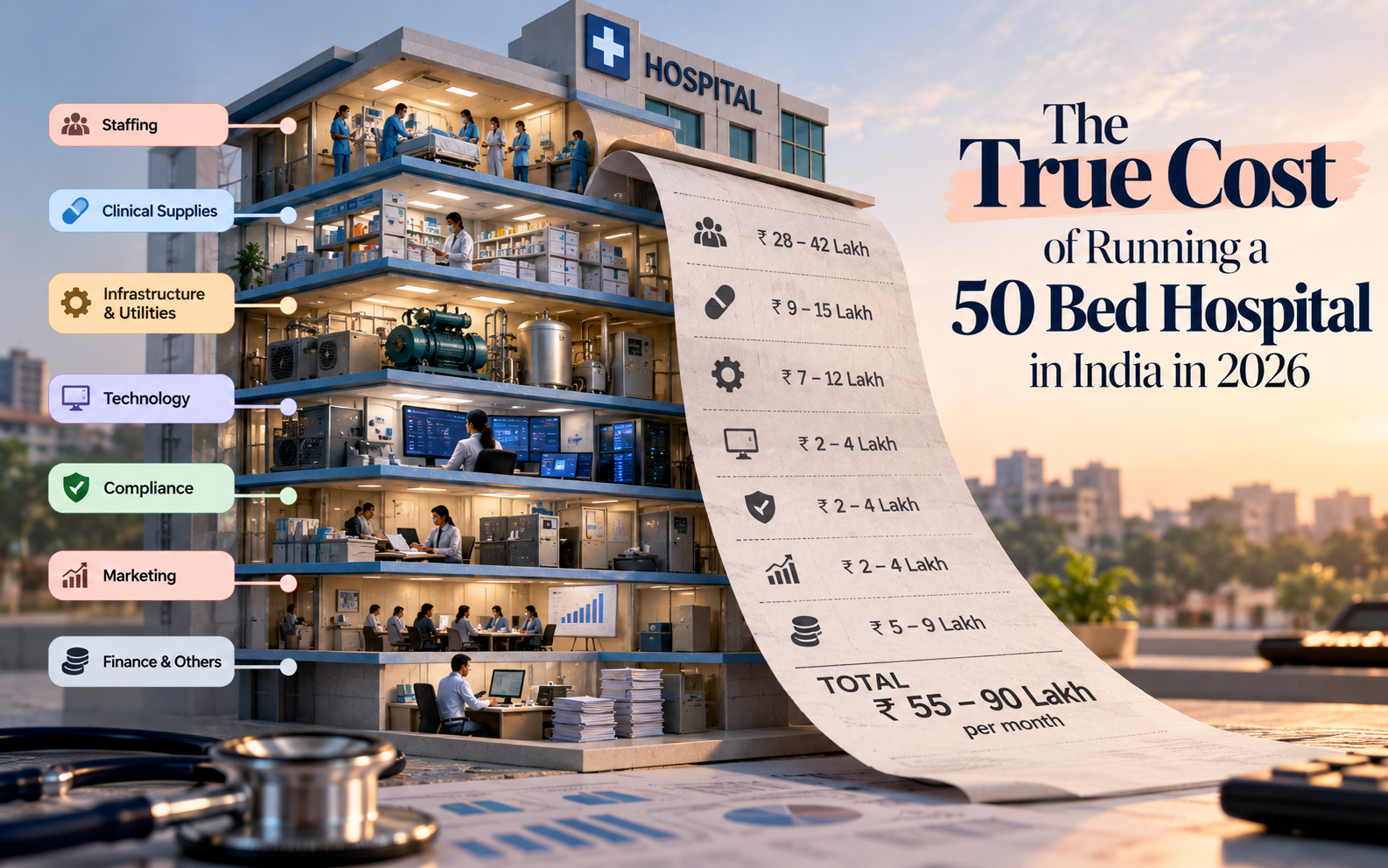
The short answer: a 50 bed multi specialty hospital in India costs 55 to 90 lakh rupees per month to operate, translating to roughly 6.5 to 11 crore rupees per year. The range is wide because it depends on city tier, specialty mix, ownership model, and how much of the operation is digital.
This guide breaks the number down category by category, calls out the hidden line items most CFOs miss in year one, and shows the specific cost centres where the right technology stack shifts the ratio.
The 30 Second Answer: Monthly Cost Snapshot
A representative 50 bed multi specialty hospital operating in a Tier 2 city with 60 to 70 percent occupancy. Numbers are indicative and vary with city, specialty mix, and staffing structure.
| Category | Monthly Cost | Share of Total |
|---|---|---|
| Staffing (clinical, nursing, admin, support) | 28 to 42 lakh | 46 to 50% |
| Direct clinical supplies and consumables | 9 to 15 lakh | 15 to 18% |
| Infrastructure, utilities, rent or EMI | 7 to 12 lakh | 12 to 14% |
| Technology, software, hardware | 2 to 4 lakh | 3 to 5% |
| Compliance, regulatory, insurance admin | 2 to 4 lakh | 3 to 5% |
| Marketing, patient acquisition, referrals | 2 to 4 lakh | 3 to 5% |
| Interest, depreciation, provisions | 5 to 9 lakh | 8 to 11% |
| Total Monthly | 55 to 90 lakh | 100% |
| Total Annual | 6.5 to 11 crore |
Staffing: The Line That Consumes Half the Budget
Staffing is the single largest cost centre in any Indian hospital, absorbing 46 to 50 percent of monthly operating expense. A 50 bed facility running proper 24 by 7 clinical cover needs roughly the following headcount and monthly cost.
Clinical Staff
- 4 to 6 in house consultants across core specialties (medicine, surgery, gynaecology, paediatrics, anaesthesia): 8 to 14 lakh per month combined
- 6 to 10 visiting consultants on per case or retainer basis: 3 to 6 lakh per month
- 2 to 3 resident medical officers for 24 by 7 emergency and ward cover: 2 to 3.5 lakh per month
Nursing and Paramedical Staff
- 18 to 22 nurses across three shifts, with a nurse to bed ratio of roughly 1 to 3 for general beds and 1 to 1 for ICU: 5 to 7 lakh per month
- 4 to 6 lab and imaging technicians: 1.5 to 2.5 lakh per month
- 2 to 3 pharmacists across shifts: 60,000 to 1 lakh per month
- 2 to 3 physiotherapists and rehabilitation staff: 60,000 to 1 lakh per month
Administrative and Support Staff
- 8 to 12 front desk, billing, and back office staff: 2 to 3 lakh per month
- 12 to 16 housekeeping and ward attendants: 1.5 to 2 lakh per month
- 4 to 6 security personnel: 80,000 to 1.2 lakh per month
- 2 to 3 biomedical and IT support staff: 60,000 to 1 lakh per month
Note: Beyond salaries, add 12 to 15 percent for PF, ESIC, gratuity provisions, and health insurance. Add another 3 to 5 percent for annual increments already built into the monthly run rate.
Direct Clinical Supplies: 15 to 18 Percent of Cost
This category covers medicines dispensed to patients, consumables like syringes and sutures, lab reagents, radiology contrast media, medical gases, and disposables. For a 50 bed hospital running 60 to 70 percent occupancy, this line runs 9 to 15 lakh per month depending on specialty mix.
The variance inside this category is where most Indian hospitals silently lose 8 to 15 percent of their pharmacy revenue every month to operational leakage. Ward medicines that never make it to patient bills, expiry write offs from poor batch tracking, and duplicate dispensing account for most of it.
The six pharmacy loopholes covered separately show exactly where the money goes and how to close each leak.
Infrastructure and Utilities: The Unavoidable 12 to 14 Percent
Rent or EMI is the largest sub line here. A 50 bed hospital typically occupies 20,000 to 30,000 square feet of built up space. In a Tier 1 city that is 4 to 8 lakh per month in rent or equivalent EMI. In a Tier 2 city, 2 to 4 lakh.
- Power with backup generator and UPS: 1.5 to 2.5 lakh per month
- Water including reverse osmosis for dialysis and lab use: 40,000 to 80,000 per month
- Medical gases (oxygen, nitrous oxide, compressed air): 60,000 to 1.2 lakh per month
- Biomedical waste management under Central Pollution Control Board norms: 40,000 to 80,000 per month
- Equipment maintenance contracts (AMC) for critical biomedical equipment: 80,000 to 1.5 lakh per month averaged
- Housekeeping supplies, laundry, and linen: 60,000 to 1 lakh per month
Utilities are relatively fixed and do not scale down with occupancy, which is why running a 50 bed hospital at 50 percent occupancy versus 70 percent occupancy changes the per bed economics dramatically.
Technology and Software: The Cheapest Line That Moves the Most Levers
Technology is one of the smallest cost centres at 3 to 5 percent of monthly operating expense, but it is the line that most directly affects every other line. Right sized technology reduces staffing overhead, closes pharmacy leakage, cuts compliance workload, and shortens the revenue cycle.
Undersized or fragmented technology quietly amplifies costs across the entire operation.
Software and Platforms
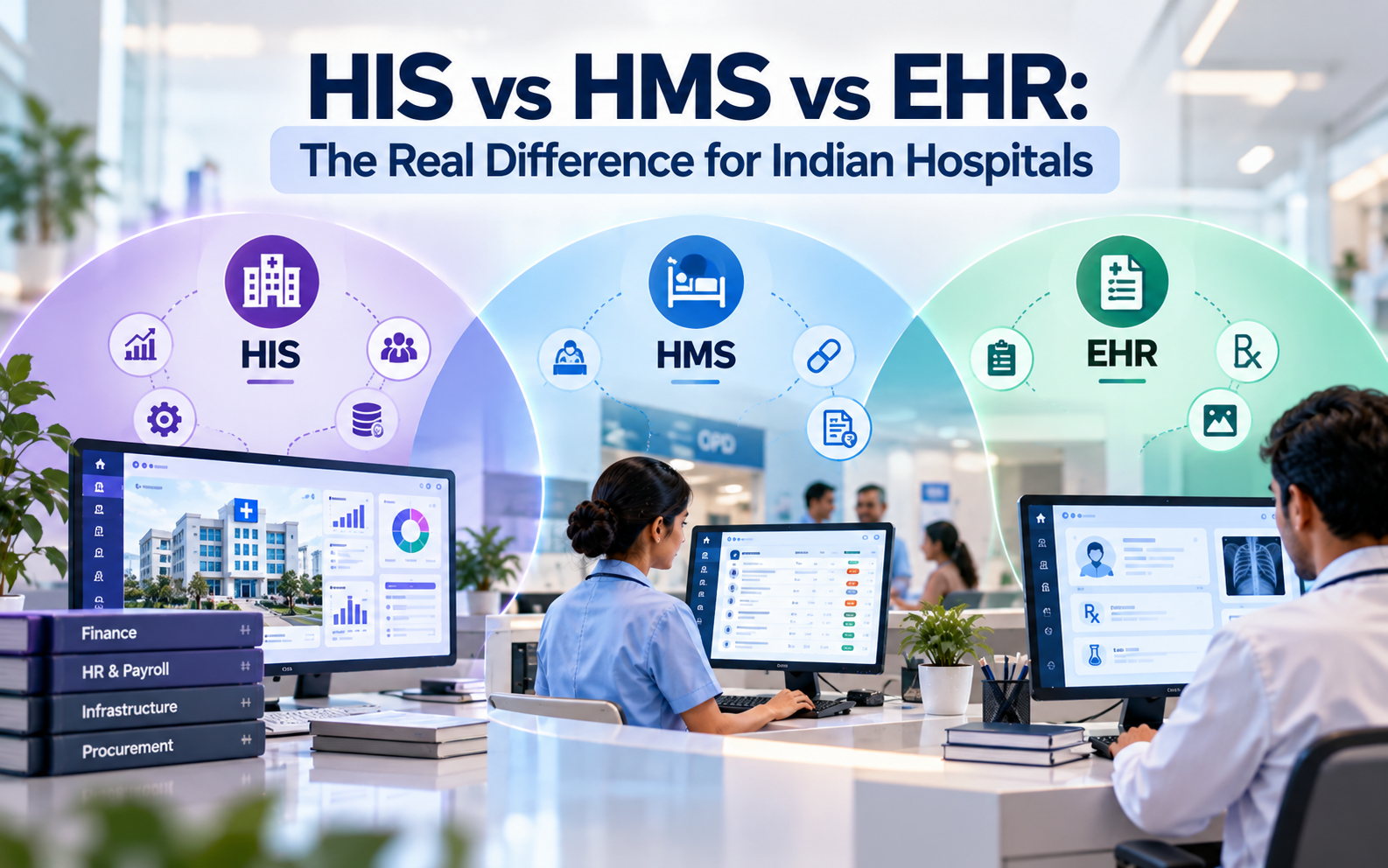
Modern platforms bundle the EHR software module inside the wider HMS at no extra line item, which is what the cost ranges below assume.
- Hospital management platform with EHR, pharmacy, lab, and billing modules: 30,000 to 1.5 lakh per month depending on user count and deployment
- ABDM readiness and FHIR R4 support (often included in modern platforms, else 20,000 to 60,000 incremental per month)
- Accounting and payroll: 20,000 to 40,000 per month if separate from HMS
- Communication tools (WhatsApp Business API, SMS gateway, email): 15,000 to 30,000 per month
- Backup, security, and monitoring services: 20,000 to 40,000 per month
Hardware and Network
- Workstations, tablets, printers, POS terminals: 30,000 to 60,000 per month averaged as depreciation and refresh
- Server infrastructure or cloud hosting: 40,000 to 1 lakh per month
- Internet with primary and backup connections: 15,000 to 30,000 per month
- Network switches, wifi access points, and cabling maintenance: 15,000 to 30,000 per month
A serious hospital management platform that ships with EHR, pharmacy, lab, billing, ABDM, and WhatsApp integration on a single database delivers most of these capabilities at the lower end of the ranges above.
Platforms like CuraBiz that are built on Java and Oracle with SHA 512 password hashing, Apache Shiro session security, and OWASP hardening also remove the need for separate security, backup, and monitoring services in most deployments.
Compliance and Regulatory: The Invisible 3 to 5 Percent
Every hospital in India runs under a stack of regulatory obligations that translate into direct and indirect costs. For a 50 bed multi specialty hospital, the monthly compliance overhead runs 2 to 4 lakh.
- Statutory filings (GST, TDS, PF, ESIC, professional tax): 30,000 to 60,000 per month including CA retainer
- Fire safety, pollution control, biomedical waste, and radiation licenses: 20,000 to 40,000 per month averaged as annual renewal cost
- Insurance and TPA reconciliation admin (accounts, follow ups, rejections): 40,000 to 1 lakh per month
- NABH accreditation preparation or renewal (averaged from three yearly cycle): 30,000 to 60,000 per month
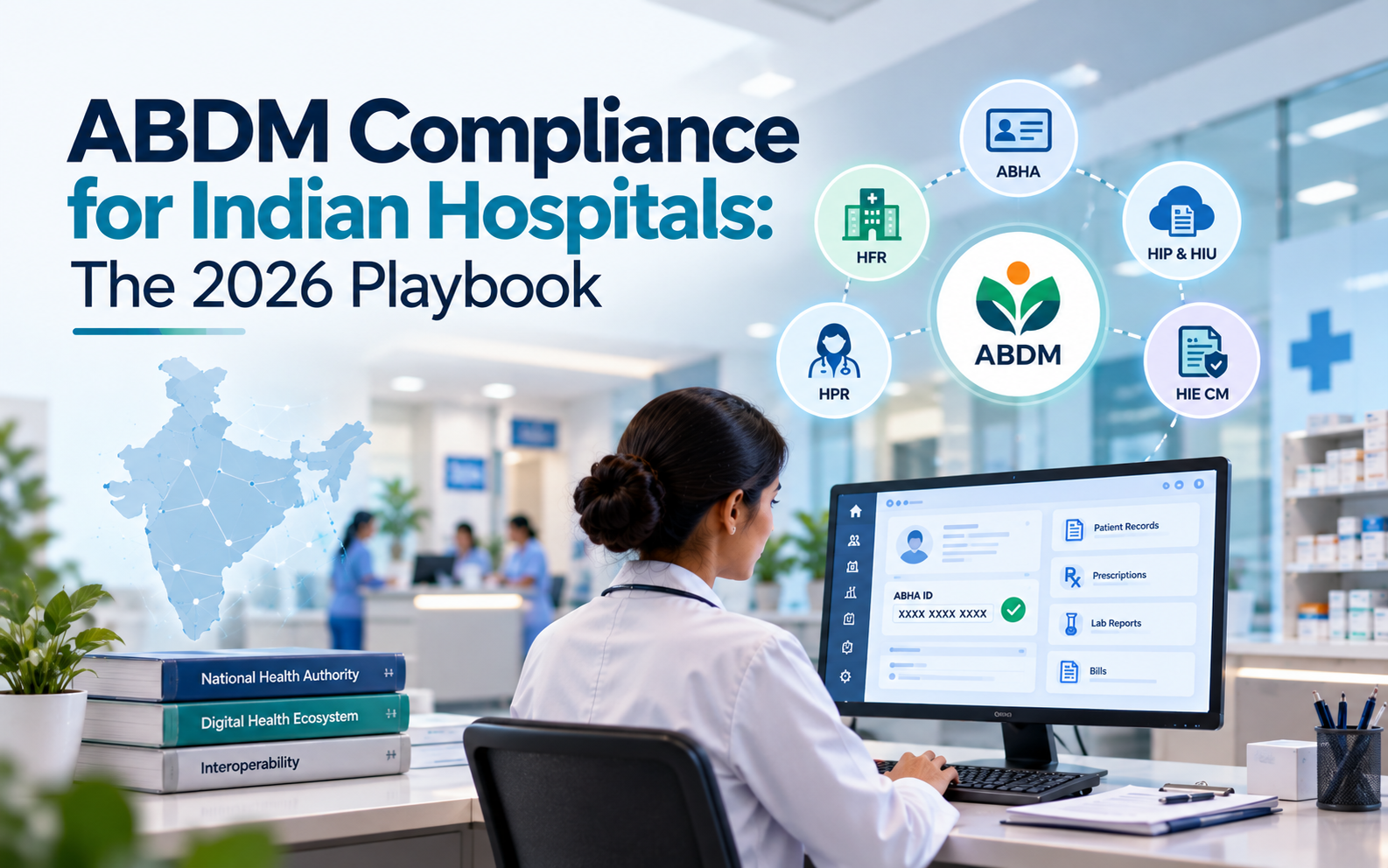
- ABDM compliance including HFR, HPR, HIP registration, and ongoing maintenance: 20,000 to 40,000 per month
- Drug store compliance under CDSCO norms including batch traceability: 15,000 to 30,000 per month
Compliance costs are often invisible in year one because most hospitals absorb them into administrative overhead. They become visible at renewal or during an audit.
NABH accreditation preparation for a first time facility can consume 8 to 15 lakh spread over 12 to 18 months. ABDM compliance through M3 costs an average mid sized Indian hospital 3 to 6 lakh total when the underlying platform already supports the milestones.
The 5 Hidden Costs That Blow the Budget
The categories above account for the visible operating cost. The hidden costs are what silently push a 50 bed hospital from 65 lakh a month toward 90 lakh a month, and they rarely show up on the standard P and L until they have already happened.
1. Pharmacy Revenue Leakage
Between 8 and 15 percent of monthly pharmacy revenue vanishes to unbilled ward medicines, expiry write offs, and cash sale under reporting. For a 50 bed hospital with a pharmacy turning over 25 to 40 lakh per month, that is 2 to 6 lakh per month walking out the door.
2. Insurance and TPA Claim Delays
Rejected or delayed claims tie up working capital. Indian hospital receivables from insurers and TPAs typically run 60 to 120 days. For a 50 bed hospital doing 25 percent cashless business, that is 30 to 60 lakh in perpetually stuck receivables.
The cost of that working capital at 10 percent per annum is 3 to 6 lakh per year in pure interest terms, not counting the operational overhead of chasing settlements.
3. Staff Attrition
Nursing attrition alone runs 25 to 40 percent annually in Indian hospitals. Replacing one experienced nurse costs roughly 60,000 to 1.5 lakh in recruitment, onboarding, and productivity ramp. For a 20 nurse team at 30 percent attrition, that is 4 to 9 lakh per year in replacement cost, most of it invisible in the monthly run rate.
4. Revenue Leakage from Billing Errors
Missed consultation charges, unbilled procedures, and undercoded diagnostics typically leak 3 to 6 percent of monthly revenue in a paper first or fragmented billing setup. For a 50 bed hospital doing 1.5 to 2.5 crore monthly revenue, that is 5 to 15 lakh a month never invoiced.
5. Under Utilised Bed Capacity
A 50 bed hospital running at 55 percent occupancy versus 70 percent occupancy differs by roughly 15 to 25 lakh per month in gross revenue on the same fixed cost base. Occupancy is not fully controllable, but slow discharge processes, referral network gaps, and appointment friction are all fixable with the right tooling.
Where the Right Software Actually Moves the Ratio

Technology is a small line, but the compound effect on the other lines is where the real financial case lives. A well integrated hospital management platform typically shifts a 50 bed hospital's cost structure in the following ways over the first 12 months.
Pharmacy Leakage Closure
6 out of 6 loopholes closed within 90 days. Recovery of 6 to 15 lakh per month depending on prior state. This alone often pays for the full technology stack for the year.
Faster Billing and Discharge
Discharge summary time dropping from 3 to 6 hours to under 60 minutes. That translates into 8 to 15 more beds turning over per month at the same 50 bed capacity, worth 6 to 12 lakh in additional revenue.
Insurance and TPA Cycle Time
Structured records and FHIR R4 output reduce claim rejection rates by 30 to 50 percent. Receivable days can drop from 90 to 60, releasing 10 to 20 lakh of working capital.
Front Desk Productivity
Automated appointment booking, ABHA lookup, and digital consent cut front desk time per patient by 30 to 40 percent. Enables the same team to handle 20 to 30 percent more patient volume without adding headcount.
Compliance Workload
NABH documentation, ABDM record generation, and GST reporting move from month end scramble to automated background processes. Direct saving of 40 to 80 hours of administrative time per month.
Frequently Asked Questions
How does the cost change for a 100 bed or 200 bed hospital?
Costs scale non linearly. A 100 bed hospital runs 90 lakh to 1.6 crore per month. A 200 bed hospital runs 1.8 to 3.2 crore per month. Larger hospitals see per bed cost advantages on infrastructure, technology, and compliance, but staffing scales roughly linearly. The doubling of beds does not double the cost, and the ratios shift toward direct clinical costs.
What is the typical revenue for a 50 bed hospital?
A 50 bed multi specialty hospital in a Tier 2 city typically generates 1.2 to 2.5 crore in monthly revenue at 60 to 70 percent occupancy, resulting in 15 to 30 crore annual revenue. EBITDA margins run 12 to 22 percent for well managed facilities. Facilities running below 8 percent EBITDA usually have unresolved cost leakage or occupancy problems.
How much can technology actually save?
A serious hospital management platform implementation typically delivers 12 to 20 percent operating cost reduction and 15 to 25 percent revenue capture improvement inside the first 12 months for facilities that were previously on paper or fragmented tools. The savings compound because closing pharmacy leakage, tightening billing, and shortening discharge all reinforce each other.
What is the minimum viable software stack for a 50 bed hospital?
A modern hospital management platform with EHR, pharmacy, lab, IPD, billing, ABDM readiness, and WhatsApp integration on a single database. Everything else can be built on top of that foundation. Fragmented tools per department add cost without adding capability.
How much should a hospital budget for NABH accreditation?
First time NABH accreditation preparation for a 50 bed hospital costs 8 to 15 lakh spread over 12 to 18 months, including consultant fees, documentation work, staff training, and process changes. Renewal every three years costs 3 to 6 lakh. Facilities with strong existing digital infrastructure spend at the lower end of both ranges.
Is it cheaper to run a hospital in a Tier 2 city than in a Tier 1 city?
Yes, by roughly 20 to 30 percent on total operating cost. Rent, staff salaries, and utilities are all lower. Revenue per patient is also lower, so margins compress but often not proportionally. Tier 2 and Tier 3 hospitals typically show better return on invested capital because upfront infrastructure investment is significantly lower.
The Financial Case for Getting the Foundation Right
Running a 50 bed hospital in India is a business with fixed costs that rarely go down and variable costs that quietly go up if left unmanaged. The financial case for the right technology foundation is not that it reduces the technology line. It is that it changes the ratios everywhere else.
A well integrated hospital management platform pays for itself inside the first 6 to 9 months through pharmacy leakage recovery alone. Everything after that is upside.
SlateBiz builds CuraBiz, a unified healthcare management platform designed for the exact economics described in this piece. CuraBiz delivers EHR, pharmacy, lab, IPD, billing, insurance, ABDM readiness, and WhatsApp integration on a single database, built on Java and Oracle with SHA 512 password hashing, Apache Shiro session security, and OWASP hardening.
It deploys across cloud, LAN, or WAN and typically pays back inside 6 to 12 months for a 50 bed hospital moving from paper first or fragmented tools. The SlateBiz implementation team has run this transition across hospitals in Delhi, Rajasthan, and Gujarat.
Book a walkthrough: Reach out at info@slatebiz.com or call +91 92573 73668, or visit slatebiz.com to book a CuraBiz walkthrough.