ABDM compliance, or Ayushman Bharat Digital Mission compliance, stopped being optional for Indian hospitals somewhere between 2024 and 2026. As of mid 2026, over 380 million ABHA IDs have been created nationwide, more than 480,000 facilities are registered on the Health Facility Registry, and 100 crore health records are already linked to ABHA accounts. That last number doubled from 50 crore in just 15 months.
Behind those numbers is a regulatory shift that Indian hospitals ignore at real cost: state insurance empanelment, NABH 5th edition accreditation, PM JAY, CGHS, and ECHS all now require ABDM compliance in some form.
This playbook explains what ABDM compliance actually requires, breaks down the five building blocks every hospital administrator must understand, maps the four progressive milestones from M1 to M4, and lays out a phased implementation plan you can start this quarter. It is written for hospital owners, medical superintendents, and IT heads who need to move from awareness to operational compliance without hiring a full time consultant.
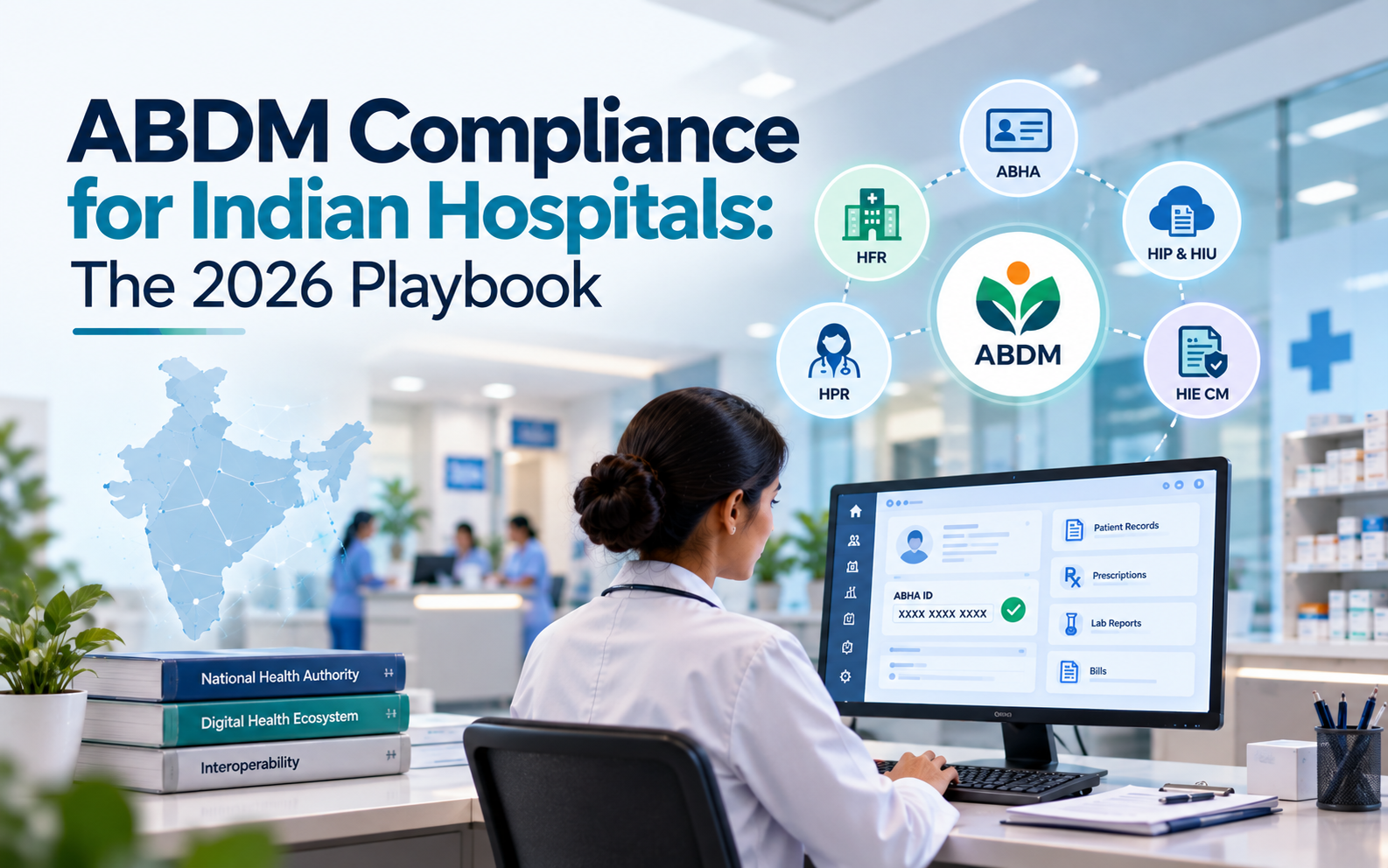
The 5 ABDM Building Blocks Every Hospital Must Understand
ABDM is not a single product or a software you install. It is a set of national digital rails built and maintained by the National Health Authority. Every hospital operates on top of these five components. Understand what each one is, and compliance stops feeling like a moving target.
1. HFR: Health Facility Registry
The HFR is the Government of India's national directory of every healthcare facility that participates in ABDM. Hospitals, clinics, nursing homes, diagnostic labs, imaging centres, and pharmacies all register here, across both modern medicine and AYUSH systems. Registration is done at facility.abdm.gov.in and produces a verified HFR ID that becomes your facility's digital identity across the ABDM ecosystem.
- Who registers: The facility owner or designated administrator.
- Documents needed: Facility registration certificate, ownership proof, address proof, contact details, list of medical services offered.
- Typical timeline: 3 to 7 working days if documents are in order.
2. HPR: Healthcare Professionals Registry
The HPR is the national verified database of doctors, nurses, paramedics, and allied health professionals. Each professional receives an HPR ID that can be used to digitally sign clinical documents. HPR registration is separate from Medical Council of India or state medical council registration but cross references those licences. Under NABH 5th edition, every treating doctor at an accredited facility is expected to hold an HPR ID.
- Who registers: Each individual practitioner registers themselves, though the facility usually organises a batch drive.
- Documents needed: State medical council registration number, Aadhaar based identity verification, qualification certificates.
- Typical timeline: Same day for auto verified profiles, 5 to 10 working days for manual verification.
3. ABHA: Ayushman Bharat Health Account
ABHA is the patient facing side of ABDM. It is a 14 digit unique digital health ID issued to every Indian citizen who opts in. Patients can create their own ABHA at abha.abdm.gov.in, or the hospital can create one at the OPD registration desk during patient intake. Once created, all clinical records generated during that patient's visits can be linked to this single ID and accessed from any ABDM compliant application with patient consent.
- Who creates it: The patient, or the front desk on the patient's behalf with consent.
- What the hospital needs: An ABDM ready hospital management software or clinic management platform with ABHA creation and verification workflows built in.
- Typical creation time: Under 60 seconds at the front desk with Aadhaar or mobile OTP based verification.
4. HIP and HIU: Health Information Provider and User
HIP and HIU are the two roles a hospital can play in health data exchange. As an HIP, your facility is authorised to push patient health records into the ABDM network. As an HIU, your facility can request and fetch records from other ABDM linked facilities, always with patient consent. Most hospitals eventually need both roles. Insurance empanelment increasingly requires at least HIP registration.
- Who registers the facility: The hospital IT head or compliance officer, through the ABDM sandbox and production certification process.
- Prerequisites: HFR ID must be active, HMS must be ABDM certified for the relevant milestone.
- 2026 relevance: NABH 5th edition and PM JAY empanelment now require HIP registration.
5. HIE CM: Health Information Exchange and Consent Manager
The Health Information Exchange and Consent Manager is the ABDM rail that carries actual patient records between facilities, always brokered by patient consent. When a specialist requests records from a general physician, the patient receives a consent notification, approves or denies, and the records flow through encrypted channels only if approved. Nothing moves without patient consent. This is the mechanism that makes India's health data ecosystem privacy first rather than default open.
- What the hospital needs: An EHR software that supports FHIR R4 based record generation and the standard ABDM consent handshake.
- What the patient needs: An ABHA linked patient app or the ability to approve consent via SMS.
The M1 to M4 Milestones: What Actually Progresses
ABDM compliance is structured as four progressive milestones. Each milestone builds on the previous one, and each unlocks different regulatory and commercial benefits. This is the single most important framework for any hospital administrator to internalise.
| Milestone | What It Requires | What It Enables | Typical Time to Achieve |
|---|---|---|---|
| M1 | ABHA creation and verification at patient registration | Patient onboarding into the ABDM ecosystem, HFR listing visible to patients | 2 to 4 weeks |
| M2 | Clinical records linked to ABHA IDs, generated in FHIR R4 format | Patients access history across ABDM apps, referral quality improves | 4 to 8 weeks after M1 |
| M3 | Bidirectional data exchange via HIP and HIU roles, consent workflows | Cross facility record fetch, portable health history nationwide | 6 to 10 weeks after M2 |
| M4 | NHCX integration for cashless insurance claim processing | Faster insurance settlement, reduced TPA cycle time, PM JAY readiness | 4 to 8 weeks after M3 |
Most Indian hospitals are somewhere between M1 and M2 today. Getting from M2 to M3 is the biggest jump because it requires production certification from the ABDM sandbox environment, not just self attestation. M4 is the newest milestone and is tightly tied to the National Health Claims Exchange rollout.
The 2026 Pressure Points Every Hospital Should Know
The regulatory calendar is what turns ABDM compliance from a nice to have into a business critical project. Below are the four pressure points already active or arriving in 2026.
NABH 5th edition. The National Accreditation Board for Hospitals now requires HIP registration as part of the accreditation and reaccreditation process. Facilities pursuing NABH in 2026 cannot get certified without ABDM readiness, which is why NABH compliant hospital management software now has to cover the ABDM layer too.
PM JAY and Ayushman Bharat empanelment. State authorities across multiple states have issued directives requiring PM JAY empanelled hospitals to be ABDM compliant, with software vendors also brought into the compliance perimeter. Bihar was among the first to formalise this, with more states expected in 2026.
CGHS and ECHS empanelment. Central Government Health Scheme and Ex Servicemen Contributory Health Scheme empanelment renewals now include ABDM readiness checks. Existing empanelments will face this at renewal, not at the next audit.
State insurance schemes. State level health insurance schemes are increasingly aligning with ABDM as their default data exchange layer. Non compliant hospitals risk delayed reimbursement or removal from the panel.
The 4 Phase Implementation Playbook
Do not try to hit M4 in one sprint. Every successful ABDM compliance project runs in four phases across roughly 90 to 120 days. This is what the phasing looks like in practice for an average Indian hospital.
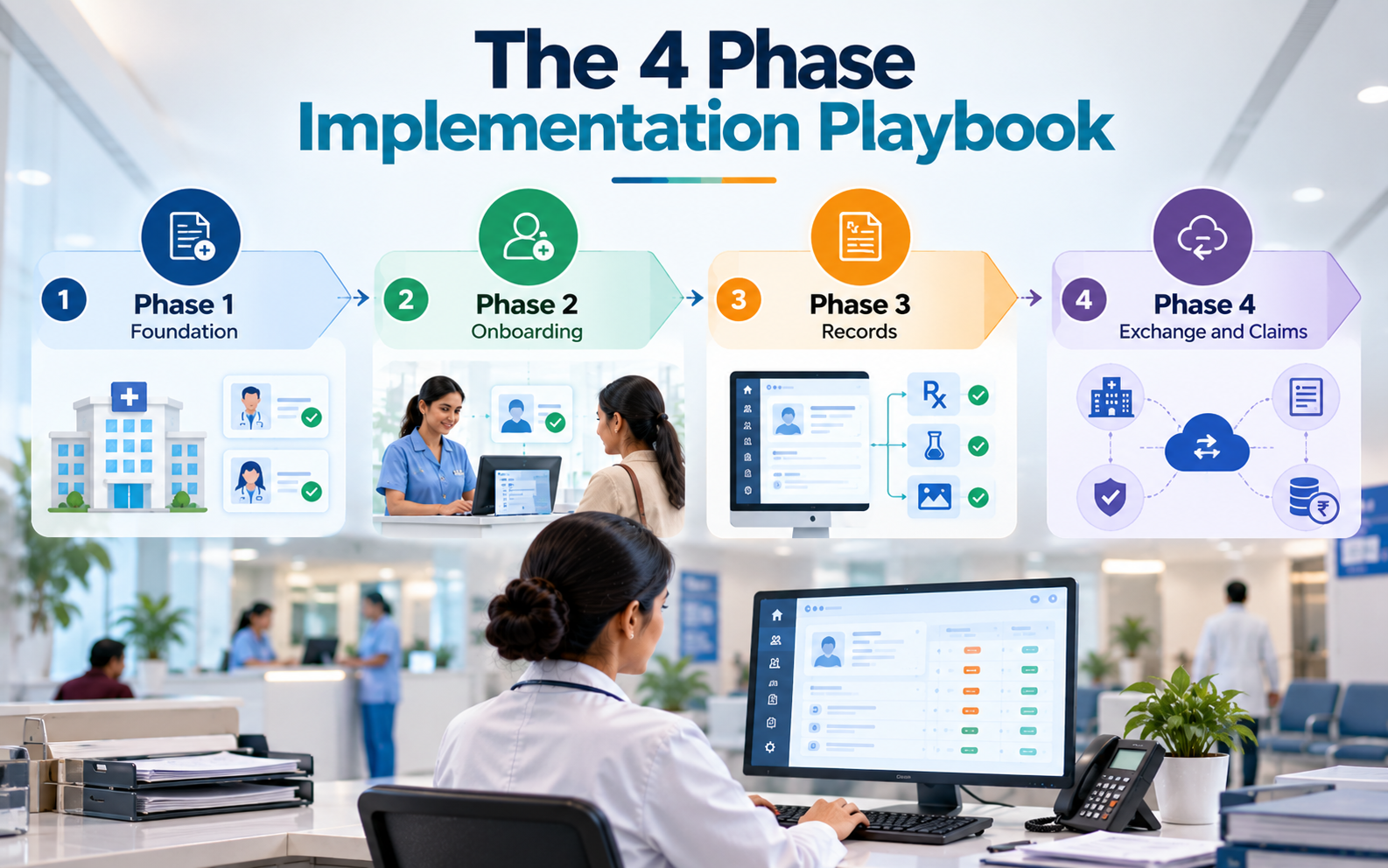
Phase 1: Foundation, weeks 1 to 3
Register the facility on HFR. Register all treating doctors and key allied health staff on HPR. Choose or confirm an ABDM ready hospital management software that already supports M1 and M2 out of the box, using the evaluation criteria in our hospital management software buyer guide for India. If your current HMS cannot demonstrate a live ABHA lookup, this is the point at which vendor change becomes cheaper than vendor upgrade.
Phase 2: Onboarding, weeks 4 to 6
Enable ABHA creation and verification at every front desk. Train the front desk team on the two ways patients can create ABHA at intake: mobile OTP or Aadhaar based verification. Update patient consent forms to include ABDM data sharing options. This is the M1 milestone and it should be visible in daily operations within two to three weeks.
A properly integrated clinic management software handles this at the same registration screen used today. Our clinic management software buyer guide covers what to check before you commit.
Phase 3: Records, weeks 7 to 12
Ensure every clinical record generated by EHR software, the pharmacy module, and the lab module is produced in FHIR R4 format and linked to the patient's ABHA ID. Prescriptions, discharge summaries, lab reports, diagnostic images. This is M2. Modern platforms like CuraBiz do this automatically once M1 is active. Facilities still on paper records should first work through a 30 day paper to EHR migration before attempting M2.
Hospitals that use fragmented tools per department will discover integration gaps here, and the same gaps show up as revenue leakage in the hospital pharmacy. This is often the moment they consolidate onto a single unified platform.
Phase 4: Exchange and Claims, weeks 13 to 20
Register the facility as an HIP and complete the sandbox exit audit for M3. Enable consent flows so patients can approve or deny record sharing requests. If insurance settlement is a priority, add M4 with NHCX integration for cashless claim processing.
By the end of week 20, an average mid sized Indian hospital that follows this phasing is fully ABDM compliant through M4 and NABH 5th edition ready on the digital dimension of the standards.
The Four Pitfalls That Derail ABDM Compliance Projects
Treating ABDM as an IT project rather than an operational one
The technical work sits with the HMS vendor. The operational work sits with the front desk, the doctors, and the compliance officer. Hospitals that treat this as a pure IT installation without training the intake team fail to hit M1 in operations even when the software is ready. ABHA creation at every OPD registration is a workflow change, not a code deployment.
Underestimating HPR registration friction
Getting 50 to 200 doctors registered on HPR is not a five minute exercise. Some doctors will resist, some will lose their credentials midway, some will discover their state medical council data is stale. Assign one person as the HPR champion, run a batch drive, and treat this as a two to four week internal project, not an assumption.
Buying HMS that claims ABDM readiness without production certification
Every vendor claims ABDM ready. Fewer have actually passed the ABDM sandbox certification for M2 and M3. Ask for the certification reference number and verify it on the ABDM sandbox portal. A vendor that hedges here is a vendor whose integration will slip when the auditor visits.
Waiting for state directives before starting
Every state has issued or will issue ABDM directives on its own timeline. Hospitals that wait for their state notification are typically 12 to 18 months behind hospitals that treated the national trajectory as inevitable. Given that basic HFR registration takes a week, there is no downside to starting Phase 1 today.
What ABDM Compliance Actually Costs
Direct cost breakdown for a typical mid sized Indian hospital reaching M3 compliance:
- HFR facility registration: no fee
- HPR professional registration: no fee per doctor
- ABDM ready HMS incremental cost: often included in existing subscription if the vendor already supports the milestones, else 50,000 to 3 lakh rupees per year for the ABDM module
- Sandbox certification and M3 production readiness: 1 to 3 lakh rupees one time if the vendor charges separately for it
- Staff training and workflow update: 30,000 to 1 lakh rupees for two to four training sessions
- Internal compliance officer time: 60 to 100 hours across the full 90 to 120 day implementation
For a hospital under 100 beds using an ABDM ready platform, full M1 to M3 compliance typically fits inside 3 to 6 lakh rupees. For hospitals above 300 beds, budgets run 8 to 20 lakh rupees depending on how much legacy integration is required.
In every case, the cost of empanelment loss or NABH accreditation delay dwarfs the compliance investment. Platforms like CuraBiz that ship with M1 and M2 support already active often keep the incremental compliance cost in the lower half of these ranges.
Frequently Asked Questions
Is ABDM compliance mandatory for private hospitals in India?
Not universally, but effectively yes for any private hospital that wants to be empanelled with PM JAY, Ayushman Bharat, CGHS, ECHS, most state insurance schemes, or pursue NABH 5th edition accreditation. Standalone cash only private hospitals with no insurance dependency can still delay, but the direction is one way and delay compounds.
Do I need to register on HFR before HPR?
HFR and HPR are independent registrations. HFR is for the facility, HPR is for individual professionals. Most hospitals run them in parallel to save time. HFR registration is a prerequisite for eventual HIP and HIU registration.
How long does the full ABDM compliance journey take?
A typical Indian hospital using an ABDM ready HMS reaches M1 in 2 to 4 weeks, M2 in another 4 to 8 weeks, and M3 in a further 6 to 10 weeks. Full M1 to M3 compliance in 90 to 120 days is realistic. M4 adds another 4 to 8 weeks after M3 if cashless claims are in scope.
What is FHIR R4 and do I need to understand it?
FHIR R4 is the international standard for structuring electronic health data. ABDM uses FHIR R4 profiles for record exchange. As a hospital administrator you do not need to code FHIR, but your HMS must generate records in this format. Ask the vendor to demonstrate FHIR R4 output during evaluation.
Can a clinic or nursing home be ABDM compliant, or is it only for hospitals?
Every clinic, nursing home, diagnostic lab, and pharmacy in India can and increasingly should be ABDM compliant. The registration process is the same, only the scale is smaller. Clinics typically reach M1 and M2 in 4 to 6 weeks with a modern clinic management platform.
What happens if my HMS vendor is not ABDM certified?
You cannot achieve compliance beyond M1 without a certified HMS. If your vendor does not have a documented ABDM sandbox certification for at least M2, evaluate a migration to an ABDM ready platform. The switching cost is usually less than the cost of losing insurance empanelment.
Ready to Start Phase 1
The single most important step today is deciding whether your current HMS can carry you through M2 and M3, or whether you need to plan a platform change as part of the ABDM compliance project. Everything else follows from that decision. HFR registration can begin the same week. HPR drives can start alongside. Once the platform question is settled, the 90 to 120 day compliance journey becomes a matter of execution, not strategy.
SlateBiz builds CuraBiz, a unified healthcare platform that ships with M1 and M2 support out of the box, includes ABHA creation at OPD registration, generates FHIR R4 records across EHR, pharmacy, and lab modules, and supports the HIP and HIU workflows needed for M3. CuraBiz is built on Java and Oracle with SHA 512 password hashing, Apache Shiro session security, and OWASP hardening, and deploys across cloud, LAN, or WAN.
The SlateBiz implementation team has run the four phase compliance playbook described above across hospitals and clinics in Delhi, Rajasthan, and Gujarat and can join your project from Phase 1.
Reach out at info@slatebiz.com or call +91 92573 73668, or visit slatebiz.com to book a walkthrough.