
Every hospital pharmacy in India loses between 8 and 15 percent of monthly revenue to leakage that never shows up as theft on the CCTV. It shows up as expired stock written off at month end, medicines dispensed on a ward that never got billed, cash sales that quietly bypass the till, and emergency purchases at 25 percent markup because nobody noticed the stock was low. For a 100 bed hospital pharmacy turning over 40 lakh rupees a month, that is 3 to 6 lakh rupees walking out the door every 30 days, without a single bad actor in the building.
The losses are not caused by dishonest staff. They are caused by operational loopholes that manual registers and disconnected billing tools cannot close. Below are the six loopholes that account for most of the leakage in Indian hospital pharmacies, what each one typically costs, and the exact fix using pharmacy management software that connects to the wider hospital workflow. If your hospital pharmacy is still relying on paper registers, spreadsheets, or a standalone billing tool that does not talk to the doctor's prescription screen, at least four of the six loopholes below are open in your operation right now.
Loophole 1: Dispensing Without a Prescription Link
The pharmacist hands out medicines against a handwritten prescription from a paper pad, or worse, against a verbal request from a ward nurse. There is no automatic link between what the doctor prescribed, what the pharmacy dispensed, and what the patient's bill records. Missed dispensing charges, wrong quantities, and unbilled ward medications all disappear into this gap.
Typical monthly loss: 40,000 to 1.5 lakh rupees per 100 bed hospital
The fix: A proper pharmacy management software pulls the doctor's prescription directly from the EHR into the pharmacy screen, dispenses against that exact record, and pushes the dispensing charge into the patient's active bill in the same action. The pharmacist confirms the drug, checks the stock, and hands it over. Every unit is tracked from prescription to bill without paper in between.
Loophole 2: Expiry Losses from Poor Batch Tracking
Medicines get stocked in random order on the rack. The staff picks whatever is in front, which is often the newest batch. Older stock sits at the back and quietly crosses its expiry date, then gets written off at month end. Nobody spots it until the loss is already booked.
Typical monthly loss: 3 to 5 percent of pharmacy inventory annually
The fix: Batch tracking inside pharmacy inventory management software enforces first expiry first out dispensing. Every drug carries a batch number, expiry date, and rack location in the system. When the pharmacist scans or selects a drug, the platform serves the batch closest to expiry, not the newest one. Automated alerts flag any batch approaching 60 days to expiry so the store manager can push a return, run a clearance, or move stock to a busier branch.
Loophole 3: Ward and IPD Medicine Leakage
A nurse takes three strips of paracetamol and two vials of injectable from the ward pharmacy cabinet for a patient. The consumption note is scribbled on a paper slip. The slip goes missing before the shift changes. The patient's final bill at discharge is missing those three strips and two vials. Multiply by every ward, every shift, every day.
Typical monthly loss: 60,000 to 2 lakh rupees per 100 bed hospital
The fix: Ward level medicine issue must be tied to a specific patient's IPD chart in the software, not scribbled on a slip. When the nurse pulls stock from the ward cabinet, the system asks which patient, links to that patient's active admission, and posts the charge to the running IPD bill immediately. At discharge, the hospital billing pulls every medicine that was ever issued for the patient, and the discharge summary reflects the full consumption.
Loophole 4: Manual Reorder Points and Emergency Purchases
The store manager checks stock levels once a week using a paper register or an Excel sheet that nobody has updated in three days. A fast moving drug runs out on a Tuesday. Nobody notices until a patient prescription cannot be filled on Wednesday. The store rushes an emergency purchase from the nearest wholesaler at 15 to 25 percent higher price than the standard supplier.
Typical monthly loss: 80,000 to 3 lakh rupees per 100 bed hospital
The fix: Every drug inside pharmacy inventory management software has a defined reorder point calculated from average daily consumption and supplier lead time. The moment stock drops below that point, the system auto generates a purchase order or a low stock alert to the store manager. Fast moving drugs never hit zero. Emergency purchases stop being routine and become the exception. When the pharmacy module sits inside an integrated hospital management software, consumption data flows in from wards, OPD, and outpatient sales in real time, making reorder calculations far more accurate than any manual weekly stock check.
Loophole 5: Duplicate Prescriptions Filled Twice
A patient loses the printed prescription and gets a duplicate from the doctor. Or a family member picks up the medicine on Monday and the patient picks up the same prescription again on Wednesday, unaware. Or a prescription is dispensed at the OPD pharmacy in the morning and the IPD pharmacy in the evening because the two systems do not talk to each other. The hospital has now paid for the drug twice but billed the patient once.
Typical monthly loss: 20,000 to 60,000 rupees per 100 bed hospital
The fix: A pharmacy management software tied to the patient's EHR marks every prescription as dispensed the moment it is filled. Any subsequent attempt to fill the same prescription raises an alert, whether it happens at the OPD counter, the IPD ward pharmacy, or a branch pharmacy across the road. Duplicate dispensing becomes physically impossible without a supervisor override that is logged in the audit trail.
Loophole 6: Cash Sale Under Reporting and GST Leakage
Walk in cash sales at the pharmacy counter are the easiest revenue to lose. The counter clerk rings up 500 rupees but records 300. The rest never enters the till. GST on the missing 200 is never collected, and the pharmacy quietly builds up a GST exposure that only surfaces during an audit. Even without dishonesty, missing invoices for OTC sales and untracked returns add up.
Typical monthly loss: 50,000 to 2 lakh rupees plus GST liability
The fix: Every counter sale must generate a system invoice with GST auto calculated, regardless of payment mode. A pharmacy billing software integrated with the cash drawer means the till only opens after the bill is generated. GSTR 1 and GSTR 3B ready reports remove the month end scramble. Daily reconciliation between physical stock movement, system dispensing, and cash collected exposes any gap the same day, not three months later. Hospitals pursuing NABH accreditation need this level of documented pharmacy control anyway, so closing this loophole doubles as compliance groundwork.
Manual vs Software Driven Pharmacy: What Actually Closes
The six loopholes above all trace to the same root problem: workflows that depend on paper slips, disconnected registers, and human memory. Software does not fix the loopholes by itself. It fixes them by making the correct behaviour easier than the leaking behaviour.
| Loophole | Manual Pharmacy | Software Driven Pharmacy |
|---|---|---|
| Prescription to bill link | Paper slip, often lost | Auto pushed to patient bill |
| Batch and expiry tracking | Random rack pick | First expiry first out enforced |
| Ward medicine consumption | Scribbled cabinet log | Tied to patient IPD chart |
| Reorder triggers | Weekly manual check | Automated reorder point alerts |
| Duplicate prevention | Not possible to detect | System flag, audit logged |
| GST and cash reconciliation | Month end reconciliation | Daily, auto generated |
The First 30 Days of Recovery
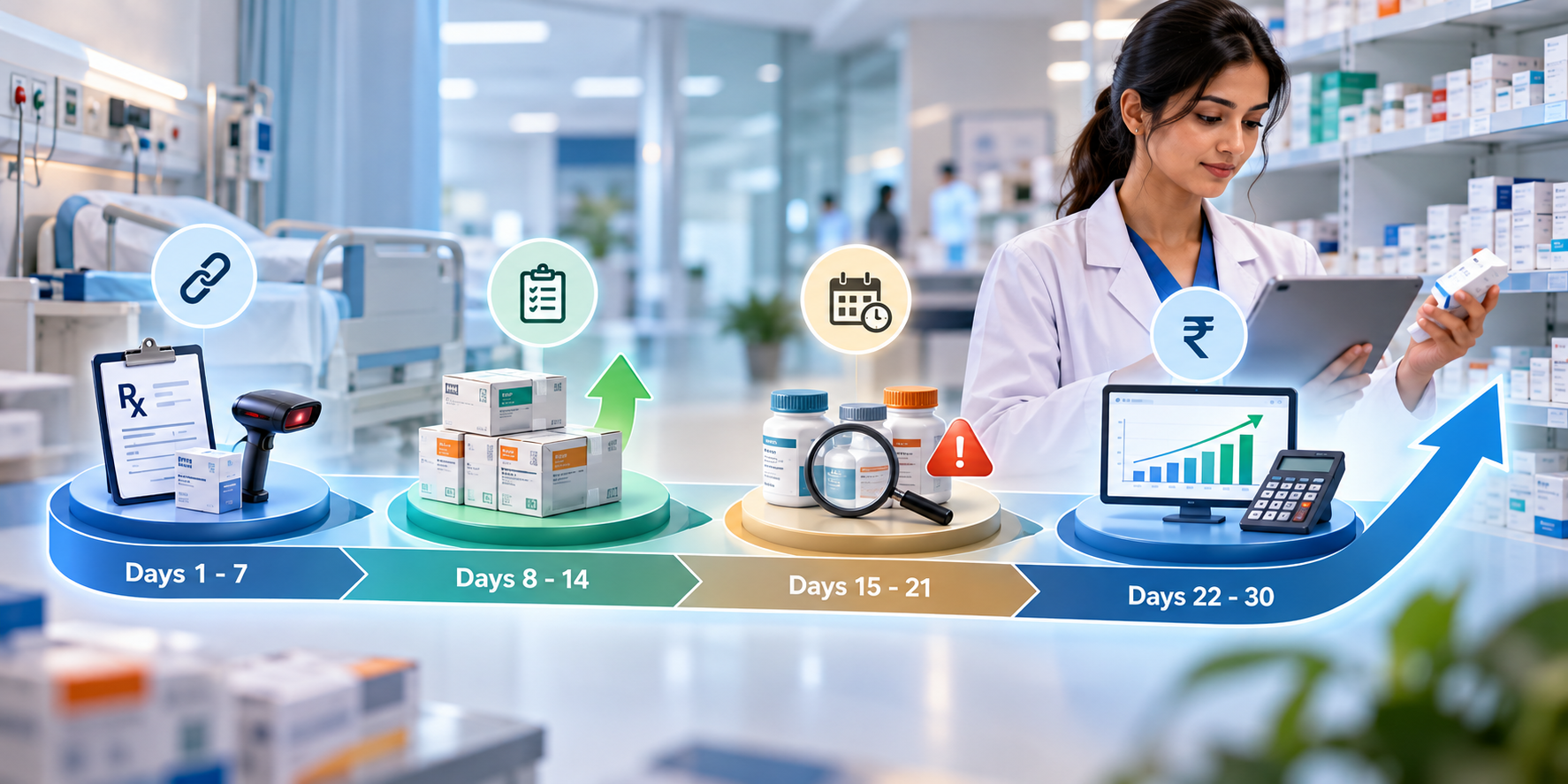
If your pharmacy is losing 8 to 15 percent of monthly revenue to the loopholes above, the recovery framework is deliberately narrow. Do not try to close all six loopholes in the first week. Address the biggest leaks first, in this order.
- Days 1 to 7: Close Loophole 3 (ward leakage) and Loophole 1 (prescription to bill link). These two account for the largest rupee losses in most hospitals.
- Days 8 to 14: Set up automated reorder points for the top 20 fast moving drugs. Loophole 4 stops within two weeks of activation.
- Days 15 to 21: Turn on batch expiry alerts and first expiry first out dispensing. Loophole 2 is a slow leak, but the recovery is significant over 90 days.
- Days 22 to 30: Close Loophole 6 (cash reconciliation) and Loophole 5 (duplicate dispensing). These require workflow discipline more than software alone.
By day 30, most Indian hospitals recover 40 to 60 percent of the leakage they were losing before. Full closure of all six loopholes typically takes 90 days including staff training and audit cycle changes. Every pharmacy management software worth its price tag supports this exact framework, but the platform is only half the equation. The other half is a store manager willing to run the daily reconciliation and a hospital administrator willing to review the weekly leakage report.
Beyond the operational recovery, the same discipline builds a compliant paper trail for drug schedule audits under Indian pharmacy law. The regulations administered by CDSCO require batch level traceability that manual registers simply cannot produce during an inspection.
Frequently Asked Questions
How much revenue does an Indian hospital pharmacy typically lose to leakage
Industry audits consistently show 8 to 15 percent of monthly revenue disappearing to the six loopholes above. For a 100 bed hospital pharmacy turning over 40 lakh rupees monthly, that is 3 to 6 lakh rupees per month. A 300 bed hospital typically loses 10 to 20 lakh rupees monthly. Recovery of 60 to 80 percent of that leakage inside 90 days is realistic with the right pharmacy management software and workflow discipline.
What does pharmacy management software cost for an Indian hospital
A standalone pharmacy management software module for a mid sized hospital typically runs 60,000 to 3 lakh rupees per year depending on user count and integration scope. When bundled inside a full hospital management platform, the incremental cost is often 30,000 to 1 lakh rupees per year because the master data, patient records, and billing engine are shared. For clinics running only an OPD pharmacy, integrated clinic management software with a light pharmacy module typically starts around 40,000 rupees per year.
Can pharmacy software work if the rest of the hospital is still on paper
It can, but 60 to 70 percent of the recovery vanishes because Loophole 1 (prescription link) and Loophole 3 (ward consumption tracking) both require the doctor and nursing workflow to also be digital. Standalone pharmacy software closes billing and stock loopholes but leaves the dispensing loopholes wide open. Integrated deployment is where the real recovery happens.
How long does it take to see the recovery
The first three loopholes typically close inside 30 days. Full recovery across all six takes 60 to 90 days including staff training and audit cycle adjustments. Hospitals that treat this as a one week software installation rather than a 90 day operational change usually stall around day 40.
Do I need to change my pharmacy staff to make this work
Almost never. In practice the same team, working with a system that makes correct behaviour easier than the leaking behaviour, closes 90 percent of the loopholes. Staff changes are only required when there is documented dishonesty, which is rare and different from the operational loopholes covered here. The real change is in workflow, not personnel.
Is GST reconciliation actually a legal risk for hospital pharmacies
Yes. Under reported cash sales create real GST liability that surfaces during audits, and pharmacies have been penalised for cumulative GST leakage on unbilled OTC sales. A pharmacy billing software with auto GST calculation and daily reconciliation removes both the operational leak and the audit exposure.
Ready to Close the Loopholes
The six loopholes above are not unique to any single hospital. They repeat across almost every Indian pharmacy running on paper registers or disconnected billing tools. The recovery framework above works, and the pharmacy management software that closes each loophole is available from every serious vendor in the Indian market. What varies is how well the software integrates with the doctor's prescription screen, the ward nurse's cabinet log, and the accountant's GST filing. Fragmented tools leave loopholes open. Integrated platforms close them.
SlateBiz builds CuraBiz, a unified healthcare platform with a full pharmacy management software module tied to the EHR, IPD ward workflow, and billing engine on a single database. CuraBiz handles medicine prescription integration, patient data integration with EHR, drug inventory with batch and expiry tracking, drug dispensing with first expiry first out enforcement, and automated low stock alerts. The CuraBiz pharmacy module is built on Java and Oracle with SHA 512 password hashing, Apache Shiro session security, and OWASP hardening, deploys across cloud, LAN, or WAN, and supports the exact 30 day recovery framework described above. Hospitals running CuraBiz across OPD, IPD, and pharmacy on a single database typically close four of the six loopholes inside the first month.
Reach out at info@slatebiz.com or call +91 92573 73668, or visit slatebiz.com to book a walkthrough.