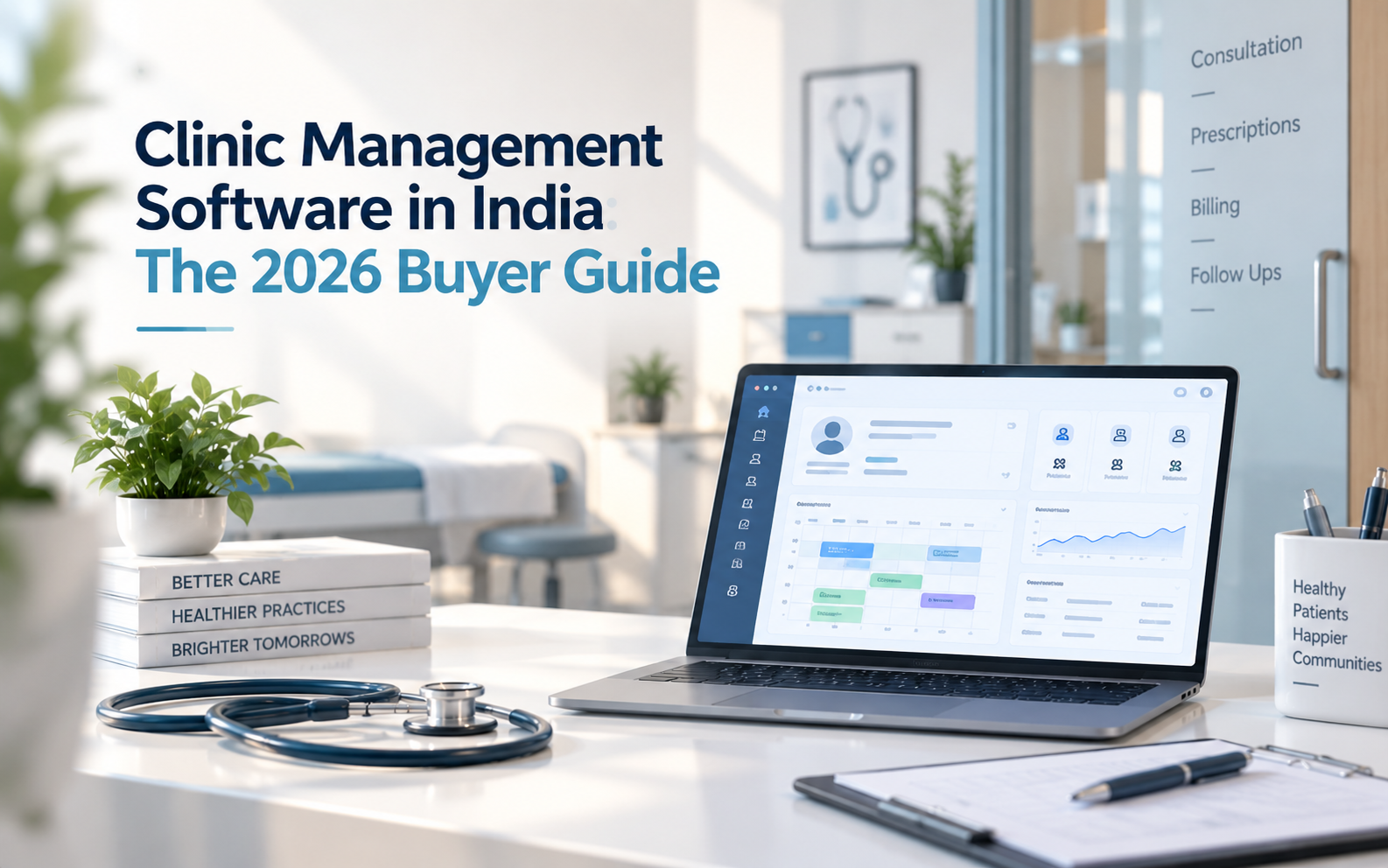
Clinic management software has quietly become the deciding factor between clinics that grow and clinics that stall. A doctor running a solo practice in Delhi, a polyclinic in Jaipur juggling six specialists, or a small chain expanding across Rajasthan and Gujarat now competes on the same benchmarks large hospitals do: appointment booking on WhatsApp, digital prescriptions, ABHA linked patient records, and clean invoices with GST. A modern clinic management system, often abbreviated as CMS, handles all of it from a single dashboard and removes the paper registers, printed prescription pads, and Excel appointment sheets that still dominate most Indian outpatient practices.
This guide covers what a CMS actually does, the features that matter for solo doctors and polyclinics, how it differs from full hospital management software, what to pay, and the checklist to use when you evaluate vendors.
What Is Clinic Management Software
Clinic management software is a lightweight, doctor first platform that runs the full outpatient workflow of a clinic or polyclinic. It handles appointments, patient registration, medical history, digital prescriptions, billing, WhatsApp reminders, and reports. Everything a small practice needs, on one screen, without the complexity or price tag of a full hospital management system.
It sits in the same software family as hospital management software but is engineered for a different reality. A clinic does not admit inpatients, does not run wards, and rarely operates a full pharmacy or lab. A clinic needs speed at the front desk, a fast consultation screen for the doctor, and clean billing at checkout. A good CMS delivers exactly that.
Solo Practice vs Polyclinic: What Changes
Every clinic falls somewhere on a spectrum from single doctor practice to multi specialist polyclinic to small chain. The software that fits each is different, and buying the wrong tier is one of the most common mistakes owners make.
| Need | Solo Doctor | Polyclinic | Multi Branch Chain |
|---|---|---|---|
| Users | 1 doctor, 1 to 2 staff | 3 to 10 doctors, 5 to 15 staff | 10 plus doctors across branches |
| Appointment complexity | Single calendar | Multi doctor, multi room | Multi branch, cross booking |
| Billing model | Simple consultation | Doctor payout splits | Branch level P and L |
| Deployment | Cloud only | Cloud, sometimes LAN | Cloud with branch sync |
| Typical annual cost | 15 to 40 thousand rupees | 60 thousand to 2 lakh rupees | 3 to 8 lakh rupees |
Why Every Clinic in India Needs Software Now
Patient no shows are eating your revenue
Indian outpatient clinics see no show rates between 15 and 25 percent. Automated WhatsApp and SMS reminders sent the day before and the morning of the appointment cut that number by more than half. For a clinic seeing 30 patients a day at 500 rupees consultation, recovering even half those slots is close to 5 lakh rupees in extra annual revenue.
Patients expect digital prescriptions
Handwritten prescriptions get lost, misread by the chemist, or thrown away by the patient. A digital prescription sent over WhatsApp is easier to follow, easier to refill, and easier to share with a specialist during referral. It also builds a searchable prescription history that helps every follow up visit go faster.
The ABHA linked record era has arrived
The Ayushman Bharat Digital Mission is pushing every clinic toward ABHA linked patient records. Clinics that cannot issue or link ABHA numbers will be locked out of insurance empanelment, government schemes, and referral networks. The right CMS handles ABHA lookup and consent based record sharing out of the box.
Insurance and TPA cashless is the growth channel
More Indian patients now walk in with an insurance card than ever before. Clinics that can raise a proper GST invoice, issue a compliant receipt, and generate the paperwork insurance and TPA companies ask for capture a segment that cash only clinics simply cannot serve.
Must Have Features in a Clinic Management System
A good clinic management software strips out hospital complexity and keeps only what a busy outpatient practice actually uses. Insist on the following as standard.
Appointment scheduling and reminders
Online appointment booking that patients can use from a link or a mini website, combined with the same calendar the receptionist manages at the front desk. Automated WhatsApp, SMS, and email reminders should go out one day before and one hour before the visit. Rescheduling and cancellation should take one tap for the patient.
Patient registration and medical history
New patient registration in under a minute. A unique patient ID that persists across every visit. Full history including demographics, allergies, chronic conditions, past prescriptions, and family history. For pediatric practices, growth charts for children under two and immunisation schedule tracking are non negotiable, which is why platforms like CuraBiz include these workflows as standard rather than paid add ons. Our paper to EHR migration playbook shows how to move existing patient files into a complete digital record.
Doctor consultation screen
The consultation screen is where doctors either adopt the software or abandon it. It must load a returning patient's full EHR in under three seconds, offer favourite drug and lab test lists, allow one click copy of the previous prescription, and let the doctor finish a consultation in three minutes without touching a mouse if they prefer.
Digital prescription and referral
Clean PDF prescription, one click share over WhatsApp, print option for patients who still want paper. Full drug database with dosage and frequency helpers. Automatic drug interaction alerts. Referral letters to specialists with a copy of the patient record attached.
Billing with GST and multiple payment modes
OPD billing that handles consultation fees, procedure charges, and any medicines dispensed. Payment through cash, card, UPI, or net banking. GST applied automatically where relevant. Insurance and TPA billing for clinics that accept cashless. Doctor payout tracking for polyclinics where consultants earn a percentage.
Reports that a clinic owner actually reads
Daily patient count, revenue by doctor, revenue by service, most prescribed medicines, no show rate, and repeat visit rate. Available as a mobile dashboard so the owner can see the day at a glance without asking the receptionist. Monthly P and L, GSTR 1 and GSTR 3B ready for the CA.
Cloud, mobile, and cross platform access
The software must run in a browser, on Windows, Mac, or Linux, and offer a mobile app or mobile web view for doctors who want to check the schedule or write a prescription from outside the clinic. Automatic daily backups, encrypted patient data, and role based access are the security baseline.
What Should a Clinic Pay for the Right Software
Clinic management software pricing in India varies more than most owners realise. The market runs from free trial platforms that upsell aggressively to enterprise systems that overserve a solo practice. As a rough guide:
- Solo doctor clinic: 15,000 to 40,000 rupees per year on a cloud subscription. Anything cheaper is usually a stripped down tool with hidden charges. Anything more expensive is overkill.
- Polyclinic with 3 to 10 doctors: 60,000 to 2 lakh rupees per year including multi doctor scheduling, doctor payout tracking, and small pharmacy or lab modules.
- Multi branch clinic chain: 3 to 8 lakh rupees per year for cross branch reporting, centralised patient records, and branch level P and L. Implementation adds one time cost between 50,000 and 3 lakh rupees.
The single most expensive mistake is buying cheap. Low subscription fees hide poor support, missing features, expensive data migration when you outgrow the platform, and hours of wasted staff time on workarounds. Evaluate total cost of ownership over three years, not the sticker price of month one.
How to Choose the Right Clinic Management Software

Use this checklist during vendor evaluation. Any vendor who cannot answer clearly should not make your shortlist.
- Doctor consultation screen that loads a full patient history in under three seconds
- WhatsApp, SMS, and email reminders built in, not sold as add ons
- ABHA lookup and ABDM consent flow demonstrated live
- Online appointment booking through a shareable link or mini website
- Digital prescription with drug database, dosage helpers, and PDF share
- Doctor payout tracking for polyclinics
- Multi branch support if you plan to expand
- Cross platform on Windows, Mac, Linux, plus mobile
- Role based access, encryption, and automatic daily backups
- Free two to four week pilot before signing an annual contract
- Local Indian support with response times specified in the contract
- All updates included in the subscription, no change request fees
Frequently Asked Questions
What is the cost of clinic management software in India
A cloud based subscription for a solo doctor typically runs 15,000 to 40,000 rupees per year. A polyclinic with three to ten doctors pays 60,000 to 2 lakh rupees per year. Multi branch chains invest 3 to 8 lakh rupees per year plus one time implementation. Free tools exist but almost always upsell essential features.
How long does it take to set up clinic software
A solo clinic can go live in one to three days with a cloud platform. A polyclinic with multi doctor scheduling, doctor payouts, and past patient data migration takes one to three weeks. Chains take four to eight weeks depending on the number of branches and the volume of historical data.
Does clinic management software work offline
Well engineered platforms support offline mode for critical workflows like billing and prescription writing, then sync automatically when the connection returns. This matters in Tier 2 and Tier 3 cities where internet reliability varies.
Can multiple doctors use the same clinic software
Yes. A polyclinic ready CMS supports multi doctor scheduling with separate calendars, individual doctor login accounts, per doctor patient records visible only to authorised users, and consultant payout tracking. Insist on seeing this in a live demo before you buy.
Is clinic software different from hospital management software
Yes. Hospital management software includes IPD, ward management, ICU, full pharmacy, lab, and TPA workflows that a clinic never uses. A clinic focused CMS strips those out, keeps only outpatient workflows, and delivers a simpler, faster, cheaper platform. Buying hospital software for a clinic wastes money and slows the team down.
Do I need ABDM compliant clinic software
Effectively yes. Any clinic that wants to empanel with insurance, accept cashless patients, or participate in referral networks needs ABDM compliant software that can look up ABHA numbers and share health records with patient consent. The regulatory direction is one way, and clinics that delay will face a rushed migration later.
Getting Started
The right clinic management software pays for itself in the first three months through fewer no shows, faster consultations, cleaner billing, and happier patients. The wrong one costs you staff hours, patient trust, and eventually a painful migration. Take the checklist above, shortlist three vendors, and insist on a proper pilot in your clinic before you commit.
SlateBiz builds CuraBiz, a unified healthcare management platform designed for Indian doctors, polyclinics, and specialty practices. CuraBiz covers appointment scheduling, EHR, digital prescription, WhatsApp reminders, GST billing, and ABHA workflows on a single database, is built on Java and Oracle for enterprise grade performance, and deploys on cloud, LAN, or WAN depending on your clinic size.
Reach out at info@slatebiz.com or call +91 92573 73668, or visit slatebiz.com to book a walkthrough.