HIS, HMS, and EHR are three of the most confused acronyms in Indian healthcare technology. Vendors use them interchangeably in sales pitches. Hospital administrators inherit them from their predecessors without knowing the difference. Doctors dismiss all three as IT jargon.
The result is that hospitals routinely buy the wrong category of software, pay for capabilities they will never use, or worse, miss capabilities they urgently need.
This guide clears the confusion. HIS is Hospital Information System, HMS is Hospital Management System, and EHR is Electronic Health Record. They are not synonyms. They serve different purposes, target different audiences, and belong in different budget lines.
This piece explains what each one actually is in the Indian healthcare context, how they overlap, when you need which, and the exact question to ask a vendor to expose whether their product is what they claim it is.
The 30 Second Answer
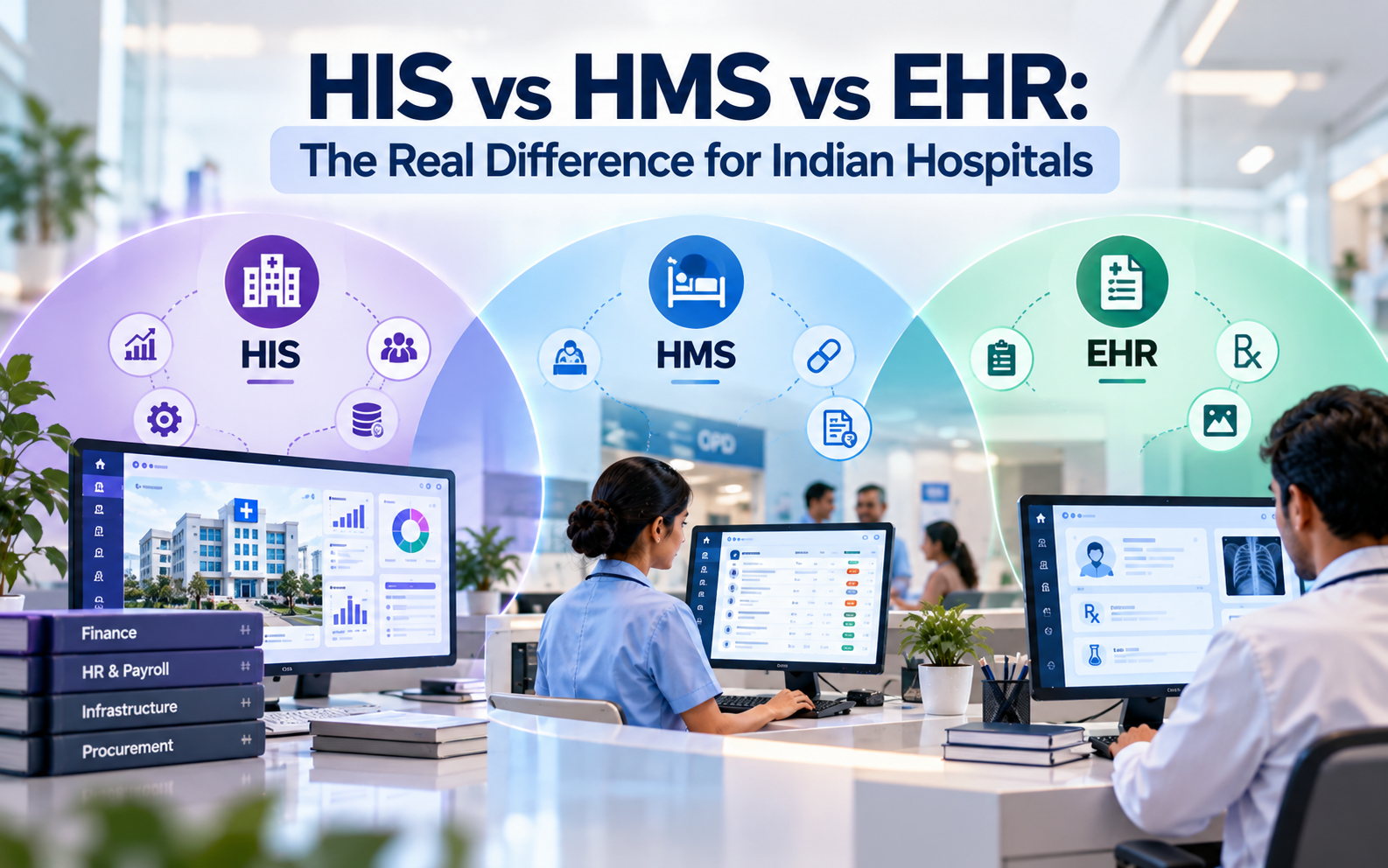
Note: If you only read one paragraph, read this. HIS is the umbrella system that runs the entire hospital including patient data, staff, inventory, finance, and infrastructure. HMS is the operational subset of HIS focused on day to day clinical and administrative workflows like OPD, IPD, pharmacy, and billing. EHR is a specific module inside HMS that holds the digital patient chart with diagnosis history, prescriptions, and lab reports.
Every hospital needs all three, ideally on one integrated platform. The distinction matters because vendors selling only an EHR often market it as a full HMS, and vendors selling only an HMS sometimes claim to be a full HIS.
HIS vs HMS vs EHR: Side by Side
The clearest way to see the difference is to look at what each one covers, who it serves, and where it fits in the hospital's software stack. This table is the single most requested comparison in Indian healthcare technology conversations.
| Dimension | HIS | HMS | EHR |
|---|---|---|---|
| Full form | Hospital Information System | Hospital Management System | Electronic Health Record |
| Scope | Enterprise wide, all functions | Operational, clinical plus admin | Clinical, patient chart only |
| Primary user | CIO, CTO, administrator | Front desk, doctor, pharmacist, billing | Doctor, nurse, clinical staff |
| Covers OPD, IPD, pharmacy, lab | Yes, plus finance, HR, biomed | Yes, as core modules | No, clinical records only |
| Covers billing and insurance | Yes | Yes | No |
| Covers HR, payroll, finance | Yes | Sometimes, via add on | No |
| ABDM ready | Yes, if the underlying HMS is | Yes, in modern platforms | Yes, by design |
| Typical buyer | Large hospitals, hospital chains | Mid sized hospitals, polyclinics | Solo doctors, small clinics |
| Typical annual cost | 15 to 60 lakh rupees | 2 to 20 lakh rupees | 15 thousand to 3 lakh rupees |
What Is HIS: Hospital Information System
HIS is the widest of the three. It is the enterprise software layer that runs the entire hospital as an organisation, not just the clinical or administrative parts. In global healthcare technology terminology, HIS is the top of the software stack.
A true HIS covers everything that HMS covers, plus:
- Finance and accounting
- Human resources and payroll
- Biomedical equipment tracking
- Facility management
- Procurement and vendor management
- Budgeting and capex planning
- Executive dashboards for the board
In the Indian market, very few facilities need or run a true HIS. Most Indian hospitals under 200 beds run what is technically an HMS with some HR and finance modules bolted on. The label HIS is often used loosely by vendors to signal scale, but the actual scope may or may not match.
A large multi specialty hospital with 500 plus beds, or a chain of hospitals across multiple cities, is where a genuine HIS makes sense. These are also the facilities where NABH accreditation requirements demand the enterprise wide reporting, audit trails, and role based governance that only a true HIS delivers reliably at scale. Public sector procurement under the Ministry of Health and Family Welfare often specifies HIS scope for government tertiary care hospitals for exactly this reason.
Verdict: Buy HIS if you run 300 plus beds, multiple locations, or if the CFO and CIO explicitly need one platform to consolidate finance, HR, and clinical operations. Below that scale, an integrated HMS is usually enough.
What Is HMS: Hospital Management System
HMS is the operational software that runs the day to day clinical and administrative work of a hospital. This is what most Indian hospitals actually mean when they say they are looking for hospital software. It includes:
- Patient registration
- OPD and IPD management
- Doctor consultation and prescription
- Pharmacy and inventory
- Laboratory integration
- Billing and insurance
- Appointment scheduling
- Management reporting
The best HMS platforms include a full EHR as one of their modules, so hospitals do not need a separate EHR product. They also include pharmacy, lab, billing, and appointment scheduling as native modules on the same database. Modern HMS is delivered as a single integrated platform, not a stitched together suite of separate tools that pretend to be integrated through file exports.
The Single Patient Journey Test
The clearest way to test whether a vendor is selling a true HMS is to ask them to demonstrate a single patient journey end to end:
- Appointment booked online
- Front desk registration with ABHA lookup
- Doctor consultation with digital prescription
- Pharmacy dispensing
- Lab test order and result
- IPD admission
- Discharge with automated summary
- Final billing with insurance
If any of those steps require switching to a different application or exporting a file, the vendor is selling an EHR or a partial suite, not a complete hospital management system.
Verdict: HMS is the right buy for hospitals between 20 and 300 beds, polyclinics, nursing homes, and diagnostic chains. It is also the right buy for any facility that wants integrated clinical and billing operations without paying the enterprise complexity of a full HIS.
What Is EHR: Electronic Health Record
EHR is the digital patient chart. It holds demographics, medical history, allergies, chronic conditions, diagnosis history, past prescriptions, lab reports, imaging, vital signs, and clinical notes for every patient across every visit. Unlike an EMR which sits inside a single practice, a true EHR is designed to be shared across doctors, hospitals, and pharmacies with patient consent.
EHR does not handle appointment scheduling, billing, insurance claims, pharmacy inventory, or lab operations. Those workflows live in the HMS or HIS layer above. This is the single most common misunderstanding in Indian healthcare technology.
Doctors who buy standalone EHR products often discover after implementation that they still need to run appointments in a separate calendar, bill through a different tool, and manage pharmacy stock on paper. The EHR fixes the clinical documentation problem but leaves every other operational problem untouched.
In India, EHR compliance is defined by the Ayushman Bharat Digital Mission and requires FHIR R4 record generation, ABHA linkage, and consent based sharing. A standalone EHR that supports these is useful for a solo doctor or small clinic where operational needs are minimal. For any facility with multiple doctors, IPD, or a pharmacy, the EHR should be a module inside a broader HMS, not a standalone product.
Verdict: Standalone EHR fits solo doctors and small single specialty clinics. Anything larger needs the EHR as a module inside an HMS.
Which One Does Your Facility Actually Need
Use this decision framework. It cuts through the vendor marketing and points you to the right category.
| Your Facility | What You Need |
|---|---|
| Solo doctor, 1 clinic | EHR inside a clinic management platform, or standalone EHR |
| Polyclinic, 2 to 10 doctors | HMS with EHR as a native module |
| Nursing home, 10 to 50 beds | HMS with IPD workflow, pharmacy, and billing |
| Small hospital, 50 to 100 beds | Full HMS with all clinical and admin modules |
| Mid sized hospital, 100 to 300 beds | Full HMS, optional HR and finance integration |
| Large hospital, 300 plus beds | HIS with clinical HMS core |
| Hospital chain, multiple locations | HIS with multi facility consolidation |
How Vendors Blur the Lines and How to Test Them
The Indian healthcare software market is full of vendors who use HIS, HMS, and EHR interchangeably to make their product sound bigger than it is. Below are the three most common misleading claims and the exact question that exposes each one.

Claim: “Our EHR does everything a hospital needs”
Ask the vendor to demonstrate insurance claim submission with TPA reconciliation. A pure EHR cannot do this. If they show a screen, it is either a bolted on tool or the product is actually an HMS being marketed as EHR.
Claim: “We are a full HIS platform”
Ask the vendor to show the finance module posting a journal entry, HR module processing payroll, and biomedical equipment maintenance calendar. If any of these are missing or delivered through a third party integration, the product is an HMS, not a HIS.
That is fine if HMS is what you need. It is a problem if you were sold on the HIS label.
Claim: “Our HMS includes EHR”
Ask the vendor to show three things:
- A returning patient's three year history loaded in under three seconds during the consultation screen demo
- FHIR R4 output of a discharge summary
- A live ABHA lookup
A modern HMS with a real EHR module handles all three. A billing focused HMS with a token clinical layer will stumble on at least one. This test also matters for NABH accreditation, which under its 5th edition standards now expects hospitals to demonstrate integrated digital clinical documentation, not fragmented tools bolted together.
Frequently Asked Questions
Are HIS and HMS the same thing?
No. HIS is broader than HMS. HIS includes HMS plus finance, HR, biomedical, procurement, and facility management. HMS focuses on clinical and administrative operations. Vendors often use HIS and HMS interchangeably in marketing, but the technical scope is different.
Is EHR a part of HMS or separate?
In modern integrated platforms, EHR is a native module of HMS. In older or standalone products, EHR can be a separate application that syncs with HMS through file exports or APIs. For any hospital, an integrated approach where EHR sits natively inside HMS is preferable because it removes the reconciliation overhead between systems.
Do small clinics need HIS?
No. Solo doctors and small clinics do not need HIS. They need either a standalone EHR or a lightweight clinic management platform with EHR built in. HIS is designed for large hospitals with complex finance, HR, and multi department operations.
Which is more important for ABDM compliance: HIS, HMS, or EHR?
The EHR module is the actual compliance layer because ABDM compliance requires FHIR R4 formatted clinical records linked to ABHA IDs. The HMS provides the workflow layer that captures those records. The HIS provides the enterprise wrapper. For ABDM, the EHR is what matters most, but it must be integrated with HMS workflows to be operational.
Can I start with EHR and add HMS later?
Yes, but the migration cost is significant. If you know you will need HMS eventually, buying an integrated platform from the start is cheaper than replacing a standalone EHR in two years. The data migration, staff retraining, and workflow redesign of a mid life switch typically costs 40 to 60 percent of the original software investment.
What do Indian vendors typically mean when they say hospital software?
In the Indian market, hospital software almost always refers to HMS with a built in EHR module. Very few vendors deliver a true HIS. Most standalone EHR products are marketed as HMS. The safest approach is to ignore the label and evaluate the actual modules, integration depth, and ABDM readiness.
The Right Choice for Your Facility
The clarity you gain from understanding HIS, HMS, and EHR pays for itself the first time you sit through a vendor demo. You will spot the gaps that marketing decks are designed to hide, and you will negotiate from a position where you know exactly what you are buying and what is missing.
SlateBiz builds CuraBiz, a unified healthcare platform that delivers a full HMS with a native EHR module for Indian hospitals, clinics, and polyclinics. CuraBiz covers OPD, IPD, pharmacy, laboratory, billing, insurance, and reporting on a single database, supports ABDM and ABHA workflows for M1 through M3 compliance, and integrates with HR and finance for hospitals moving toward HIS scope.
It is built on Java and Oracle with SHA 512 password hashing, Apache Shiro session security, and OWASP hardening, and deploys across cloud, LAN, or WAN depending on facility size.
Book a walkthrough: Reach out at info@slatebiz.com or call +91 92573 73668, or visit slatebiz.com to book a CuraBiz walkthrough.