Most GST notices to jewellery businesses don't start with an intentional mistake. They start with a small gap between what should have been captured at billing and what actually got captured. That gap sits quietly for months until a filing deadline or an audit finally surfaces it. Here are eight of those gaps, and what closes each one before it becomes a notice.
The Wrong HSN Code on Even a Small Share of Invoices
Gold, silver, and diamond jewellery fall under HSN code 7113. The exact subcode varies across studded pieces, plain gold, and mixed metal items. When HSN mapping lives at the item master level, every invoice generated from that item carries the right code automatically. When it doesn't, a wrong code creeps into a small percentage of invoices. It stays invisible until a GSTR filing flags a mismatch nobody can trace back to the original sale. Our guide to the GST rate on gold jewellery covers the full rate structure and HSN classification in more depth, and our guide to jewellery inventory management covers how item masters carry this same detail through to stock.
A Blended Tax Rate Where Two Separate Rates Should Apply
Jewellery GST splits across metal value, making charges, and stone value inside one invoice, each taxed differently. Software that treats GST on metal, making, and stone as one flat percentage on the total bill doesn't just make a small rounding error. It misrepresents the transaction on every filing built from that data. Splitting it correctly at the moment of billing keeps the filing an accurate reflection of the sale, not a total reconstructed after the fact. Our guide to jewellery billing software covers what that split should look like at the counter, before it ever reaches a filing.
An Exempt Transaction Taxed Like Every Other One
Certain jewellery transactions, specific exemptions, particular customer categories, special case sales, fall outside standard GST treatment. A system that can't apply a zero or exempt rate where it genuinely applies causes real problems. It either over-collects from a customer who shouldn't be charged, or under-reports because the exception got handled as a manual workaround outside the normal billing flow. Proper zero GST handling keeps these cases inside the system, not outside it.
A Filing Rebuilt From Scratch Instead of Generated From What Already Happened
GSTR-1 filing and GSTR-3B filing both pull from the same underlying question. Does the sales data reported to the government match what actually happened at the counter all month. When invoices already carry the correct GST split and HSN code, GSTR-1 and 3B ready reports generate directly from that live billing data. When they don't, filing becomes a reconstruction project. Someone ends up manually rebuilding a month's worth of correct tax treatment from invoices that were never captured that way in the first place. This is the single most common point where a small billing gap becomes a filing mismatch large enough to draw attention.
A Cash Transaction That Quietly Crosses a Legal Threshold
Section 269ST sets a cash transaction limit under income tax law. Jewellery, with its higher average transaction values, is a category where this limit gets tested more often than most retail. A single cash sale, or the aggregate from one customer across the day, can cross that threshold without anyone at the counter realising it in the moment. Cash limit warnings flag a transaction approaching that threshold before it's completed, not after a return filing surfaces it as a violation already on record.
Tax Deducted at Source, Applied Inconsistently Across Purchases
TDS applies to specific jewellery purchase and payment transactions above certain thresholds, and exactly which transactions qualify isn't always obvious from the invoice alone. TDS masters maintain the current rules for purchase and payment compliance. Withholding gets applied consistently based on the actual rule, not on whoever happened to be entering that particular purchase and what they remembered about the threshold that week.
A Signed Invoice That Failed to Generate, and Nobody Noticed
E-invoicing requires a signed IRN and QR code generated through a government API at the point of billing. That generation can fail, time out, or need a retry. Without a log tracking success, pending, and retry states, a failed generation can sit unresolved. An invoice that looks complete to a customer was never actually reported the way compliance requires. E-invoice API logs trace exactly which invoices succeeded, which are pending, and which need a retry, so nothing silently falls through.
A Compliance Integration That Stops Working Without Warning
Every e-invoice, every GSTR-ready report, every automated compliance check depends on a secure, authenticated connection to the relevant GST systems staying live. GST API authentication keeps that connectivity secure and current. Compliance integrations that look automated on a good day shouldn't quietly stop functioning the moment a credential expires or a connection drops.
Why These Eight Gaps Rarely Show Up One at a Time
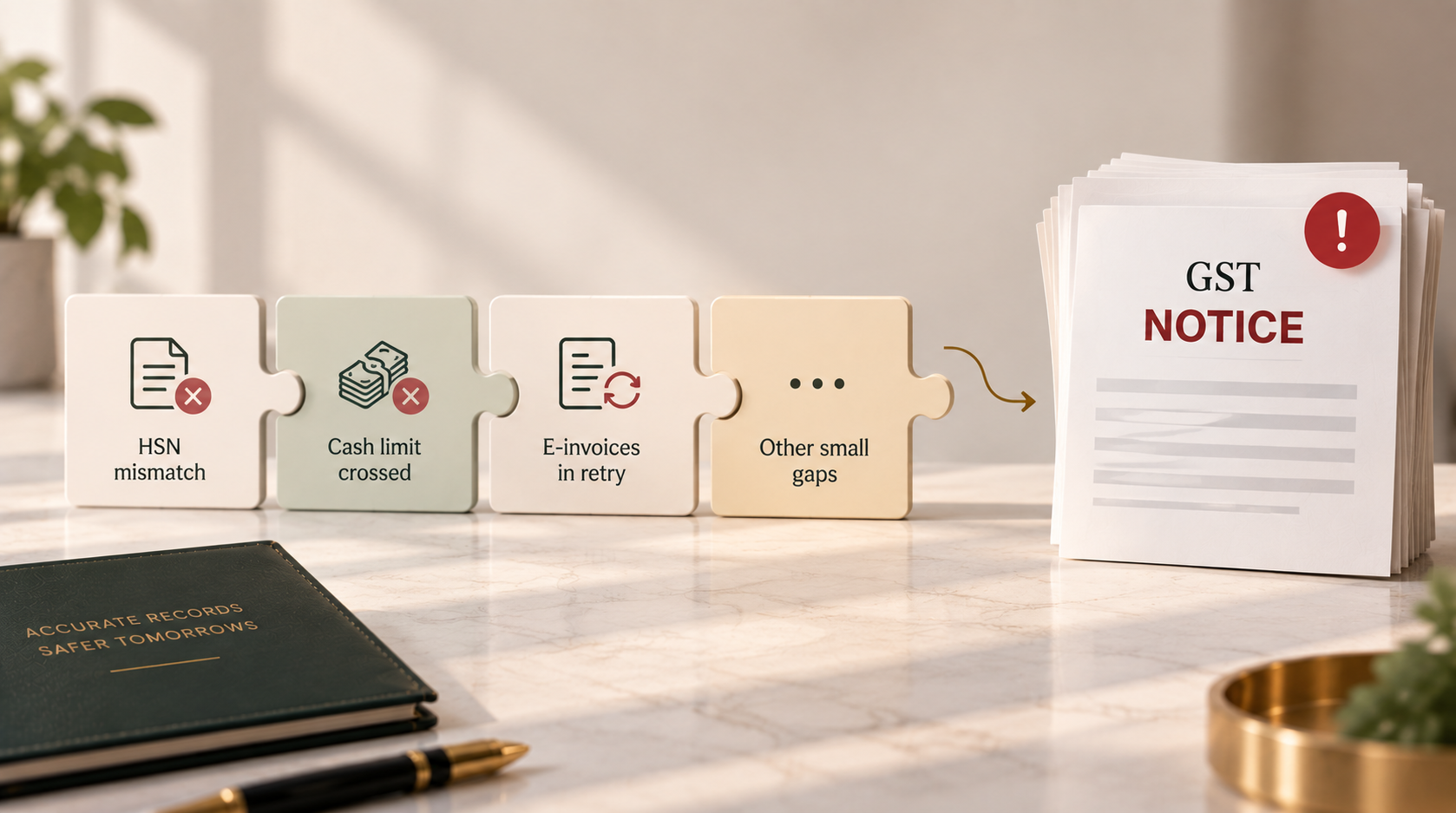
A jewellery business running into GST trouble almost never has one dramatic compliance failure. It has three or four small gaps compounding across a filing period. An HSN mismatch here, a cash transaction that crossed a threshold there, a handful of e-invoices stuck in a retry state nobody checked. Individually, each is a minor discrepancy. Together, across a GSTR-1 or GSTR-3B filing covering a full month of sales, they add up to a pattern that's hard to explain after the fact. It's easy to explain if every gap had been visible at the point of billing.
Our guide to jewellery accounting software covers how this connects to the wider ledger. Our guide to jewellery ERP software covers how compliance ties into billing, inventory, and purchase on the same connected system.
What to Check Before Your Next Filing Period
Does every invoice carry the correct HSN code automatically, or does someone verify it manually? Does GST split correctly across metal, making, and stone at billing, or get reconstructed at filing time? Are cash transactions flagged before they cross a legal threshold, not after? Do GSTR-1 and GSTR-3B reports generate from live data, or get rebuilt from scratch each period? If more than one of these still depends on someone remembering to check, that's usually where the next filing mismatch comes from.
Frequently Asked Questions
What is the cash transaction limit jewellery businesses need to watch under Section 269ST?
Section 269ST restricts cash transactions above a certain threshold from a single person in a day, or against a single transaction or event. Given jewellery's typically higher transaction values, this limit is tested more often in jewellery retail than in most other categories, and violations carry real penalties.
What's the difference between GSTR-1 filing and GSTR-3B filing?
GSTR-1 reports the details of outward supplies, essentially the sales invoices issued during the period. GSTR-3B is a summary return declaring tax liability and input tax credit for the same period. Both need to reconcile against each other and against the actual billing data, which is where mismatches between the two most commonly surface.
Why does e-invoicing sometimes fail, and what happens if nobody notices?
E-invoice generation depends on a live connection to a government API, which can time out or fail for reasons outside the business's control. If a failed generation isn't tracked and retried, an invoice can appear complete to staff and the customer. It was never actually reported the way e-invoicing compliance requires.
How does HSN code accuracy affect GST filing specifically?
Each HSN code carries an expected GST treatment. A mismatch between the code on an invoice and the actual rate applied is exactly the kind of inconsistency that shows up during return scrutiny. Mapping HSN at the item level, rather than choosing it manually per invoice, keeps this consistent across every sale.
What kinds of jewellery transactions qualify for zero GST or exempt treatment?
Specific exemptions and special case sales vary by notification and customer category, and aren't always obvious from a standard invoice. The key requirement isn't memorising every exemption, it's making sure the system can apply one correctly when it genuinely qualifies, rather than defaulting every transaction to the standard rate.
Which jewellery purchases actually require TDS deduction?
TDS thresholds and applicable transaction types are set by current tax rules and change with notifications over time. Rather than relying on staff to judge each purchase individually, TDS masters apply the current rule automatically, which is what keeps deduction consistent as the rules themselves shift.
Does GST API authentication need to be managed manually?
It shouldn't. Credentials and connections to government compliance systems should stay current and secure without someone having to notice an expiry and manually reauthenticate. A lapsed connection can quietly break e-invoicing or filing generation without an obvious warning sign at the counter.
Can a small jewellery business skip GSTR-1 and GSTR-3B ready reporting?
No, filing obligations apply regardless of business size. What changes with size is how painful manual reconstruction becomes. A smaller volume of monthly transactions is more forgiving to rebuild by hand than a high volume one, but the underlying risk of a mismatch exists either way.
Close Every Compliance Gap Before It Becomes a Notice
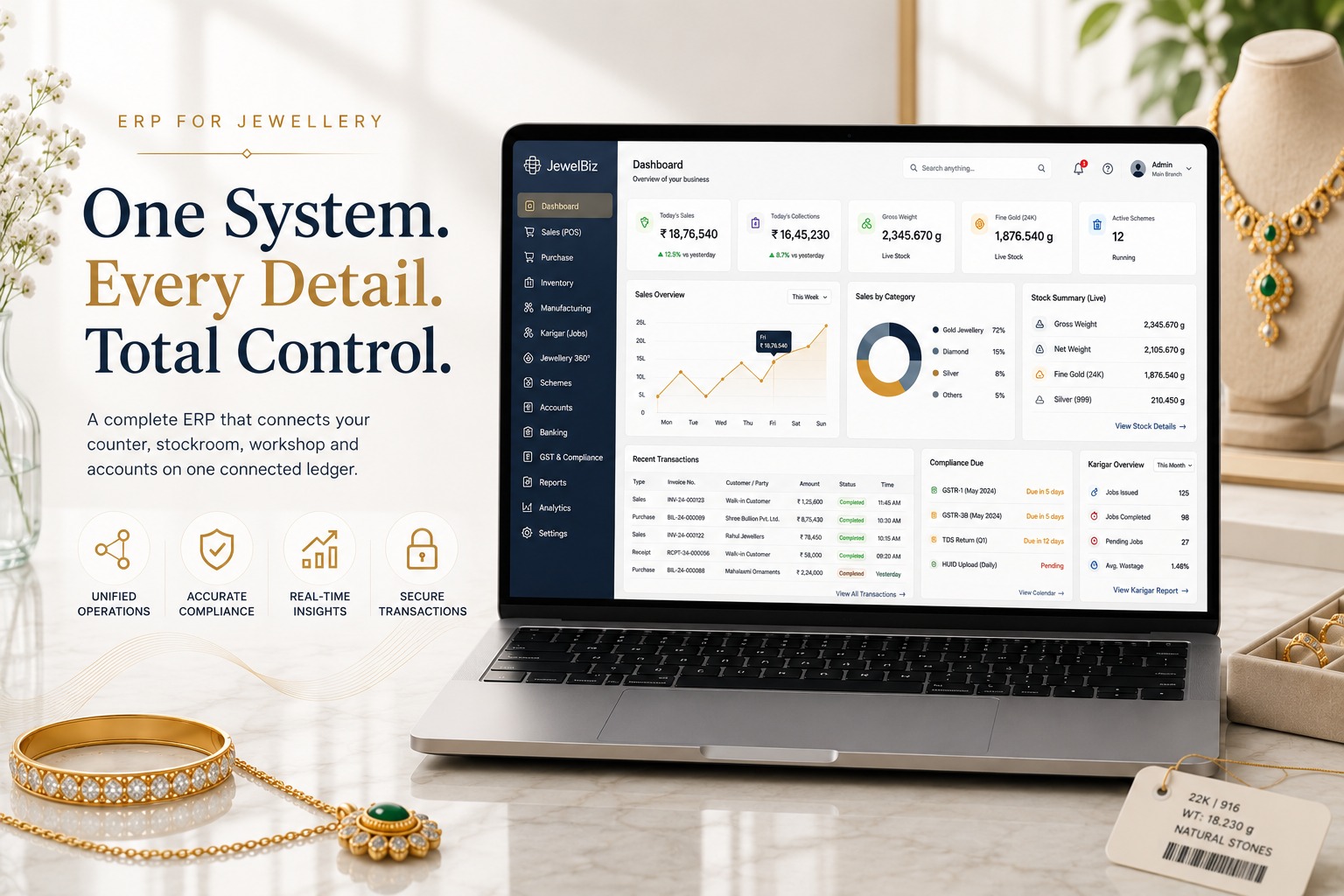
JewelBiz's Taxation and Compliance module maps HSN and GST rates at the item level, splits tax correctly across metal, making, and stone at billing, and handles zero GST and exempt cases. It generates GSTR-1 and GSTR-3B ready reports from live data, flags cash transactions approaching legal thresholds, maintains TDS rules, and logs every e-invoice through a secure, authenticated connection. If you want to see how it handles your own filing history, reach out at info@slatebiz.com or call +91 92573 73668, or visit slatebiz.com to book a walkthrough.