
A workshop sends metal out and gets finished jewellery back. Everything that matters about manufacturing sits in the gap between those two moments. How much went out, how much came back, how much was lost to wastage, what it actually cost to make, and who's accountable for the difference. Here's what a single completed job card actually needs to hold, field by field, and what happens when any one of those fields is missing.
| Field | Value |
|---|---|
| Job card | JR-4471 |
| Karigar | Assigned artisan, rate card on file |
| Design | Diamond solitaire ring, size 14 |
| Metal issued | 6.20 grams, 18K gold |
| Stone issued | 1 diamond, 0.62 carat, against certificate |
| Expected wastage | 2.5%, per this karigar's standard rate |
| Finished weight received | 6.04 grams |
| Actual wastage | 2.6%, within tolerance |
| Job cost | Making charge plus wastage, computed against this job specifically |
Every one of the eight capabilities below either fills in one of these fields correctly, or makes the whole card meaningless if it's missing.
Who This Job Is Actually Assigned To, and What They're Owed
The karigar field on this card isn't just a name. It's a profile carrying that artisan's agreed rate, their typical wastage allowance, and a running record of every job assigned to them. A karigar master keeps that profile current. Job cost calculates against the right rate automatically, and accountability for a job traces back to a specific person, not a general assumption about who was probably working that week.
The Two Numbers That Have to Be Logged the Moment They Happen
6.20 grams issued. 6.04 grams received back. Both numbers only mean something if they're logged the moment the metal actually moves, not reconstructed later from memory, or from a karigar's own notebook. Issue and receipt vouchers capture both sides of that exchange as it happens, against this specific job card. The two numbers that determine everything else on the card are never in question.
What Actually Happened to the Metal in Between
Between issue and receipt, this piece went through melting, casting, setting, and finishing. The manufacturing voucher records that process, not just the before and after weights. If a stone comes back a slightly different size than expected, or a step needs repeating, that detail lives on the voucher, not in a conversation someone has to remember weeks later.
Where This Job Actually Sits While It's Not on the Shelf and Not in the Ledger
From issue to receipt, this job exists in a state most systems handle badly. Not sold inventory, not raw stock, just work in progress. WIP auto-update keeps that status current as the job moves through each stage. Anyone checking on JR-4471 at any point gets an accurate answer instead of a shrug, the same way a piece already on the shelf shows up correctly in jewellery inventory management once manufacturing hands it off.
Tracking the Stone as Carefully as the Gold
The 0.62 carat diamond issued against this job deserves the same discipline as the metal. Issued against a certificate, expected back in the finished piece, or accounted for if it isn't. Metal and stone issue control tracks both commissions and returns together. A valuable stone never becomes a loose end just because the metal side of the job closed out cleanly.
When Metal Doesn't Go Straight From Issue to Finished Piece
Sometimes the 6.20 grams issued didn't start as clean 18K stock. It came from melting down older pieces, or converting raw bullion first. Raw material and conversion keeps a clear ledger through that step too. The fine weight feeding into this job card stays accurate even when the metal took a longer path to get there.
The Number That Actually Matters: What This Specific Job Cost
Job cost on this card isn't a shop-wide average making charge applied to every piece regardless of complexity. It's calculated against this specific job, this karigar's rate, this design's actual wastage. Know making cost per job, not just the final selling price. Margin on a design stops being a guess and starts being a number you can defend, and one that flows cleanly into jewellery accounting software once the job closes.
Following One High-Value Piece Individually, Not Averaged Into a Batch
A solitaire ring with a 0.62 carat certified stone shouldn't ever get folded into an averaged batch figure alongside twenty simpler pieces made the same week. Piece-wise manufacturing follows a job like this individually through the entire process. Its specific cost, wastage, and stone accounting stay attached to it alone, exactly the detail a high-value design actually needs.
What Happens When a Field on This Card Is Missing

A job card missing its karigar assignment can't hold anyone accountable for the wastage. One missing an issue voucher timestamp can't prove when metal actually left the vault. One without piece-wise tracking averages a high-value stone's cost into a figure that tells nobody anything useful. Every field exists because leaving it blank has a real cost. An argument with a karigar over wastage nobody can settle. A stone that can't be located when a customer asks. A margin number that's really just a guess dressed up as a report.
Our guide to jewellery ERP software covers how this manufacturing data connects to purchase, inventory, and accounting on the same ledger. Once a piece like this reaches the counter, our guide to jewellery billing software and our guide to a jewellery management system cover what happens to it next.
Frequently Asked Questions
What's the difference between expected wastage and actual wastage on a job card?
Expected wastage is the standard allowance agreed for a karigar or job type, based on past performance. Actual wastage is what the finished weight actually shows once the piece comes back. Comparing the two on every job surfaces a karigar consistently running high wastage, rather than treating each job as an isolated, unremarked event.
Why does job costing need to be calculated per job instead of using an average making charge?
An average making charge treats a simple chain and an intricate, hand-finished ring as if they cost the same to produce. They don't. Per-job costing captures the actual karigar rate, actual wastage, and actual complexity for that specific piece, so margin reporting reflects reality instead of a shop-wide estimate.
What happens to work in progress if a job gets paused partway through?
It should stay visible as WIP at whatever stage it's currently at, not disappear from view until it's finished. A paused or delayed job sitting untracked is exactly the kind of gap that turns into a dispute later, either about where the metal is or how long the job has actually been outstanding.
Does piece-wise manufacturing apply to every item, or just high-value pieces?
It matters most for high-value or stone-set pieces where individual accounting genuinely changes the numbers. Simpler, high-volume production can reasonably run through batch tracking, but a certified stone or an unusually complex design needs to be followed on its own.
See a Real Job Costed on Your Own Karigar Rates
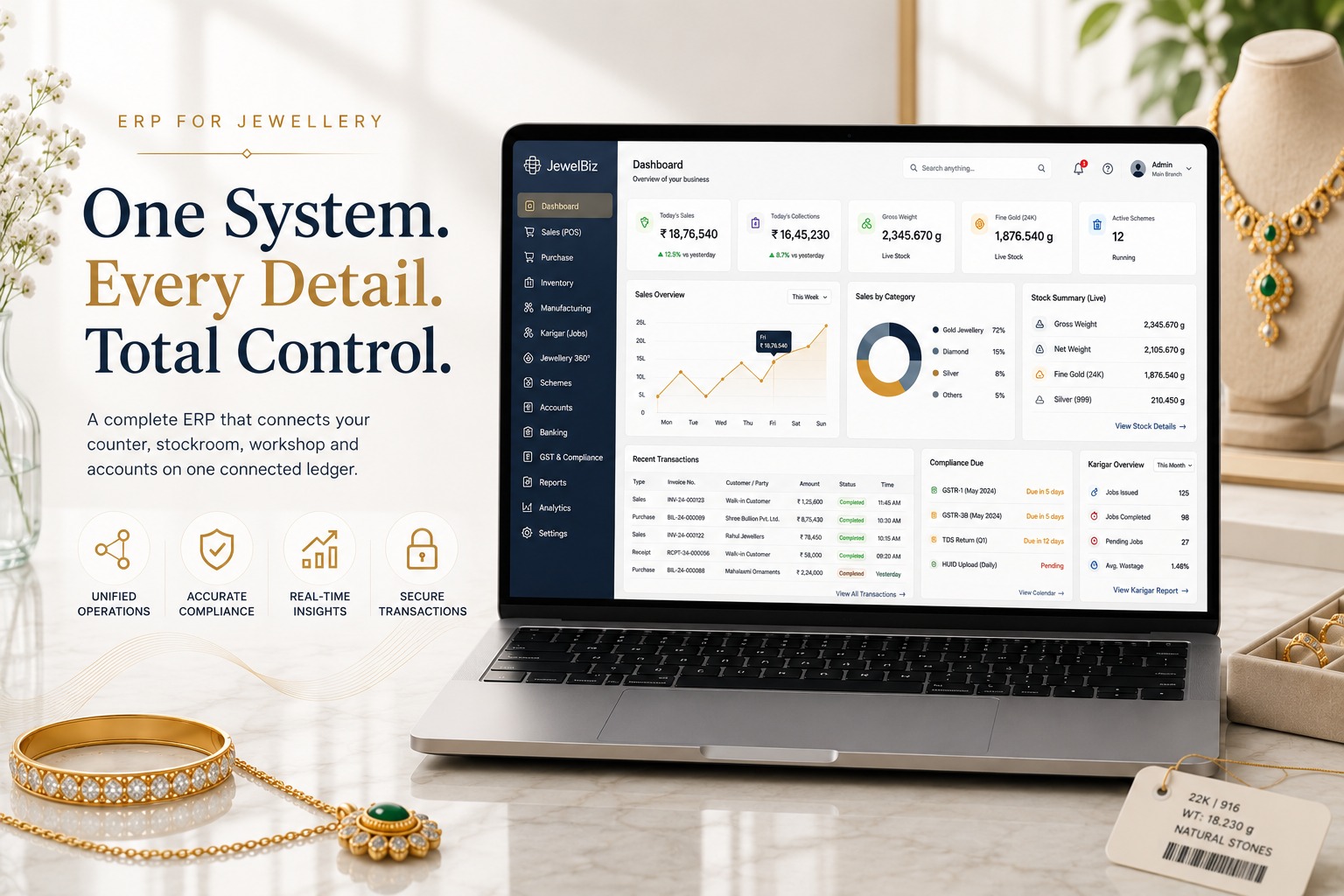
JewelBiz's Manufacturing and Karigar module tracks karigar profiles, issue and receipt vouchers, the full manufacturing process, work in progress status, metal and stone issue control, raw material conversion, and job costing. All tied to the same job card, from the moment metal goes out to the moment it's costed and closed. If you want to see how it handles your own karigar rates and wastage tolerances, reach out at info@slatebiz.com or call +91 92573 73668, or visit slatebiz.com to book a walkthrough.