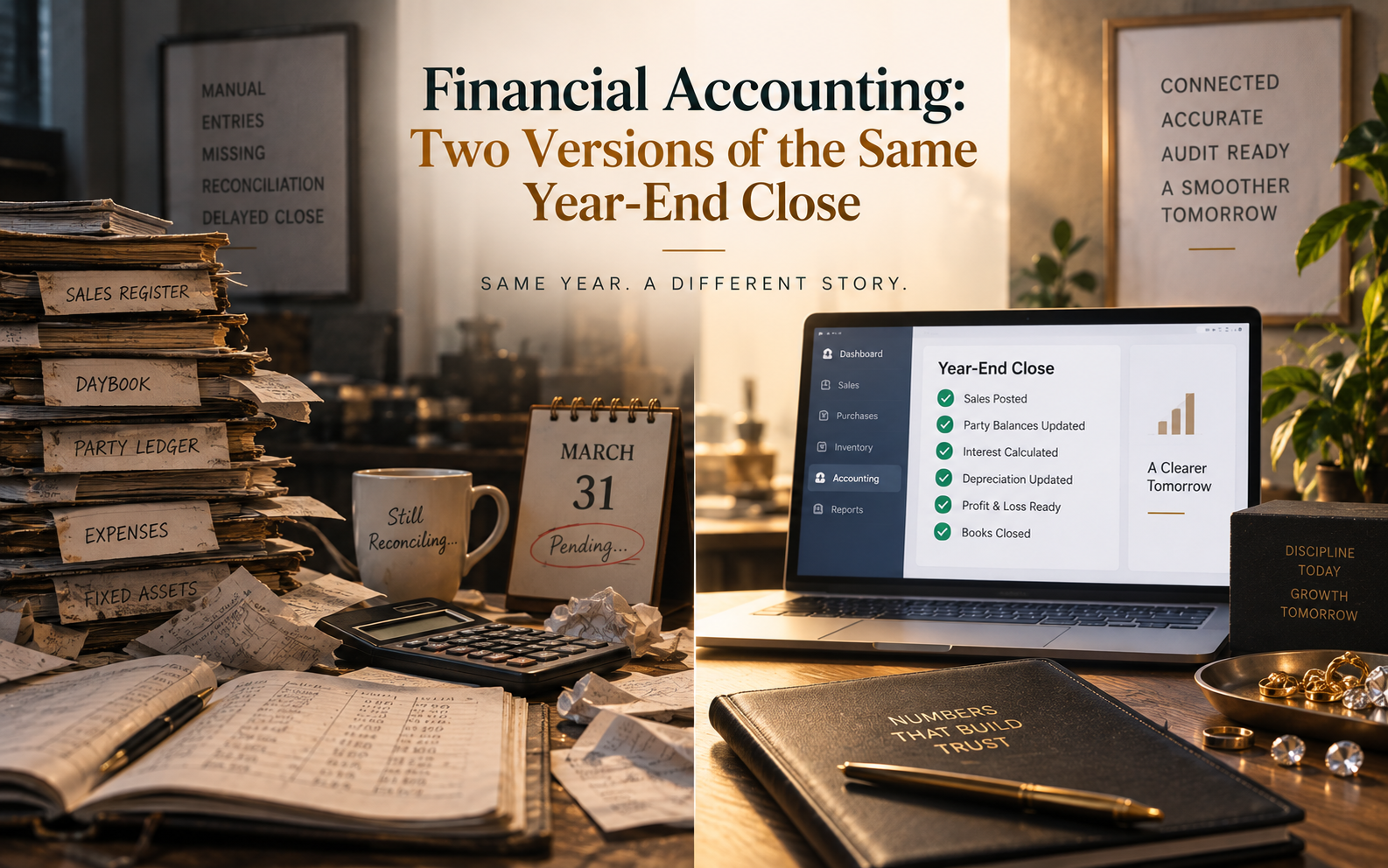
Every jewellery business closes its books on March 31st. What that close actually looks like, a controlled two-day process or a two-week scramble, depends entirely on what happened in the 365 days before it. Here is the same showroom's financial year, closed two different ways.
Version One: A Year Built on Registers, Closed Under Pressure
Sales get entered into the counter register through the year, and the accountant separately maintains a daybook, transcribing entries from the counter slips a few days behind. By February, the two don't quite agree, and nobody's sure exactly where the gap opened up.
Receipts and payments get tracked against parties in a notebook, one page per major supplier or customer. Interest owed on a few large credit accounts gets calculated by hand each quarter, when someone remembers to do it. A fixed asset, a new display counter bought in June, sits on a depreciation schedule that exists as a spreadsheet nobody's updated since August.
March 31st arrives. Closing the financial year means physically locking the register, but the actual books, daybook, journals, party ledgers, don't close cleanly. They get reconciled over the following two weeks under real pressure, because the new year's entries are already piling up while last year's numbers are still being chased down. Our guide to jewellery billing software covers what a controlled counter close should look like at a single day's end, the same discipline this year-end close is missing.
Profit and loss for the year gets calculated as a final, manual step. It pulls numbers from the daybook, the party ledgers, and whatever the depreciation spreadsheet says this quarter. Small mismatches get rounded off by hand, sometimes without a clear record of which entries were adjusted or why.
None of this is negligence. It's what happens when a year's worth of financial activity lives across a register, a notebook, and two spreadsheets that were never actually connected to each other.
Version Two: The Same Year, Closed on One Ledger
Every sale, receipt, and payment posts to the daybook and journal the moment it happens, not transcribed later from a slip. The daybook and the counter are the same record. There's no gap to discover in February because there was never a second version to drift apart from.
Receipts and payments track against party ledgers automatically, updating each account's balance the moment money moves. Interest calculation on credit accounts runs on schedule against the actual outstanding balance, not recalculated by hand when someone remembers. The display counter bought in June sits on a proper depreciation chart from the day it's recorded as an asset. The schedule maintains itself instead of waiting for a quarterly update.
March 31st arrives, and closing the financial year is a controlled step, not a scramble. Balances carry forward with a clean, defined FY open and close process, and the new year opens with nothing unresolved trailing in from the old one.
Profit and loss auto-transfer happens at year end, calculated from the same connected data every other number on the books already agrees with. Round-off through auto journal rules is applied consistently, not ad hoc adjustments made under deadline pressure with no clear record behind them.
Same business, same year, same number of transactions. The only difference is whether the books were connected the whole time, or reconciled at the end and hoped for the best.
What Actually Separates the Two Versions
| Moment in the Year | On Registers and Spreadsheets | On One Connected Ledger |
|---|---|---|
| Daily sales entry | Transcribed days later, gaps go unnoticed | Posted the moment the sale happens |
| Party balances | Tracked in a notebook, updated irregularly | Updated automatically with every transaction |
| Interest on credit | Calculated by hand when remembered | Computed on schedule against actual balances |
| Depreciation | A spreadsheet nobody's updated in months | A live chart maintained from the asset's entry date |
| Year-end close | A two-week reconciliation scramble | A controlled, defined carry-forward process |
| Profit and loss | Assembled manually from several sources | Auto-transferred from data already agreed |
| Rounding adjustments | Ad hoc, undocumented | Rule based auto journal entries |
Why This Matters More at Audit Time Than at Closing Time
A messy close is uncomfortable for two weeks. What it leaves behind lasts longer. Adjustments with no clear record, a depreciation figure that can't be traced back to when an asset was actually acquired, a party balance that doesn't match what the party themselves would report. Financial accounting done on one connected ledger doesn't just make March 31st easier. It makes every number from the year defensible afterward, to an accountant, an auditor, or a bank reviewing the business for a loan.
Our guide to jewellery accounting software covers how this connects to GST and the wider compliance picture. Our guide to jewellery ERP software covers how accounting ties into billing, inventory, and manufacturing, and our guide to a jewellery management system covers what this same discipline looks like across a full connected day.

What to Check Before Closing Your Next Financial Year This Way
Does every sale post to the daybook the moment it happens, or get entered separately later? Are party balances updated automatically, or tracked in a register that needs manual reconciliation? Is depreciation maintained as a live schedule from the day an asset is recorded, or rebuilt periodically from a spreadsheet? And when the financial year closes, is that a defined, repeatable process, or a scramble that happens to work out most years?
If the honest answer to more than one of those is the harder option, the mid-February gap that showed up in version one isn't a one-time problem. It's next year's problem too, arriving on schedule.
Frequently Asked Questions
What's the difference between a daybook and a journal?
A daybook records every transaction as it happens, in the order it occurs. A journal entry is a more structured accounting record, often used for adjustments, corrections, or transactions that don't originate at the counter. Both need to stay connected to the same ledger rather than living as separate records that require manual reconciliation.
Why does interest calculation need to run on a schedule rather than manually?
Interest on credit accounts compounds against a changing balance, and calculating it by hand periodically means it's usually working off a stale number. Running it on schedule against the actual current balance keeps the figure accurate continuously, not just whenever someone gets around to it.
What does FY open/close actually control?
It governs how balances carry forward from one financial year into the next, and how cleanly the previous year's books lock once they're finalized. A controlled close prevents old transactions from being edited after the fact and ensures the new year opens with accurate starting balances.
Does round-off and auto journal replace an accountant's judgment?
No, it replaces ad hoc manual adjustments with consistent, rule based ones. An accountant still sets the rules and reviews the results. Every rounding or minor correction follows the same logic instead of depending on whoever happens to be closing the books that day.
What does account maintenance actually track for a jewellery business?
Party and ledger masters built for jewellery trade specifically, supplier accounts, customer credit accounts, karigar accounts, and any other party the business transacts with regularly. Keeping these as proper masters rather than informal notes is what makes every other module, receipts, payments, interest, reporting, work off the same accurate account list.
How is P&L auto-transfer different from calculating profit and loss manually?
A manual calculation pulls numbers from wherever they happen to live, the daybook, party ledgers, a depreciation spreadsheet, and assembles them under time pressure at year end. P&L auto-transfer moves the same closing profit and loss automatically from data that was already accurate throughout the year, so the year-end figure is a transfer, not a reconstruction.
Does the depreciation chart handle different types of fixed assets differently?
Yes, different asset categories, fixtures, equipment, vehicles, typically carry different depreciation rates and schedules under standard accounting treatment. A proper depreciation chart maintains each asset's schedule individually from its recorded acquisition date, rather than applying one blanket rate across everything the business owns.
How does receipts and payments tracking help avoid disputes with suppliers or customers?
When every receipt and payment posts against a party's ledger the moment it happens, that party's running balance is always current and always traceable to specific transactions. A supplier or customer disputing a balance can be shown the exact entries behind the number, rather than the business having to reconstruct a history from a notebook after the fact.
Close Your Next Financial Year on One Ledger
JewelBiz's Financial Accounting module runs the daybook and journals, receipts and payments, account maintenance, P&L auto-transfer, interest calculation, depreciation charts, and round-off through auto journal rules. All on one connected ledger, with a controlled FY open and close process, the same connected approach covered in our guide to jewellery inventory management. If you want to see how your own year would close on it, reach out at info@slatebiz.com or call +91 92573 73668, or visit slatebiz.com to book a walkthrough.