You take gold as collateral against a loan. You hedge a position on MCX. You run a savings scheme customers pay into every month. You issue a hallmark number that has to trace back to one exact piece years later. None of that is unusual, it's just Tuesday for a jewellery business. What's unusual is expecting a general accounting package to handle any of it. It can't, and here's what you're actually managing instead.
Your Pawn Book, Run Properly
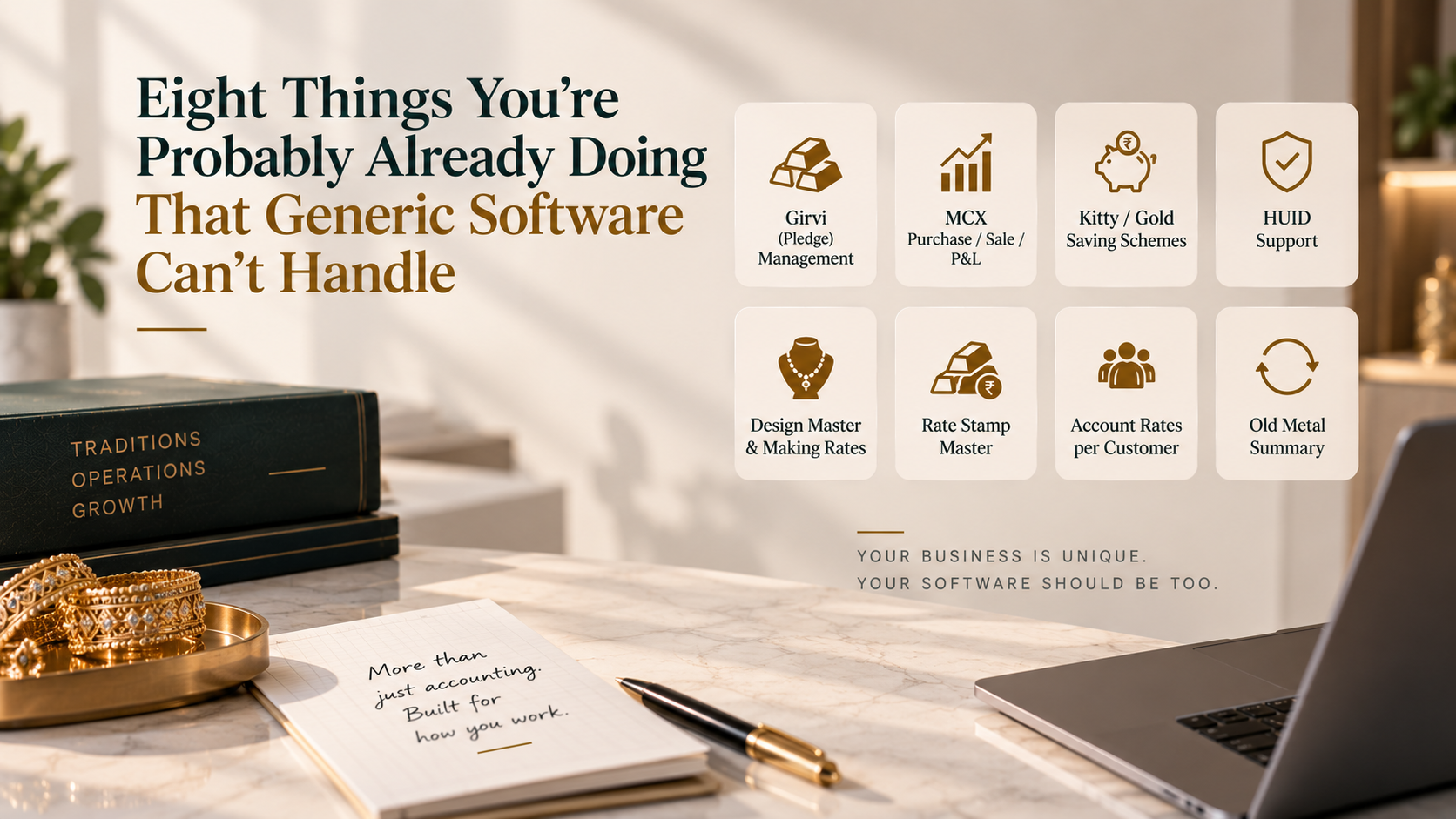
A customer hands over gold against a loan, and you're now holding collateral, not making a sale. You need interest accruing over time, a guarantor on file, and an alert before a loan goes overdue. Your accounting software has no idea what a pledge even is. This is Girvi (pledge) management, and it's why you're probably tracking this in a separate paper register right now, disconnected from everything else you already track digitally.
Your Trading Position, in the Same Picture as Everything Else
If you hedge or trade on MCX, that position affects your business whether or not your software knows about it. MCX purchase, sale, and P&L tracking means that gain or loss shows up in your real financial picture, not sitting in a separate account you have to check and reconcile manually. Connect it, and a trading day stops being a number you look up somewhere else.
The Scheme You're Already Running, Actually Tracked
You enrol a customer, they pay instalments for months, and eventually they redeem into jewellery. Every step of a Kitty or gold saving scheme needs a record, or you're running a months-long financial promise on nothing but trust. Our guide to scheme management software covers exactly what this looks like when it runs on a register instead of a system, and what tends to go wrong.
The Hallmark Number You're Already Required to Issue
Every piece you hallmark carries a HUID, a six digit number that has to trace back to that exact piece years from now. If that link breaks, at tagging, at sale, or during a split or conversion, you can't prove what you're required to prove. HUID support means the number on a customer's certificate always matches a real system record, not a printed tag that could belong to anything once it's separated from the piece.
One Making Rate Per Design, Not One Per Staff Member
You have hundreds of designs, and every one of them needs a consistent making rate, set once and applied the same way no matter who's at the counter. Without design master and making rates, the same design gets billed differently depending on who's working that day, and you're losing margin you never see. Our guide to jewellery billing software covers exactly where this calculation happens at the counter.
One Rate, Used Everywhere, All Day
Your gold rate needs to be the same number whether you're billing a customer or valuing a purchase that just came in. If billing and purchase each capture that rate separately, they will drift apart, it's only a matter of when. A rate stamp master stamps the rate once, centrally, so both sides work off the same figure.
The Deal You Already Gave Your Biggest Customer
You've negotiated special terms with a long standing wholesale account or a high value retail customer, and now you need to remember to apply them every single time they buy. You shouldn't have to. Account rates per customer let the negotiated rate live against that account permanently, not as a manual override you're trusting yourself to remember.
Every Gram of Old Gold, Traced Through Every Conversion
Old gold comes in through an exchange, gets melted, and gets converted into new stock, and its purity and value change at every step. An old metal summary shows intake, purity, and conversion together, so the fine weight going into new stock traces back to exactly where it came from. Our guide to jewellery inventory management covers this same standard once the piece reaches the shelf.
Why You Won't Find These Eight on a Generic Feature List

None of this is what you think about first when comparing software, that's usually billing speed or stock accuracy. But you're doing all eight of these things already, whether or not your current system acknowledges it. A pawn book, a bullion position, a scheme redemption, a hallmark number, these aren't edge cases for you. They're routine, and a general accounting package was never built around any of them.
Our guide to jewellery ERP software covers how these specialised tools sit alongside the modules every business needs. Our guide to jewellery accounting software covers how the financial side of MCX trading and Girvi interest connects to your wider ledger.
Frequently Asked Questions
What is a HUID number, and why does it need to stay linked to a specific piece?
A HUID, or Hallmark Unique Identification number, is a six digit code assigned to a piece of gold jewellery through BIS hallmarking, certifying its purity. It needs to stay traceable to that specific piece through tagging, sale, and any later handling. A HUID separated from its piece, or matched incorrectly, breaks the compliance trail the number exists to provide.
Is Girvi management the same as a general loan management system?
Not really. Girvi specifically covers gold pledged as collateral within jewellery trade practice, with interest and guarantor tracking suited to that context. A generic loan system isn't built around gold as the underlying asset or the specific redemption and overdue patterns typical of jewellery pledges.
Why does MCX trading need to connect to jewellery operations instead of running separately?
A trading position still represents real financial exposure for the business, gains and losses that affect overall profitability. Tracking it completely separately means the true financial picture only comes together manually, if at all. It should be part of the same connected reporting as retail and manufacturing.
Can account rates per customer apply to only some products, not all of them?
Typically yes, negotiated terms can apply broadly to an account or be scoped to specific categories or designs, depending on what was actually agreed. The point is that the exception lives against the account rather than requiring a manual override on every applicable invoice.
Does old metal summary track metal through multiple conversion steps?
It should, since old gold sometimes moves through more than one conversion before becoming new stock, melted into bullion, then recast into a specific design. Tracking purity and weight at each step keeps the fine weight accurate through to the final piece, rather than only capturing the first and last state.
What does design master and making rates actually standardise?
It sets one making rate per design, tied to the design itself rather than recalculated or estimated by whoever is billing a particular sale. That consistency is what keeps two customers buying the same design from ever being quoted meaningfully different making charges without a documented reason.
Why does the rate stamp need to be controlled centrally rather than entered at each counter?
If billing and purchase each capture the day's rate separately, small discrepancies between the two are almost guaranteed over time, one counter updates a few minutes before another, or someone enters a typo. A single stamped rate used everywhere removes that gap entirely.
Is Kitty scheme management the same across all jewellery businesses, or does it vary?
The core mechanics, enrolment, instalments, redemption, are consistent, but specific terms, instalment counts, maturity bonuses, and early redemption rules vary by business. Our guide to scheme management software covers how those specific terms should be configured and tracked once a scheme is set up.
See These Eight Running on Your Own Business
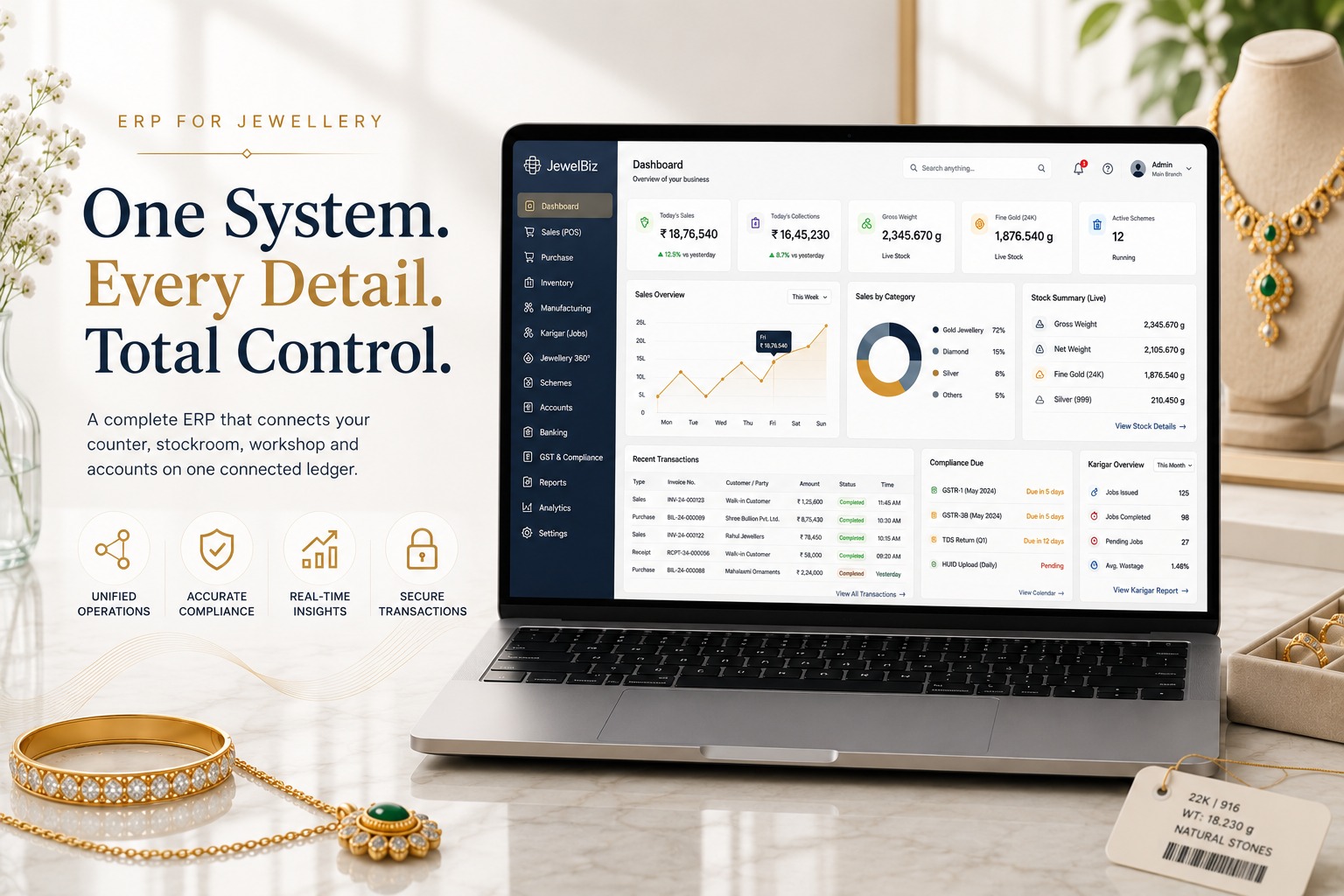
JewelBiz's Specialised Jewellery module covers Girvi pledge management, MCX trading connected to your operations, Kitty and gold saving schemes, and HUID compliance support. It also covers design master making rates, a centralised rate stamp, your account-specific customer rates, and a full old metal summary. If you want to see how these fit your own business, reach out at info@slatebiz.com or call +91 92573 73668, or visit slatebiz.com to book a walkthrough.