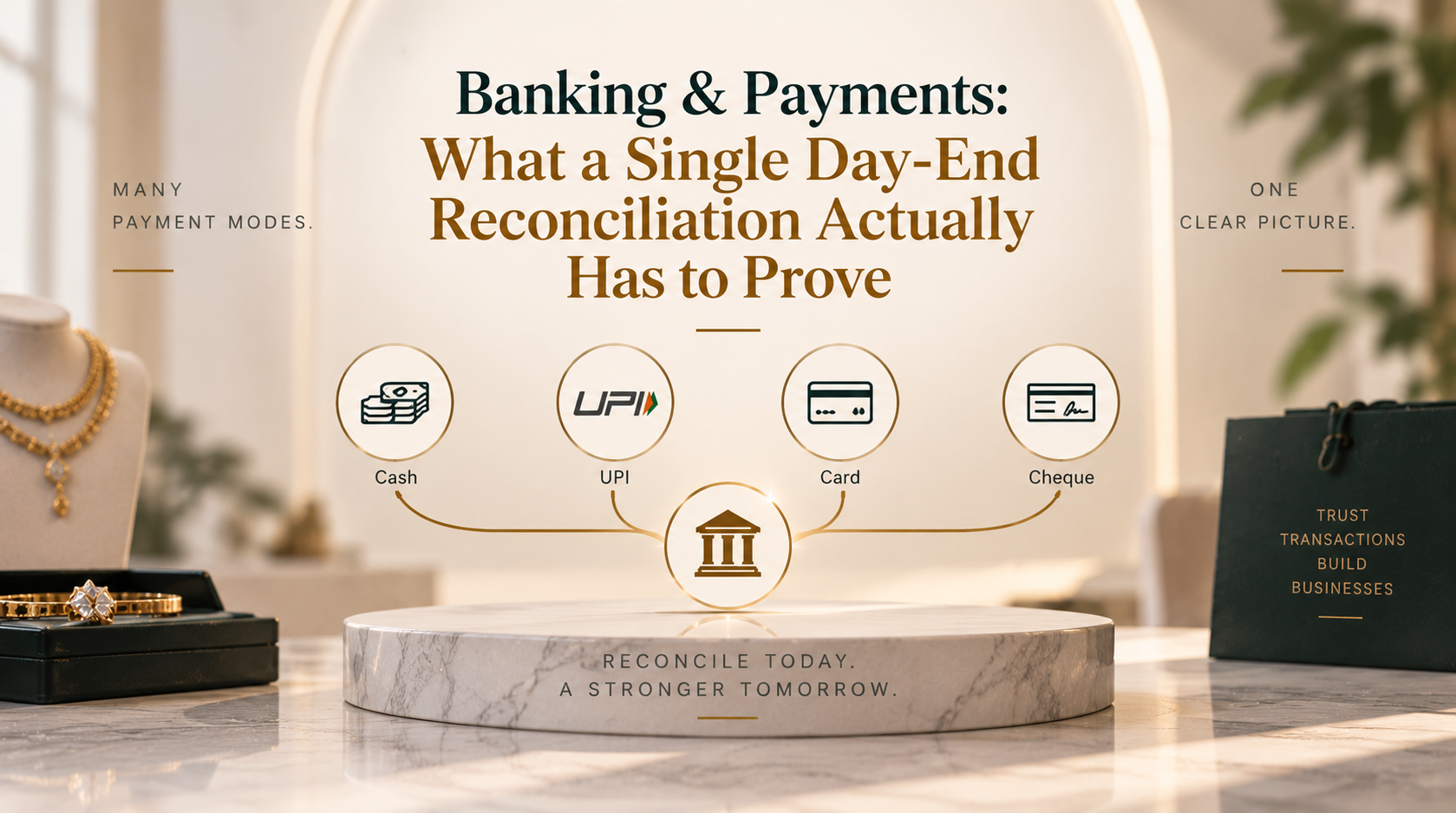
A busy Saturday at a jewellery showroom rarely settles in one payment method. Cash at the counter, a UPI QR scanned twice, two card machines from two different banks, a cheque from a wholesale customer. By closing time, every one of those needs to tie back to a specific bank account, a specific charge, and a specific customer. Here's what one day's actual reconciliation looks like, and what breaks when a piece of it is missing.
| Payment Method | Collected Today | Where It Settles |
|---|---|---|
| Cash | ₹1,85,000 | Deposited to Bank A |
| UPI QR | ₹3,40,000 across 6 transactions | Credits to Bank A next morning |
| Card, EDC Machine 1 | ₹2,10,000 across 3 transactions | Settles to Bank B, minus MDR |
| Card, EDC Machine 2 | ₹95,000 across 2 transactions | Settles to Bank A, minus MDR |
| Cheque | ₹4,50,000, one wholesale customer | Deposited to Bank B, clears in 2 days |
Six methods, two banks, two card machines, and a cheque that won't clear for another two days. Every one of the capabilities below is what keeps this from becoming a guessing exercise at month end.
Two Banks, One Finance Desk, No Manual Switching
This showroom runs Bank A and Bank B side by side. Cash and one card machine settle to Bank A, the wholesale cheque and a second card machine settle to Bank B. Multi-bank accounts operate both ledgers from the same finance desk. Nobody logs into two separate systems, or maintains two separate spreadsheets, just to see where the day's money actually went, the same connected view covered in our guide to jewellery ERP software.
Six UPI Payments, One Standard Method Across Every Counter
Six separate UPI transactions today, each generated the same way, at the same counter. No staff member choosing between different apps or manual entry methods. UPI QR and payment masters standardise how digital collection works across every counter. A customer at counter one and a customer at counter three go through an identical, predictable process.
A Cheque That Isn't Cash Yet, Tracked as Exactly That
The ₹4,50,000 cheque from today won't actually clear for two days. Treating it as collected cash the moment it's received is exactly how a cash flow picture goes wrong. Cheque clearing house tracks issued and received cheques through the actual clearing process. This cheque shows as pending until the bank confirms it, not as money already in hand.
Two Machines, Two Banks, Mapped Correctly From the Start
EDC Machine 1 settles to Bank B. EDC Machine 2 settles to Bank A. Get that mapping wrong once, and every card transaction that day reconciles against the wrong account. EDC machine support maps each physical machine into the correct daily settlement routine. Which machine a sale ran through determines where that money actually lands, automatically.
The MDR Charge That Quietly Reduces Every Card Settlement
A card payment of ₹70,000 doesn't land in the bank account as ₹70,000. The bank deducts its MDR, the merchant discount rate charged on every card transaction, before settling the rest. Card commission auto-deduct accounts for that MDR and related card charges automatically against each transaction. The difference between what was charged and what actually landed never shows up as an unexplained shortfall someone has to chase down later.
Five Card Transactions Across Two Machines, Batched Against What the Bank Actually Pays
Three transactions on Machine 1, two on Machine 2. Five separate charges that need to match up against however many separate credits the two banks actually post. Card settlement batch groups today's card collections and settles them cleanly against the bank credits when they land. A mismatch between what was charged and what was received shows up immediately, not three weeks later during a bank statement review, the same discipline covered in our guide to jewellery inventory management for stock reconciliation.
What Happens When One Piece of This Reconciliation Is Missing
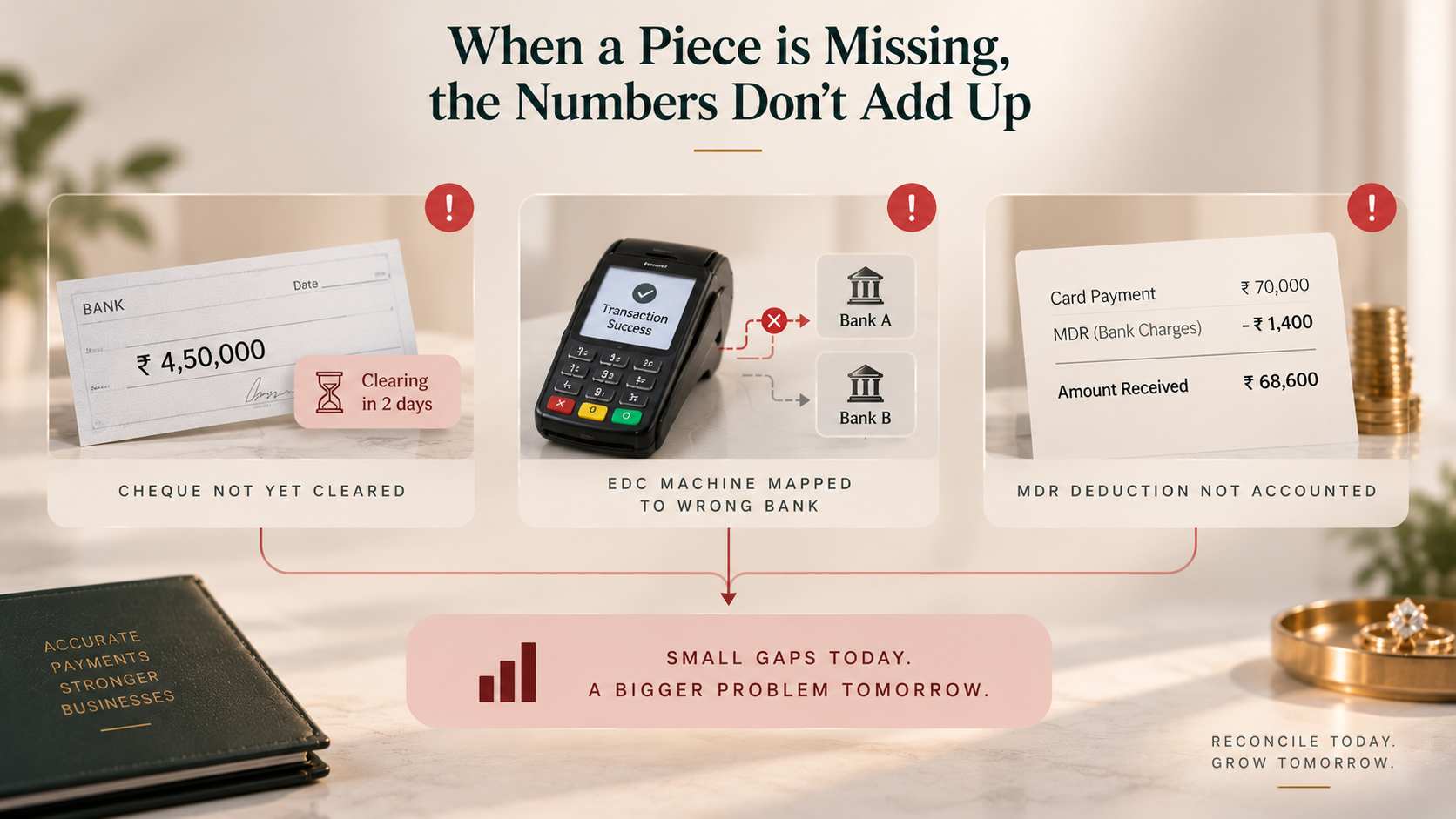
Skip the cheque clearing distinction, and today's cash position looks ₹4,50,000 healthier than it actually is. Get an EDC machine mapped to the wrong bank, and a whole day's card settlement reconciles against an account that never received it. Miss the MDR deduction, and every card day shows a small, unexplained shortfall that compounds into a real number by month end. None of these are catastrophic on their own. All of them are the kind of gap that turns a ten-minute daily reconciliation into a payment reconciliation problem someone has to solve retroactively, usually right before month end.
Our guide to jewellery billing software covers how these payment modes get collected at the counter in the first place. Our guide to jewellery accounting software covers where this settlement data flows once it's reconciled, and our guide to a jewellery management system covers what a full connected day looks like end to end.
Frequently Asked Questions
What does a banking and payments module actually cover in jewellery software?
It covers everything between a payment being collected at the counter and that money being confirmed in the right bank account. Multiple bank ledgers, standardised digital collection, cheque clearing status, card machine mapping, commission deductions, and settlement batching. The counter side of collecting the payment is a separate piece, covered in our guide to jewellery billing software.
What is MDR, and why does it matter for daily reconciliation?
MDR, the merchant discount rate, is the fee a bank charges on every card transaction. It's typically a small percentage deducted before the rest settles to the merchant's account. Without accounting for it automatically, every card day shows a small, unexplained gap between what was charged and what actually landed in the bank.
Can a showroom run more than two bank accounts through the same system?
Yes, multi-bank accounts should scale to however many banking relationships a business actually maintains, not just two. The principle stays the same regardless of count, one finance desk seeing every account, rather than separate logins or spreadsheets per bank.
How is a cheque treated differently from a card or UPI payment before it clears?
A cheque shows as pending, not collected, until the bank confirms clearing, typically a day or two later. Card and UPI payments settle faster and more predictably. Even they need a defined settlement step rather than being counted as final cash the moment the transaction shows as approved.
What happens if two EDC machines from different banks get mixed up in daily settlement?
Transactions from one machine reconcile against the wrong bank account, and the actual account that received the money shows a credit nobody can explain. Correct machine to bank mapping is what prevents this mismatch from happening in the first place, rather than being caught and corrected after the fact.
Why does UPI collection need to be standardised across every counter?
If each counter generates a UPI QR a different way, some through one app, some through another, some with manual reference notes, reconciling gets harder. It means checking several inconsistent records instead of one predictable one. A standard method across every counter means every UPI transaction looks the same in the reconciliation, regardless of which counter or staff member collected it.
How does card settlement batch prevent disputes over card collections?
It groups a day's card transactions and matches them directly against the bank credits that land for them. Any gap between what was charged and what was received is visible immediately, tied to a specific batch and a specific machine. Without that batching, a dispute over a missing card settlement means manually cross-checking individual transaction slips against a bank statement days or weeks later.
Reconcile Every Payment Method on One Screen
JewelBiz's Banking and Payments module runs multi-bank accounts, standardised UPI QR and payment masters, cheque clearing tracking, EDC machine mapping, automatic MDR deduction, and card settlement batching. All of it reconciles against the same day's sales. If you want to see how it handles your own bank and card machine setup, reach out at info@slatebiz.com or call +91 92573 73668, or visit slatebiz.com to book a walkthrough.