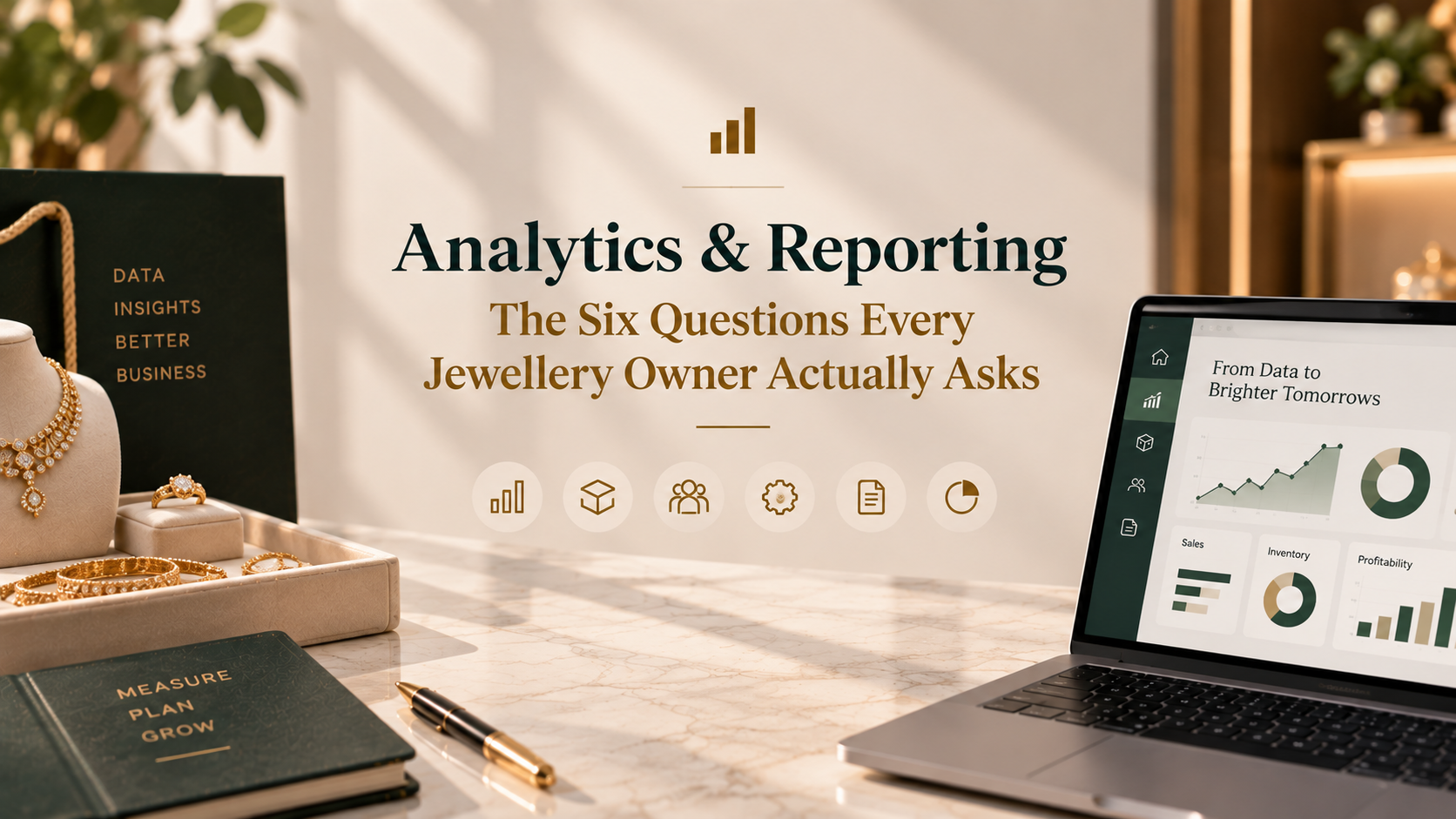
An owner doesn't open a report because they want data. They open it because they have a specific question in their head, and they want an answer before the day gets away from them. Here are six questions that come up constantly in jewellery retail, and what actually needs to answer each one.
"What Actually Happened in the Business Yesterday?"
Not a summary assembled from memory. The actual daybook, stock movement, sales, and party balances from the previous day, ready the moment someone asks. Basic operational reports pull daybooks, stock, sales, and party data out of the box, without anyone building a spreadsheet first. If this question takes more than a minute to answer, the reporting isn't doing its job. Our guide to jewellery accounting software covers where the daybook and journal data behind this actually comes from.
"What's Actually Selling, and Who's Selling It?"
Every owner has a gut feeling about which categories are moving and which staff are performing. Sales analytics replaces the gut feeling with the actual numbers. What sold, who sold it, and which categories are genuinely winning versus which ones just feel busy. A category that looks strong because of footfall and a category that's strong because of margin are two very different answers. Only real numbers separate them, the same billing data covered in our guide to jewellery billing software.
"What's Quietly Costing Us Money by Just Sitting There?"
Dead stock doesn't announce itself. It sits on a shelf, ties up capital, and only gets noticed months later during a physical count nobody wanted to do. Inventory analytics spots dead stock, purity mix, and reorder pressure early, before a slow-moving design becomes a write-off decision instead of a clearance decision. The earlier this question gets answered, the more choices an owner still has.
"Which Karigars Are Actually Worth the Rate We're Paying Them?"
Every karigar has a rate, and every karigar has an output. The two don't always match as evenly as an owner assumes. Karigar analytics measures artisan output, wastage, and job turnaround. This question gets answered with data instead of with whoever's been around longest getting the benefit of the doubt. A karigar running slightly higher wastage but faster turnaround might still be the better deal, but only the numbers can actually make that case.
"Why Doesn't a Single Report Ever Answer What I Actually Need to Know?"
Every business asks its own specific questions. A fixed set of standard reports eventually runs out of room for them. Custom report builder shapes reports around the exact questions owners ask every Monday, not the questions a software vendor guessed they might ask. If the same manual workaround keeps happening every week to get one specific number, that's exactly what this is for.
"Can I Actually Share This With My Accountant, My Partner, or My Bank, Without Retyping It?"
A number trapped inside a dashboard is only useful to the person looking at the screen. Excel and PDF export makes every report shareable in board-ready form. Nobody has to retype numbers into a fresh document just to send them somewhere else. If a report can't leave the system as easily as it was generated inside it, it's not actually finished.
Why These Six Questions Rarely Get Asked in Isolation
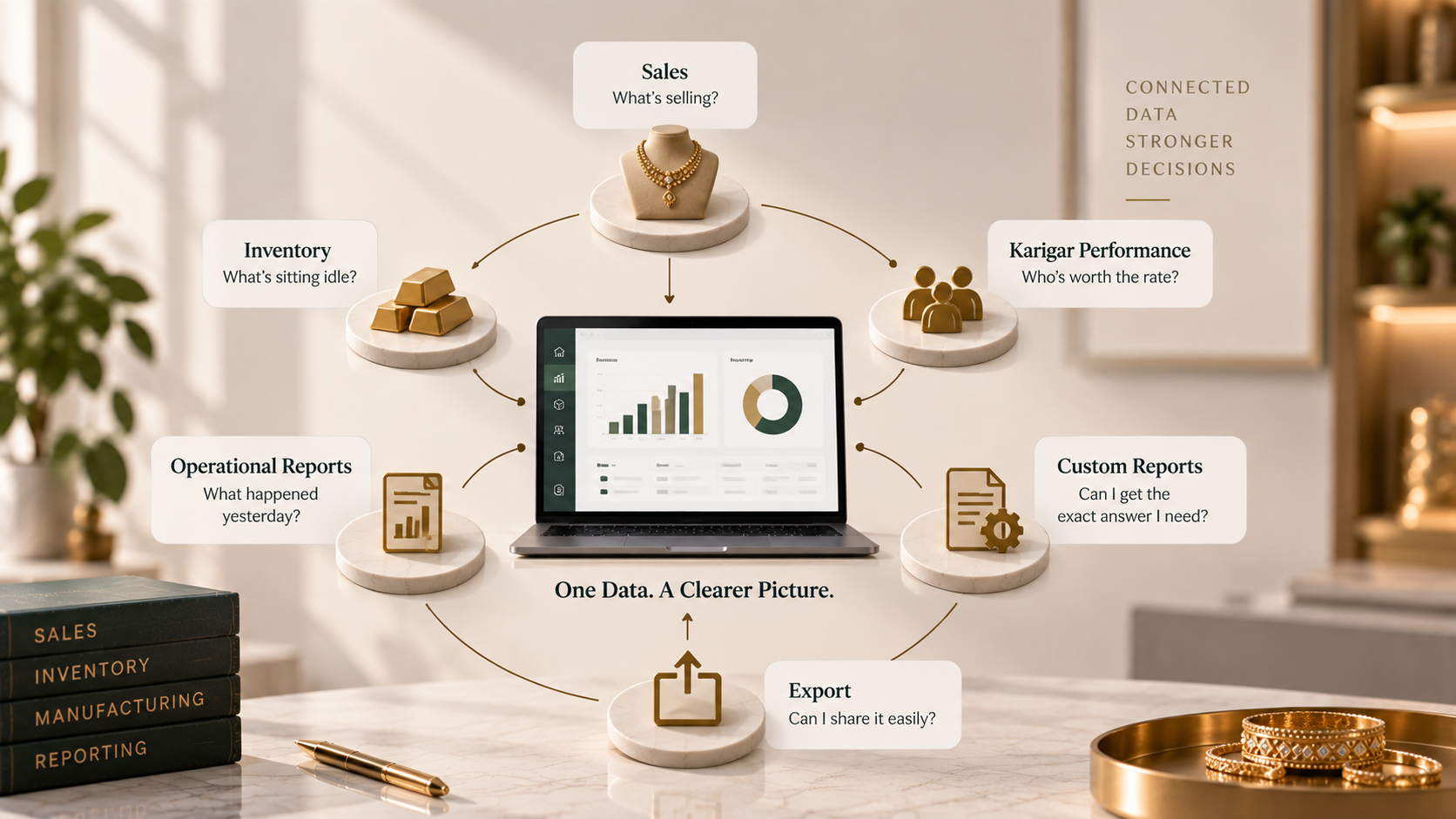
An owner checking dead stock on a Tuesday is usually also about to ask which karigar made it and whether that design is even still selling. These six questions connect to each other far more than a features list suggests. The answers only stay consistent with each other if they're all pulled from the same underlying data.
Our guide to jewellery inventory management covers where the inventory analytics numbers actually originate. Our guide to jewellery ERP software covers how sales, stock, manufacturing, and reporting sit on the same connected system, not six separate exports that don't quite agree. Our guide to a jewellery management system covers what this looks like as part of a full connected day.
What to Check Before Trusting a Report
Does it answer the question in under a minute, or does someone have to build it first? Does sales and inventory data come from the same source, or from two exports that were pulled at different times? Can a custom question actually get built without a developer, or does every new report mean a support ticket? And can the answer leave the system in a form someone outside it can actually use? If any of those default to the harder answer, the reporting is adding work instead of removing it.
Frequently Asked Questions
How current is the data behind these reports, real time or a daily batch?
It should be current to the moment, not a batch process that runs overnight. A sales analytics report that's a day behind means an owner is making today's decisions on yesterday's picture. That defeats the purpose of checking in the first place.
Can karigar analytics compare artisans fairly if they work on different types of jobs?
It should account for job complexity, not just raw output. A karigar handling intricate, high-value pieces will naturally show different numbers than one handling simple, high-volume work. Comparing them meaningfully means normalising for that difference, not just ranking by pieces completed.
Does custom report builder require technical knowledge to use?
It shouldn't. The point of a custom report builder is letting someone who understands the business shape a report themselves, not a developer. No submitting a request and waiting for someone else to build it.
What format do exported reports typically need to be in?
Excel for anything that needs further analysis or gets fed into another spreadsheet. PDF for anything meant to be read as a finished document, shared with a bank, an accountant, or a business partner without further editing.
Can inventory analytics flag dead stock before it's officially aged past a certain point?
It should flag a slowing pattern, not just a fixed age threshold. A design that's stopped moving after historically selling well is a different situation from a design that was always slow. Useful analytics distinguishes between the two rather than applying one blanket rule.
See Your Own Six Questions Answered
JewelBiz's Analytics and Reporting module covers basic operational reports, sales analytics, inventory analytics, karigar analytics, a custom report builder, and Excel or PDF export. All of it pulls from the same connected data as billing, stock, and manufacturing. If you want to see your own numbers answer these six questions, reach out at info@slatebiz.com or call +91 92573 73668, or visit slatebiz.com to book a walkthrough.