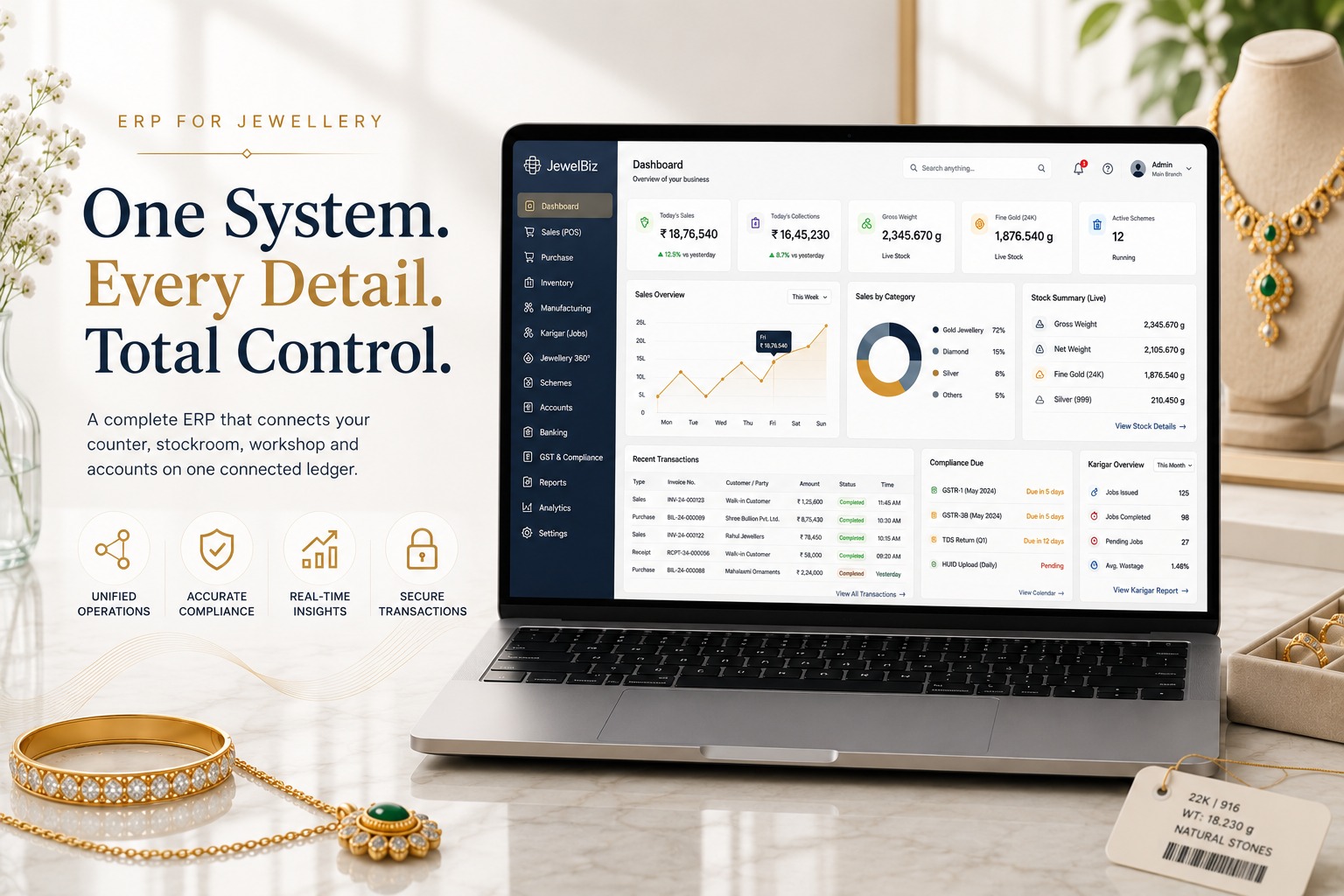

Gold and diamond stock mismatches are the gap between what the register says and what is actually in the vault. In most showrooms this gap is a data problem, not a theft problem. A barcode jewellery ERP fixes it by giving every piece its own identity, so a missing item is one scan away from being found.
Ask any showroom owner what keeps them up before a stock audit, and the answer is rarely theft. It is a gap nobody can explain, because nobody can say with certainty which piece it belongs to.
This guide covers why mismatches happen, how barcode tagging closes the gap at the source, and what to look for in a jewellery ERP if the goal is to eliminate mismatches for good, not just explain them better after the fact.
Why Gold and Diamond Stock Mismatches Happen
A mismatch is rarely one dramatic event. It is usually the accumulation of small gaps that were never designed to be closed.
Stock without a unique identifier
When ten similar rings sit in a tray tracked as a single quantity, a discrepancy of one piece stays invisible until a full physical count. Even then, it is hard to say which ring is missing.
Weight and purity recorded as one blended number
If gross weight, net weight, stone weight and purity are not captured separately, you cannot tell whether a gap is a counting error, a genuine weight loss or an actual shortage.
Counts that happen only once or twice a year
Small gaps compound for months before anyone notices. By the time the audit arrives, nobody remembers what happened.
Job work and karigar movement tracked separately
When karigar movement is not tracked against the same piece identifier used on the shop floor, it creates a second, disconnected record that never quite matches the first.
Stock split across branches, counters or exhibitions
Without a single connected view, the mismatch is often not a loss at all. It is an item nobody has located yet.
Jewellery Inventory Reconciliation: Why Registers Fall Short
Jewellery inventory reconciliation means matching what the system expects to hold against what is physically present, piece by piece. Registers can only reconcile totals. That is why a one gram difference in a tray of similar items can take days to trace, and sometimes is never traced at all.
How Barcode Tagging Prevents Jewellery Stock Mismatches
A barcode or RFID tag turns an estimated batch quantity into an identified individual piece. Instead of "twelve rings, approximately 180 grams," the system holds twelve records. Each has its own gross weight, net weight, stone weight and purity, tied to a scannable identifier that follows the piece from the moment it is tagged.
That single change removes the ambiguity at the root of most mismatches. Every movement is recorded against a specific tag, not a batch total. This includes purchase, job work issue, job work return, transfer between counters, sale, exchange and repair.
A missing piece is then no longer a mystery buried in a total. It is identified by item, by last known location and by the last person who touched it. This is the foundation of jewellery inventory management and its risks.
A quick example
Take a tray of twelve similar rings. At closing, the register shows twelve but the tray holds eleven. Without tags, someone rechecks bills, job work entries and counters over several days. With tags, one scan lists the eleven present, names the missing ring, and shows it was last moved to the repair desk at 4 pm. The same gap now takes minutes to close.
Barcode and RFID Standards for Jewellery
Not all barcodes carry the same weight of information, and the choice matters for a jewellery business.
- Internal barcodes: generated by the showroom's own system. They work well for tracking movement inside the business, linking a tag to weight, purity and stone data in the ERP.
- GS1 barcodes: GS1 India is the only authorised body issuing GS1 barcodes in the country. These are what modern trade retailers and ecommerce platforms expect for product identification.
- RFID tags: these allow an entire tray or safe to be scanned at once instead of piece by piece. This is where scan based audits get their real speed advantage.
The right choice depends on scale. A single counter operation may only need internal barcodes tied to the ERP. A multi branch chain moving stock between locations benefits from RFID for bulk scanning during transfers and audits.
How a Scan Based Stock Audit Works
A scan based stock audit replaces a full manual recount with a structured comparison between the system's expected stock and what a scanner actually finds.
- Tag every piece. Each piece carries its barcode or RFID tag from the point of purchase, job work return or manufacturing.
- Run a cycle count. Scan a section, a tray or an entire branch.
- Compare against expected stock. The system checks the scan result against what it expects to find in that location.
- Flag variances instantly. A piece in the wrong place, a piece that does not scan, or a piece the system does not expect is flagged immediately, not months later.
Because the scan takes minutes instead of hours, this audit can run weekly, or even daily for high value sections, without pulling staff off the sales floor. Mismatches get caught while the last people to handle the piece still remember what happened. That is the difference between a five minute conversation and an unexplained loss written off at year end.
Manual Stock Tracking vs a Barcode Enabled Jewellery ERP
| Capability | Manual or Register Tracking | Barcode Enabled Jewellery ERP |
|---|---|---|
| Individual piece identification | Batch quantities, not per piece | Unique barcode or RFID per piece |
| Weight and purity per item | Blended or estimated | Gross, net, stone weight and purity per piece |
| Movement history per piece | Not tracked individually | Full history from tag to sale |
| Stock audit frequency | Once or twice a year | Weekly or daily cycle counts |
| Variance detection | Found at full audit, months later | Flagged immediately at scan |
| Cross branch visibility | Separate registers per location | Single connected view |
What to Look for in a Barcode Jewellery ERP
Barcode tagging only eliminates mismatches if the software behind it is built for jewellery, not adapted from generic retail inventory. A jewellery ERP built for the trade should include the following:
- A live inventory dashboard showing stock by branch, item and status in real time
- Barcode and RFID tags linked to weight, purity and stone data per individual piece
- A melt to new stock module that tracks weight and purity through conversion when old pieces are melted for new designs
- Scan based audits that auto reconcile counts and flag variances without manual comparison
- An approval memo module that tracks items sent out on approval until they are returned or billed, so consignment stock does not sit outside the mismatch check
- Multi purity support, since 995, 916 and custom purities must be tracked as distinct stock, not averaged together
- A single connected view across branches, counters and exhibitions, not separate registers that need manual consolidation
How JewelBiz Eliminates Gold and Diamond Stock Mismatches
JewelBiz is built around the checklist above, so each item is part of the core system and not an add on. It covers the following:
- A live inventory dashboard by branch, item and status
- Barcode and RFID tags that link weight, purity and stone data to each piece
- Stock tracked by gross weight, net weight and fine weight, across 995, 916 and custom purities
- Diamond 4C and stone certificate tracking
- A melt to new stock module that follows weight and purity through conversion
- Scan based audits that auto reconcile counts and flag variances
- An approval memo module for goods out on approval until they are returned or billed
Because inventory, billing, karigar job work and accounts sit on one connected ledger, every movement is recorded once and the numbers agree at month end. Learn more at the JewelBiz product page.
Gold Stock Reconciliation: A Practical Path to Zero Mismatches

Eliminating mismatches is not a single software switch. It is a sequence that starts with the stock already on the shelf.
- Tag existing inventory. Work section by section, not the whole showroom in one weekend.
- Automate tagging at every entry point. Nothing new enters stock without a barcode, whether it arrives through purchase, job work return or manufacturing.
- Move from annual audits to scheduled scan based cycle counts. Start with the highest value sections.
- Close the approval memo gap. Items sent out on approval or consignment are one of the most common sources of stock that looks missing but is simply untracked.
Once these four steps are in place, the dashboard becomes a genuine early warning system instead of a monthly surprise.
Frequently Asked Questions
What causes gold and diamond stock mismatches in a jewellery showroom?
Most mismatches come from stock that is not uniquely identified at the piece level, weight and purity recorded as one blended figure instead of separately, and physical counts that are never reconciled against the system on a regular schedule.
How does barcode tagging prevent jewellery stock mismatches?
Barcode tagging gives every piece a unique identifier linked to its gross weight, net weight, purity and stone data. Every movement from purchase to job work to sale is recorded against that specific piece instead of an estimated batch quantity.
How often should a jewellery showroom run a stock audit?
A barcode enabled showroom can run scan based cycle counts weekly, or even daily for high value sections, without disrupting sales. A full manual audit is usually practical only once or twice a year.
Do I need RFID or are barcodes enough for jewellery inventory?
A single counter operation can work well with internal barcodes tied to the ERP. A multi branch chain moving stock between locations benefits from RFID, because a whole tray or safe can be scanned at once during transfers and audits.
Conclusion
Gold and diamond stock mismatches are not usually a sign that something has gone wrong. They are a sign that the system was never precise enough to say what happened either way.
Barcode and RFID tagging, tied to a jewellery ERP that tracks weight, purity and movement at the individual piece level, turns an annual guessing game into a weekly five minute check. The gap between the register and the vault does not need to be explained if it is never allowed to open in the first place.
Ready to close the gap between your register and your vault? Talk to the JewelBiz team or call SlateBiz on +91 92573 73668 for a walkthrough of barcode tagging and scan based audits on your own stock.