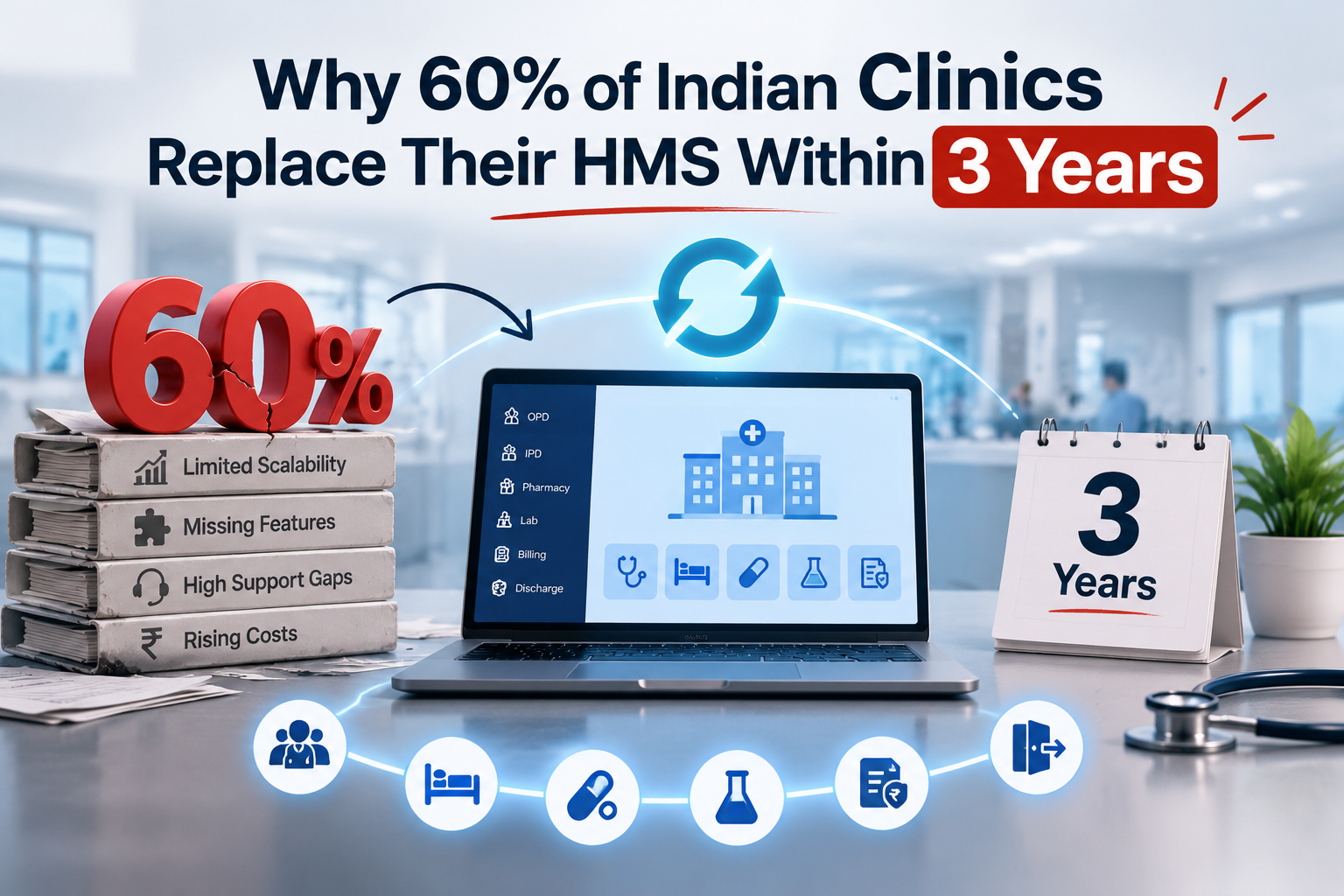
Roughly 6 out of 10 Indian clinics that buy a hospital management software end up replacing it within 3 years.
The average cost of that replatform, including new software fees, data migration, staff retraining, and lost operational productivity during the switch, runs 4 to 12 lakh rupees for a small clinic and 15 to 40 lakh rupees for a mid sized hospital. This is money that was never budgeted, never recovered, and never mentioned in the original demo.
The replatform pattern is not random. The same five root causes explain almost every case.
Before you sign your next hospital management software contract, understand why so many buyers regret their first choice, what signals during vendor evaluation actually predict a successful long term fit, and the exact questions to ask that expose whether a vendor is selling you a platform that will still fit your operation in year 3.
The Real Cost of Replatforming a Hospital Software
Most clinic owners think of HMS cost as the annual subscription fee. That is the smallest part of the actual cost of ownership. The full cost only becomes visible when you have to replace the platform.
Solo Clinic Replatform
- New software subscription: 20,000 rupees per year
- Data migration: 30,000 to 80,000 rupees
- Staff retraining: 15,000 rupees
- 3 to 6 weeks of operational slowdown: 1 to 2 lakh rupees
- Total: 2 to 4 lakh rupees
Polyclinic Replatform
- New subscription: 60,000 to 1.5 lakh per year
- Data migration: 1 to 3 lakh rupees
- Staff retraining and change management: 50,000 to 1.5 lakh rupees
- 6 to 10 weeks of productivity loss: 3 to 6 lakh rupees
- Total: 5 to 12 lakh rupees
Mid Sized Hospital Replatform
- New subscription: 2 to 6 lakh per year
- Data migration: 4 to 12 lakh rupees
- Change management: 2 to 5 lakh rupees
- 10 to 16 weeks of workflow disruption: 8 to 20 lakh rupees
- Total: 15 to 40 lakh rupees
None of this shows up on the invoice from the new vendor. It shows up as overtime, patient complaints, discharge delays, billing errors, and staff who spend six weeks working around the new system instead of with it.
Note: The most avoidable cost in Indian healthcare technology is buying the wrong HMS the first time.
The 5 Root Causes of HMS Replatform Regret
1. Bought for Today's Operation, Not Next Year's Growth
A 20 bed nursing home buys a lightweight tool built for solo doctors. Within 18 months the facility adds 15 beds, a lab, and a pharmacy. The lightweight tool cannot handle IPD workflows, ward medicine tracking, or lab integration. The clinic replatforms because it outgrew the tool it should never have bought.
Warning: The vendor cannot demonstrate their software running for a facility 3 times your current size.
2. Bought a Billing Tool Disguised as an HMS
Many Indian software vendors started with basic billing tools and later added a thin clinical layer to call it a full hospital management software. The billing works. The EHR, pharmacy, and appointment modules are shallow.
Doctors reject the platform within 6 months and the clinic replatforms to something clinically credible.
Warning: Doctors in your team feel the consultation screen is clunky during the demo, even if the billing screen is clean.
3. Bought a Fragmented Suite Marketed as Integrated
The vendor calls it one platform but the OPD, IPD, pharmacy, and lab modules run on separate databases with nightly file exports pretending to be integration. Charges post twice or not at all. Patient records show different information on different screens.
The clinic replatforms to a genuinely unified system after 12 to 18 months of reconciliation pain.
Warning: The vendor cannot demonstrate a single patient journey from appointment to discharge to insurance settlement without switching applications or exporting data mid demo.
4. Vendor Abandoned the Product After Purchase
Small Indian software vendors sometimes stop developing a product once they have enough paying customers to maintain revenue. Updates slow down, feature requests get ignored, ABDM compliance work is delayed, and the platform quietly ages out of relevance.
The clinic replatforms to a vendor that is still investing in the product.
Warning: The vendor cannot show you a public product roadmap or specific features released in the last 12 months.
5. Bought Without Checking Indian Regulatory Readiness
The platform demoed beautifully in 2023 but was never updated for Ayushman Bharat Digital Mission M2 or M3 milestones, NABH 5th edition digital documentation standards, or the latest GST filing formats.
By 2026 the clinic faces empanelment risk and NABH non conformity. Replatform becomes urgent, not optional.
Warning: The vendor cannot provide ABDM sandbox certification references or a documented NABH information management readiness statement.
What Actually Predicts a Successful HMS Selection
The clinics that get HMS selection right the first time share five behaviours during their evaluation process. None of them are expensive. All of them are systematic.
- Evaluate for year 3, not year 1. Map your expected patient volume, bed count, and specialty mix 3 years out. Test the platform against that scenario, not your current size.
- Insist on a full patient journey demo. Ask the vendor to show one patient going from appointment booking through registration, consultation, prescription, pharmacy dispensing, lab test, discharge, and insurance settlement, on a single screen, without switching applications.
- Bring your senior doctor to the demo. The clinical layer decides adoption success. Doctors who like the software on day one lead adoption. Doctors who resist it on day one kill adoption.
- Verify regulatory readiness with references. Ask for the vendor's ABDM sandbox certification number and verify it on the ABDM portal. Ask for two customer references pursuing NABH accreditation.
- Ask about their product roadmap. A vendor that ships regular updates, publishes what they are building, and can show recent releases is a vendor that will still be worth paying in year 3. Platforms like CuraBiz that maintain a public roadmap and ship multiple releases per year fall into this category. Vendors that are vague about what is coming next usually have nothing coming next.
The Right Questions to Ask During Vendor Evaluation

Before you sign any hospital management software contract, insist on clear answers to these 8 questions in writing. Any vendor who hedges is a vendor whose product will disappoint you within 24 months.
- Show me a facility 3 times my current size running on your platform. What are their operational metrics?
- Demonstrate a complete patient journey from appointment to discharge to insurance claim on a single screen.
- What ABDM milestones (M1, M2, M3, M4) is your platform certified for? Provide the sandbox certification reference.
- Which of your customers is currently pursuing NABH accreditation? Can I speak with them?
- How many product releases have you shipped in the last 12 months? What is on your roadmap for the next 6 months?
- What is the total year 3 cost including any add on modules I might need?
- Who owns my data if I decide to leave in 2 years? What is your data export policy and format?
- What is the average implementation time for a facility of my size?
Signs of a Vendor Worth Buying vs Signs of a Vendor to Avoid
The two column comparison below summarises what to look for and what to walk away from during hospital management software evaluation.
| Vendor Worth Buying | Vendor to Avoid |
|---|---|
| Demonstrates a facility 3x your size on their platform | Only shows demo environments or their own dev setup |
| Single screen patient journey across appointment to claim | Switches applications or exports files mid demo |
| ABDM sandbox certification number, verifiable on the portal | Claims ABDM readiness without documentation |
| Named NABH customers willing to give reference | No NABH pursuing customers available for reference |
| Public product roadmap, multiple releases in last 12 months | Vague answers on roadmap, sparse release history |
| Transparent year 3 cost, including add on modules | Only quotes year 1 cost, hedges on future pricing |
| Documented data export policy in standard formats | Cannot cleanly explain data ownership or export |
Frequently Asked Questions
How long should an HMS platform last before replacement is justified?
A well selected HMS should serve a clinic for 7 to 10 years without replacement, with regular updates and module additions along the way. Facilities that replace HMS within 3 years almost always did so because of a selection mistake, not because the underlying platform aged out.
What is the average cost of switching hospital management software in India?
For a small clinic, 2 to 4 lakh rupees. For a mid sized hospital, 15 to 40 lakh rupees. The cost is roughly 3 to 5 times the original annual subscription of the outgoing platform, because of data migration, staff retraining, and productivity loss during the transition period. This is why the first hospital management software you buy matters more than the second one.
How can I tell if a vendor is still investing in their HMS product?
Ask for the last 12 months of release notes. A vendor investing in the product ships multiple releases per year, adds features, closes bugs, and updates for regulatory changes.
Should I pick a global HMS vendor or an Indian one?
For hospitals and clinics operating primarily in India, an Indian vendor with proper ABDM, ABHA, NABH, GST, PM JAY, and CGHS support is almost always the right choice. The right question is not global vs Indian but modern vs legacy, and integrated vs fragmented.
Can I negotiate the switching cost with the new vendor?
Yes. Serious vendors often absorb 40 to 60 percent of the data migration cost. Ask for migration support, dedicated implementation, and a 90 day performance guarantee to be built into the contract.
Getting the Next HMS Decision Right
The next hospital software you buy is likely the platform your clinic will run on for the rest of the decade. The evaluation you do this month determines whether the year 3 economics look like a growing operation or a replatform crisis.
Use the five behaviours and eight questions above. If a vendor cannot answer them clearly, they are not the vendor you want to be paying in 2029.
SlateBiz builds CuraBiz, a unified healthcare platform designed to scale with Indian clinics and hospitals from 5 beds to 500 beds without a replatform. CuraBiz delivers OPD, IPD, EHR, pharmacy, lab, billing, insurance, ABDM compliance through M3, NABH 5th edition digital documentation, and full audit trails on a single database.
It is built on Java and Oracle with SHA 512 password hashing, Apache Shiro session security, and OWASP hardening, and ships multiple product releases per year with a public roadmap.
Book a walkthrough: Reach out at info@slatebiz.com or call +91 92573 73668, or visit slatebiz.com to book a CuraBiz walkthrough.